
The decentralized finance (DeFi) landscape is currently grappling with a period of heightened volatility, and Uniswap [UNI] has found itself at the epicenter of the latest market downturn. As broader market sentiment shifts toward risk aversion, the governance token of the world’s leading decentralized exchange has experienced significant downside pressure, breaking key psychological support levels and triggering a cascade of liquidations that have left traders scrambling.
Main Facts: The Anatomy of the UNI Sell-Off
The recent price action for Uniswap has been characterized by a sharp, aggressive decline. After failing to defend the critical $9 support level—a threshold that many analysts considered the baseline for short-term stability—the token plunged to a local low of $8.00.
At the time of reporting, UNI is trading at approximately $8.19, reflecting a 9.16% depreciation over a 24-hour window. This price erosion has been accompanied by a notable 39% surge in trading volume, a metric that typically signals intense market capitulation as participants reduce their exposure to the asset. The combination of falling prices and rising volume confirms that the selling pressure is not merely a product of low liquidity, but rather a concerted effort by market participants to offload positions amidst a climate of uncertainty.
Chronology of the Liquidation Event
The turmoil did not occur in a vacuum. Before the sharp decline, market sentiment surrounding Uniswap was decidedly bullish. Institutional and retail traders alike had aggressively built up long positions, anticipating a breakout above the $9 range. This over-leveraged environment created a "liquidation trap."

- The Build-Up: In the days leading up to the crash, open interest in UNI futures hit a local peak as traders bet on a rebound.
- The Catalyst: As the broader cryptocurrency market began to retract, UNI’s price began to bleed, slowly approaching the $9 mark.
- The Trigger: Once the price breached $9, the stop-loss orders of thousands of long-position holders were triggered simultaneously.
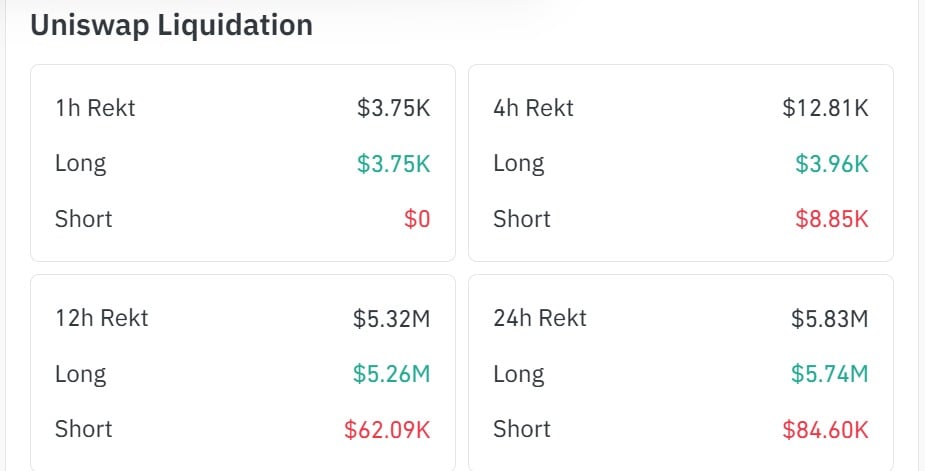
- The Cascade: As CoinGlass data indicates, over $5.7 million in long positions were liquidated in a single 24-hour period. This massive influx of forced liquidations acted as an accelerant, dumping more supply onto the order books and pushing the price further toward the $8.00 floor.
- The Panic Phase: Following the liquidation event, the market entered a phase of panic selling, where traders who were not yet liquidated chose to exit their positions voluntarily to avoid further losses, exacerbating the negative price movement.
Supporting Data: Futures and Spot Market Dynamics
The internal mechanics of the market reveal a stark divergence between the futures and spot sectors.
The Futures Market Exodus
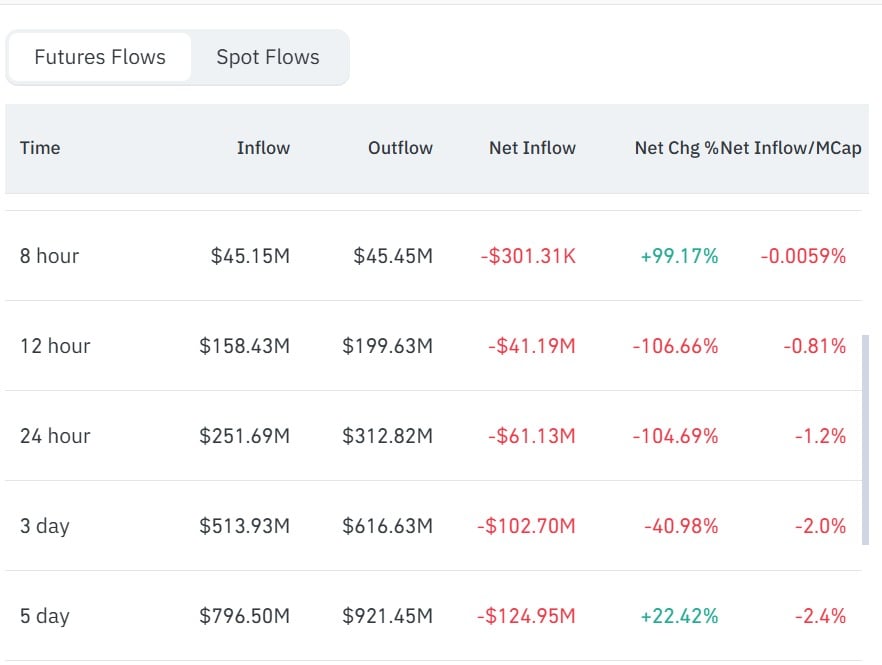
The futures market has been a primary driver of the current downward trend. Over the past 24 hours, Uniswap recorded a massive $312 million in futures outflows, significantly eclipsing the $251 million in inflows. This resulted in a Futures Netflow of -$61 million, a 104% decline that highlights a mass exodus from derivative contracts. A negative netflow of this magnitude is a bearish signal, suggesting that capital is fleeing the market rather than rotating into new positions.
Spot Market Divergence
Conversely, the spot market offers a glimmer of hope for long-term holders. Spot Netflow has fallen to -$8.89 million, which, despite the negative headline number, carries a different implication than in the futures market. A decline in spot netflow often suggests that investors are withdrawing their tokens from centralized exchanges into cold storage or private wallets. This "HODL" behavior acts as a stabilizer, potentially soaking up the excess supply that is currently wreaking havoc on the price. If spot demand remains resilient, it could serve as a floor, preventing the token from falling through the $8.00 support level.
Technical Indicators: The Bearish Momentum
The technical outlook for Uniswap remains challenged, with key momentum indicators reinforcing the current bearish bias.
MACD and Stochastic Momentum
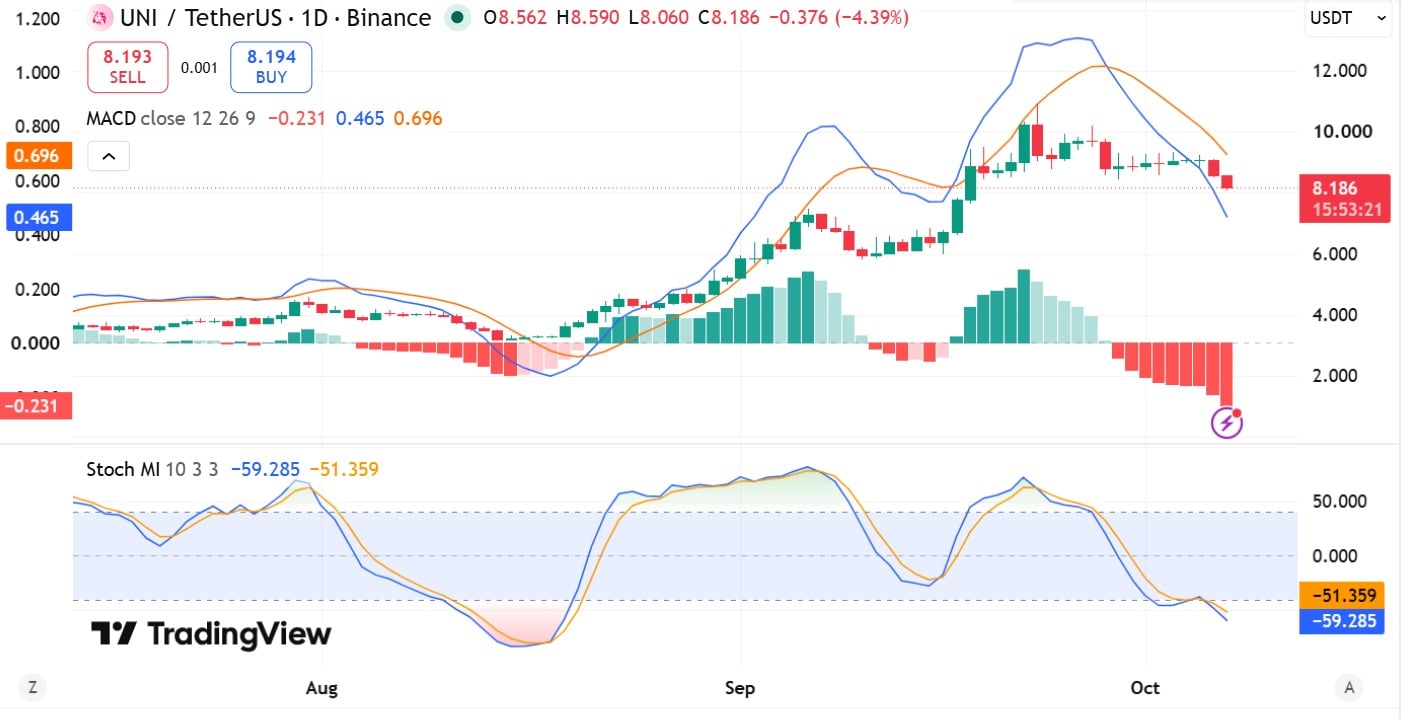
The Moving Average Convergence Divergence (MACD) indicator has been on a relentless downward trajectory, currently sitting at 0.45. The widening gap between the MACD line and the signal line suggests that the downward momentum is gaining strength, rather than exhausting itself.
Simultaneously, the Stochastic Momentum Index (SMI) has officially formed a bearish crossover and has dropped deep into the negative territory. This combination of indicators suggests that the market is currently "oversold" but lacks the necessary buy-side volume to facilitate a rapid V-shaped recovery.
Resistance and Support Levels
If the current selling pressure persists, the $8.00 support level is under significant threat. Should this level fail to hold, the next major area of support is identified at $7.60. Conversely, for the bulls to regain control, the asset must first reclaim the $9.00 resistance level. A successful flip of this level into support would be required to negate the current bearish trend and potentially initiate a move back toward double-digit valuations.
Implications for the Uniswap Ecosystem
The current market volatility has several implications for Uniswap and the broader DeFi ecosystem.
1. The Vulnerability of Leveraged Trading
The $5.7 million liquidation event serves as a stark reminder of the dangers of high leverage in crypto-assets. Uniswap, while being a utility-heavy governance token, is not immune to the speculative cycles that plague the wider market. Traders who rely on excessive leverage often find themselves at the mercy of market makers and liquidation engines when volatility spikes.
2. Governance and Sentiment
Uniswap’s price action is often viewed as a proxy for the health of the decentralized exchange (DEX) sector. As one of the most prominent blue-chip DeFi assets, a sustained decline in UNI can affect sentiment across the entire ecosystem. If the price remains depressed, it could potentially impact the participation rates in decentralized governance, as users become more focused on capital preservation than long-term protocol development.
3. Market Resilience
Despite the bearish technicals, the fact that spot outflows are occurring suggests that there is still a committed base of long-term investors. These participants are essentially "buying the dip" and removing liquidity from exchanges. If this trend continues, the reduced circulating supply on exchanges could lead to a "supply crunch" if market sentiment shifts back to positive territory.
Conclusion: Navigating the Uncertainty
Uniswap stands at a crossroads. The current bearish momentum, fueled by a massive liquidation of long positions, has undeniably damaged the short-term technical structure of the asset. The MACD and SMI indicators paint a picture of a market that is struggling to find its footing.
However, the market is rarely linear. The significant outflows in the spot market provide a counter-narrative to the panic seen in the futures sector. Whether Uniswap can hold the $8.00 line will likely depend on the broader macroeconomic climate and whether spot buyers can successfully absorb the lingering selling pressure from the derivatives market.
Investors and traders alike should exercise extreme caution. In a market where $61 million in net futures capital can evaporate overnight, volatility is the only constant. For now, all eyes remain on the $8.00 support level—a critical juncture that will dictate whether the path ahead is one of consolidation and recovery, or further capitulation into the $7.00 range.