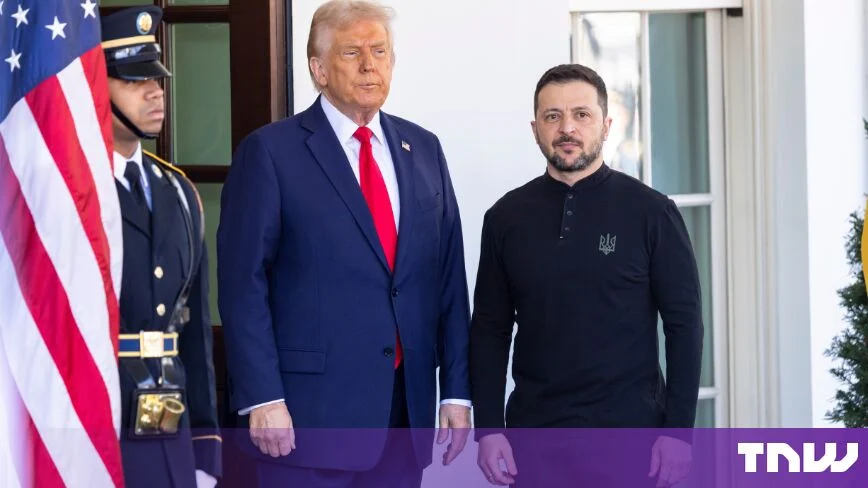
In an escalating high-stakes gambit, Ukrainian President Volodymyr Zelensky has intensified his diplomatic pressure on the United States, urging President Donald Trump to impose comprehensive sanctions against a constellation of Russian and Chinese entities currently developing a sovereign alternative to SpaceX’s Starlink. The request, which has been raised multiple times during high-level bilateral discussions—including a recent summit in New York—marks a critical shift in the technological theater of the Russo-Ukrainian War.
At the heart of the controversy is "Rassvet" (meaning "Dawn"), a satellite internet project spearheaded by the Russian technology firm Bureau 1440. According to intelligence briefings and reports from the Financial Times, the Ukrainian government believes that this project represents more than just a commercial enterprise; it is a strategic military asset that, if completed, would grant the Kremlin an autonomous, jam-proof communication network on the front lines.
Main Facts: The Strategic Threat of Rassvet
Satellite connectivity has been the backbone of Ukrainian military operations since the early days of the full-scale invasion. Elon Musk’s Starlink has provided essential bandwidth for drone coordination, artillery targeting, and real-time communication among decentralized infantry units. Russia, cognizant of this asymmetrical advantage, has invested heavily in electronic warfare (EW) to jam Starlink signals, with varying degrees of success.
Rassvet is Russia’s answer to this vulnerability. By developing a Low Earth Orbit (LEO) satellite constellation, the Kremlin aims to decouple its military communications from reliance on Western or international networks. However, the project is not a purely domestic endeavor. President Zelensky has explicitly stated that Chinese entities are providing critical support to the Russian initiative.
"We know that China works on satellites, works on the possibility of helping Russia with a similar Starlink," Zelensky remarked, highlighting the growing technological alignment between Moscow and Beijing. By targeting the supply chains of Bureau 1440 and its Chinese partners, Kyiv hopes to suffocate the project before it reaches operational status.
Chronology: A Timeline of Escalation
The development of Rassvet and the diplomatic maneuvering surrounding it can be traced through several key milestones:
- Early 2024: Bureau 1440 begins intensive testing of its LEO satellite prototypes, signaling a pivot toward a sovereign internet architecture for Russian defense.
- March 2025: A pivotal moment occurs when Bureau 1440 successfully launches its first 16 operational satellites. This deployment served as a proof-of-concept for the Russian government, providing the necessary data to scale the project.
- February 28, 2025: President Zelensky meets with Donald Trump at the White House. While the meeting was overshadowed by the breakdown of negotiations regarding critical mineral deals, the urgency of the Rassvet threat was a top priority on the Ukrainian agenda.
- Mid-2025: Intelligence reports confirm that Bureau 1440 has struggled with technical bottlenecks, forcing the company to push back its full-scale commercial launch estimates.
- Late 2025/Early 2026: Ongoing diplomatic efforts by the Ukrainian delegation in Washington seek to leverage US sanctions authority to isolate the Russian firm from global semiconductor and aerospace markets.
Supporting Data: Technical Gaps and Capabilities
While the Kremlin’s ambitions for Rassvet are expansive, technical reality remains a significant hurdle. Bureau 1440’s current infrastructure is, by most expert assessments, in its infancy.
The Scale Gap
To provide continuous, high-speed coverage over the vast territory of the Russian Federation and its occupied zones in Ukraine, a constellation requires hundreds, if not thousands, of satellites. Bureau 1440 has publicly stated a goal of a 2027 commercial launch, a timeline that many analysts view as optimistic. For comparison, SpaceX’s Starlink operates thousands of satellites; Bureau 1440’s 16-satellite pilot program is essentially a "proof-of-concept" phase.
The Chinese Connection
The crux of Zelensky’s request lies in the "China factor." Russian aerospace firms are currently heavily sanctioned, limiting their access to the high-end radiation-hardened microchips and signal processing components required for modern satellite constellations. If Chinese companies are indeed supplying these components or providing expertise in orbital mechanics and ground-station integration, they are effectively serving as a lifeline for the Russian military-industrial complex.
Sanctioning these Chinese firms would be a significant geopolitical escalation. It would require the US to target entities that may be deeply integrated into the global supply chain, potentially triggering retaliatory measures from Beijing.
Official Responses and Diplomatic Silence
Despite the severity of the allegations, the response from the primary stakeholders has been notably muted.
The White House has remained tight-lipped regarding the specific requests for sanctions against Chinese firms involved in the Rassvet project. This silence is likely a reflection of the delicate balancing act the Trump administration is performing regarding trade relations with China and the desire to avoid a wider economic conflict while supporting Ukraine.
SpaceX, while frequently vocal about the challenges of operating in contested environments, has not issued a formal statement regarding the emergence of a direct competitor like Rassvet. Internally, however, the defense and intelligence communities in Washington are reportedly conducting thorough assessments of the "Rassvet threat." The consensus among analysts is that while Rassvet is currently "small," its potential to provide a non-jamable link for Russian drones and cruise missiles makes it a high-priority target for future US export controls.
Implications: The Future of Battlefield Communication
The emergence of the Rassvet project signals a new era in modern warfare: the weaponization of orbital infrastructure. The implications of this development are profound:
1. The End of Western Hegemony in LEO
For the past several years, Starlink has enjoyed a monopoly on LEO communication services in the Ukrainian theater. A functional Russian constellation, regardless of its speed or latency compared to Starlink, would neutralize the US’s ability to act as the sole provider of battlefield connectivity. If Moscow can ensure its own communications, it becomes immune to the "kill switch" leverage that the US currently holds over Starlink.
2. A Testing Ground for Secondary Sanctions
Zelensky’s push for sanctions against Chinese companies represents a test of the US’s willingness to enforce "secondary sanctions"—penalties applied to third-party countries that do business with sanctioned Russian entities. If the US proceeds, it signals a hardening of the divide between Western-aligned tech ecosystems and the emerging Russian-Chinese bloc.
3. Accelerated Arms Race in Orbit
The existence of Rassvet necessitates a counter-response. We are likely to see increased funding for US and European "hardened" satellite networks, as well as an uptick in research into anti-satellite (ASAT) technologies. As ground-based electronic warfare reaches a stalemate, the competition for supremacy in the vacuum of space will become the new "high ground" of 21st-century conflict.
4. Technological Dependency
The struggle highlights the vulnerability of modern militaries to technological supply chains. Bureau 1440’s ability to survive depends entirely on its access to foreign tech. By cutting that supply line, Ukraine hopes to force a technological regression on the Russian military, effectively blinding them on the digital battlefield.
Conclusion: A Delicate Balance
As the war in Ukraine drags on, the battle for control of the digital skies becomes increasingly central to the conflict’s outcome. President Zelensky’s plea to the White House is a recognition that the war is no longer just about artillery and armor; it is about who owns the signals that direct them.
While Bureau 1440 remains years away from achieving a operational network comparable to the capabilities of Starlink, the strategic intent is clear. The question now is whether the United States will prioritize the technological containment of Russia and its partners over the complex economic realities of its relationship with China. For Ukraine, the answer to that question could determine whether they maintain their edge in the skies or find themselves once again fighting in the dark.