For years, the narrative surrounding decentralized perpetual exchanges has been dominated by the high-octane, high-risk world of 100x leverage trading. These platforms have been characterized by the "trader-first" ethos, where the spotlight shines brightest on those betting on massive price swings. However, beneath the surface, a shift is occurring. ApeX Omni, the flagship platform incubated by Davion Labs, is quietly pivoting the decentralized finance (DeFi) conversation toward a more sustainable, allocator-focused model.
By building a robust "second layer" of products, ApeX Omni is offering a suite of tools designed for those who prefer to allocate capital rather than actively trade. This evolution represents a maturation of the DeFi ecosystem, moving away from pure speculation and toward a sophisticated infrastructure that rewards liquidity providers, yield seekers, and algorithmic strategists.
Main Facts: The Four Pillars of ApeX Omni’s Yield Layer
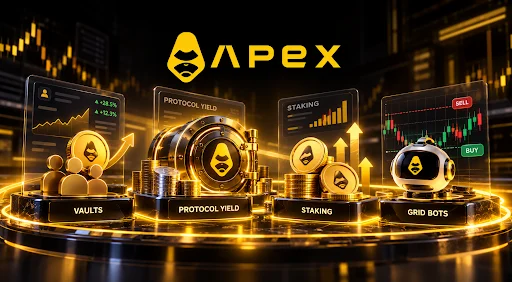
ApeX Omni’s recent product expansion is built upon four distinct pillars, each serving a unique user profile while tapping into different sources of platform-generated value.
1. Community Vaults: Delegated Alpha
Community Vaults serve as a bridge between skilled traders and capital providers. In this decentralized structure, a vault creator designs and executes a trading strategy, while investors provide the liquidity. The beauty of this model lies in the alignment of incentives: creators earn up to 10% of profits, but only on realized gains. Since the April 2025 update, the removal of individual investment caps and the reduction of the minimum vault-launch deposit to 100 USDT have democratized access to institutional-grade strategies.
2. Protocol Vaults: Harnessing Platform Revenue
Perhaps the most innovative offering, the official Protocol Vault, allows users to earn yield directly from the platform’s business model. By depositing USDT, users receive a proportional share of 100% of the daily liquidation fees generated across the Omni Perp markets. It is, in essence, a bet on the health and volume of the exchange itself, rather than a bet on a specific asset’s price.
3. APEX Staking: Long-term Alignment
The Staking 4.0 model, introduced in February 2025, provides a mechanism for long-term token holders to participate in platform success. By leveraging a weekly buyback program funded by trading fees, the protocol rewards stakers with APEX tokens. The system incentivizes commitment through a multiplier mechanism, where locking tokens for up to 24 months can earn up to 8x the base reward.
4. Grid Bots: Automation for Volatile Markets
For the user who favors volatility over directional bias, the Grid Bot automates the classic "buy low, sell high" range strategy. By utilizing resting limit orders, these bots typically earn maker fees, turning market sideways movement into a consistent stream of passive income without requiring constant monitoring.
Chronology: A Roadmap of Strategic Evolution
The development of ApeX Omni’s current ecosystem did not happen overnight. It is the result of a deliberate, multi-year progression toward a more comprehensive financial suite.
- February 2025: The launch of "Staking 4.0." This was a pivotal moment where the protocol transitioned to a buyback-driven reward model, shifting from inflationary emissions to a model tied directly to the exchange’s revenue.
- April 2025: A massive overhaul of the Community Vaults system. By removing investment caps and lowering the barrier to entry, the protocol successfully encouraged a influx of both retail capital and sophisticated algorithmic creators.
- August 2025: The Protocol Vaults reached a significant milestone, with the total vault capacity raised to 20,000,000 USDT. This signaled the protocol’s growing confidence in its ability to generate consistent liquidation revenue.
- Late 2025 to Present: Continuous integration of "TradFi perpetuals" and prediction markets, cementing ApeX Omni’s position as a "super-app" for decentralized derivatives.
Supporting Data: By the Numbers
The success of these initiatives is reflected in the platform’s underlying metrics. As of the latest reporting:
- Buyback Performance: The protocol has successfully repurchased more than 16.5 million APEX tokens through its fee-revenue buyback program.
- Staking Distributions: Total rewards paid out to the community have surpassed 3 million USDC and 1.9 million APEX, demonstrating a robust redistribution of platform wealth.
- New User Incentive: To jumpstart liquidity, the protocol allocated a 300,000 USDT incentive pool for the New User Initiative, offering a 50% APY on the first 1,000 USDT for new depositors.
- Vault Performance: Community Vaults provide transparent historical data, including daily, weekly, and monthly returns, as well as maximum drawdown metrics, allowing users to make data-driven allocation decisions.
Official Perspectives: The Mission of ApeX Protocol
The leadership behind ApeX Protocol, incubated by Davion Labs, maintains a clear vision: to deliver the speed, depth, and reliability of a centralized exchange (CEX) while ensuring that users never have to sacrifice the sovereignty of their assets.
In various technical documentations and community updates, the team has emphasized that the "honest part" of their platform is risk transparency. Unlike many DeFi protocols that hide behind obfuscated smart contracts, ApeX is explicit: none of these products are risk-free.
"We are not offering a replacement for risk management," a representative stated in a recent development brief. "We are offering tools for users to earn from a busy, high-volume exchange without necessarily being the ones holding the leveraged positions. The goal is to provide a comprehensive financial layer that mirrors the utility of TradFi while maintaining the non-custodial ethos of crypto."
Implications for the DeFi Ecosystem
The rise of ApeX Omni’s allocator-focused model has profound implications for the future of decentralized exchanges (DEXs).
1. The Death of "Degenerate-Only" Platforms
For years, the stigma of DeFi was that it was a "casino." By providing professional-grade vaults, staking, and automated bots, ApeX is helping to transition the perception of DEXs into legitimate financial service venues. This attracts a more stable, long-term investor base that is less prone to the "pump-and-dump" cycles that have plagued the sector in the past.
2. Real Revenue vs. Token Inflation
The shift toward paying rewards in APEX tokens funded by actual platform fees (rather than printing new tokens) is a hallmark of "Real Yield." This model aligns the incentives of the protocol developers, the token holders, and the platform users. When the platform wins, everyone wins.
3. The Institutionalization of Retail Tools
With the integration of Vault Keys—which allow for full API trading—ApeX has effectively lowered the barrier for developers to build hedge-fund-like strategies on-chain. This blurs the line between retail participation and institutional strategy, as everyday users can now back algorithmic systems that were once reserved for high-frequency trading firms.
4. A Template for Multi-Chain Future
As ApeX Omni continues to consolidate crypto perpetuals, TradFi perpetuals, and prediction markets into a single multi-chain interface, it is setting a template for how a "decentralized super-app" should look. By solving the fragmentation of liquidity that currently plagues many platforms, ApeX is positioning itself to be a primary venue for the next generation of DeFi users.
Conclusion: Balancing Risk and Reward
ApeX Omni’s strategy is a pragmatic acknowledgment of market reality: most capital in a perpetual exchange does not belong to the high-leverage traders. By capturing this "latent" capital—the funds sitting on the sidelines—and putting them to work through community-backed vaults, protocol-revenue sharing, and automated bots, ApeX has created a self-sustaining ecosystem.
For the modern investor, the challenge remains the same: understanding that every yield-generating product carries its own specific risk profile. Whether it is the strategy risk of a vault creator, the liquidation dependency of a Protocol Vault, or the range-bound risk of a grid bot, the tools for success are now available. What remains to be seen is how these products scale as the total value locked (TVL) on the platform continues to grow, and whether this "second layer" approach becomes the industry standard for the next generation of decentralized finance.