
As the crypto market transitions into the fourth quarter, Ethereum [ETH] finds itself at a precarious technical and psychological juncture. Following a historic third quarter that saw the asset deliver a staggering 70%+ return on investment—its best Q3 performance since inception—the narrative surrounding the world’s leading smart contract platform has shifted from unchecked optimism to a tense tug-of-war between Fear, Uncertainty, and Doubt (FUD) and Fear Of Missing Out (FOMO).
While the momentum from the summer rally remains palpable, market participants are now bracing for a potential "reality check." Investors are currently dissecting whether the current price consolidation is merely a healthy pullback before a Q4 continuation, or the beginning of a sustained bearish reversal.
The Q3 Victory Lap: A Performance for the History Books
To understand the current tension, one must first appreciate the magnitude of Ethereum’s recent performance. Throughout July, August, and September, Ethereum defied skeptical market conditions to lead the altcoin market. This 70%+ surge was driven by a combination of institutional interest, renewed optimism regarding the Ethereum ecosystem’s scalability, and a broader rotation of capital into major layer-1 assets.
This stellar performance naturally created a "FOMO" feedback loop. As prices climbed, retail and institutional interest intensified, creating a self-sustaining environment where "HODLing" became the default strategy for a large portion of the investor base. However, market history dictates that such parabolic moves are rarely linear. As the calendar flipped to October, the conversation shifted from "How high can it go?" to "Is the top in?"
The Sentiment Shift: A Departure from Bullish Norms
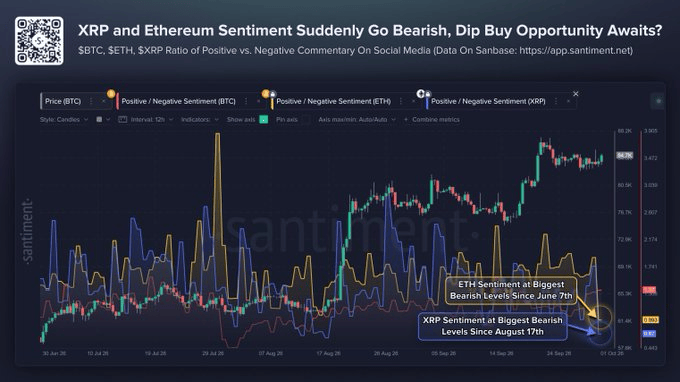
The most immediate indicator of this cooling sentiment is the latest data from Santiment, which tracks social volume and sentiment across major digital forums, including X (formerly Twitter), Telegram, and Reddit.
According to the data, Ethereum’s sentiment meter has plummeted to a ratio of 0.89 bullish comments for every one bearish comment. For context, a ratio below 1.0 indicates that the bearish narrative has begun to eclipse the bullish excitement. This represents the lowest sentiment score for Ethereum since June 7th. In the high-frequency world of cryptocurrency, such a rapid shift in public perception is often a leading indicator of price volatility, as retail sentiment tends to correlate strongly with short-term retail buying and selling pressure.
Contrarian Perspectives: Is the Fear Overblown?
Despite the decline in social sentiment, many seasoned analysts argue that this pessimism should be viewed through a contrarian lens. In market psychology, the "crowd" is often wrong at extremes. When the majority of social discourse becomes fixated on downside risk, it often suggests that the "panic selling" phase has already been largely exhausted.

Analysts point out that when fear levels are elevated, it creates a superior entry setup compared to the traditional "buy the dip" strategy. By the time the general public recognizes a dip, the institutional "smart money" has often already accumulated significant positions. If the current bearish sentiment is merely a reaction to a standard consolidation, the current environment could be setting the stage for a surprise breakout rather than a breakdown.
Chronology of the Current Market Strain
The shift in Ethereum’s market dynamics can be traced through a series of key developments over the last several weeks:
- Early September: Ethereum maintains its bullish momentum, outperforming Bitcoin and setting the stage for a Q3 record.
- Late September: Social media sentiment peaks as profit-taking begins to emerge, causing the first ripples of uncertainty.
- October 1st: Sentiment metrics drop below the 1.0 threshold, signaling a shift toward bearish rhetoric on social platforms.
- Early October: On-chain data begins to confirm the shift, with the Taker Buy/Sell Ratio hitting a four-month low and Ethereum co-founder Joseph Lubin moving a massive amount of ETH to an external wallet, causing further speculation.
- Present Day: The market watches the "exit queue" for staked ETH, which has surged to levels not seen since early 2026, putting immense pressure on the price.
Deep Dive: The On-Chain Warning Signs
While social media sentiment is subjective, on-chain data provides a cold, hard look at the behavior of Ethereum whales and institutional participants. Unfortunately for the bulls, the current on-chain signals are flashing several cautionary flags.
The Taker Buy/Sell Ratio
The Binance weekly Taker Buy/Sell Ratio is perhaps the most telling metric. Dropping to 0.95, this is the lowest level recorded in over four months. In simple terms, this means that for every buyer taking liquidity, there are more sellers actively hitting the bid. This indicates a growing urgency among traders to offload their positions, even at lower price points, which is a classic signal of weakening demand.
The "Exit Queue" Conundrum
Perhaps the most significant structural risk currently facing Ethereum is the state of its validator exit queue. Data from ValidatorQueue shows that the queue has climbed to 773,447 ETH. This represents a massive pool of capital that is actively seeking to exit the staking ecosystem. If market conditions deteriorate further, this 773k ETH represents a significant "sell-side overhang" that could hit the open market, creating massive downward pressure on the price of the asset.
Institutional Outflows
The recent performance of Ethereum ETFs has also been lackluster. Recent data shows a 1-day net outflow of 5,171 ETH, valued at approximately $13.89 million. While this is not an apocalyptic amount in the context of Ethereum’s massive market cap, it represents a change in trend from the net inflows seen during the Q3 rally. Institutional investors are notoriously risk-averse; if they are pulling capital out of ETFs, it suggests a broader cooling of institutional interest in the short term.
The Lubin Factor: Speculation and Market Impact
Adding to the complexity is the recent movement of 133,298 ETH—worth over $356 million—by Ethereum co-founder Joseph Lubin. While such movements are often related to internal foundation operations, tax planning, or personal financial management, the market rarely interprets them neutrally.
In the crypto ecosystem, large transfers by high-profile figures almost always trigger a wave of FUD. In this case, the transfer has served as a focal point for those arguing that the "smart money" is looking to take profits after a 70% quarter. Whether the move was tactical or coincidental, it has undeniably added a layer of psychological pressure on retail traders who view the move as a lack of confidence in the short-term price action.
Implications for the Fourth Quarter
As we look toward the remainder of the year, Ethereum is at a crossroads. The Q3 performance was undeniably impressive, but the current data suggests that the market is beginning to suffer from "exhaustion."
If the bearish on-chain trends continue—specifically if the exit queue remains high and the Taker Buy/Sell ratio stays below 1.0—Ethereum could see a deeper correction. A reversal would not necessarily invalidate the long-term thesis for Ethereum, but it would certainly temper the expectations of those looking for a parabolic Q4.
However, should the market prove the contrarians right, we may see a "short squeeze" scenario. If the majority of retail traders are short-selling based on the current negative sentiment, a sudden, unexpected influx of buying volume could trigger a violent move to the upside, liquidating the bears and pushing Ethereum back toward its Q3 highs.
Final Summary: Is the Party Over?
The transition from a record-breaking third quarter into an uncertain October has left the Ethereum community divided. The confluence of declining social sentiment, a concerning Taker Buy/Sell ratio, and the record-high exit queue for staked ETH suggests that the "easy money" phase of the recent rally has concluded.
For investors, the immediate future will be defined by the strength of the support levels established during the Q3 rally. If those levels hold, the current bearishness may be viewed in hindsight as a necessary reset. If they fail, however, the market may be in for a prolonged period of consolidation. The "FUD vs. FOMO" battle is currently being won by the skeptics, but in the volatile world of Ethereum, the tide can turn in an instant. Investors should watch for a stabilization in the staking queue and a return of net inflows into Ethereum ETFs as the primary signals that the bulls have regained control of the narrative.