
For most founders and marketing leads, the weekly ritual is identical: open the email service provider (ESP) dashboard, scroll past the sea of data, and glance at a handful of metrics. You see a green arrow or a red one, feel a fleeting sense of satisfaction or mild panic, and then move on to the next fire.
But here is the hard truth: most of what you are looking at is digital clutter. In the modern marketing landscape, the metrics that dominate your screen are often lagging, inflated, or entirely disconnected from your bottom line. To transform your email strategy from a "send-and-pray" operation into a sophisticated revenue engine, you must learn to ignore the vanity metrics and focus on the signals that actually dictate business health.
The State of Email Marketing: Why Your Dashboard is Lying to You
The primary challenge in modern email marketing is the erosion of trust in traditional data. The most prominent example is the "Open Rate." Before 2021, the open rate was the gold standard—a proxy for how many people actually read your message. Then, Apple introduced Mail Privacy Protection (MPP).
By pre-loading emails on servers, Apple forced a change in how opens are tracked. Today, if your email is sent to an iPhone user, it registers as "opened" the moment it hits their server, regardless of whether the recipient ever actually looked at the screen. This has led to industry-wide inflation of open rates, rendering the metric statistically unreliable for precision analysis.
However, the metric is not entirely useless. While it has lost its precision, it retains its value as a directional indicator. If your open rates are trending downward over a 90-day period, the data is still telling you something real: your subject lines are failing, your list is cooling, or your sender reputation is under assault by spam filters. Use open rates to spot trends, not to measure success.
Click-Through Rates: The North Star of Intent
If the open rate is a noisy signal, the click-through rate (CTR) is the signal of truth. No privacy feature can force a human to click a link. A click is a deliberate, conscious action that signals genuine engagement with your brand’s content.
To truly master your analytics, you must look at the two distinct flavors of click data:
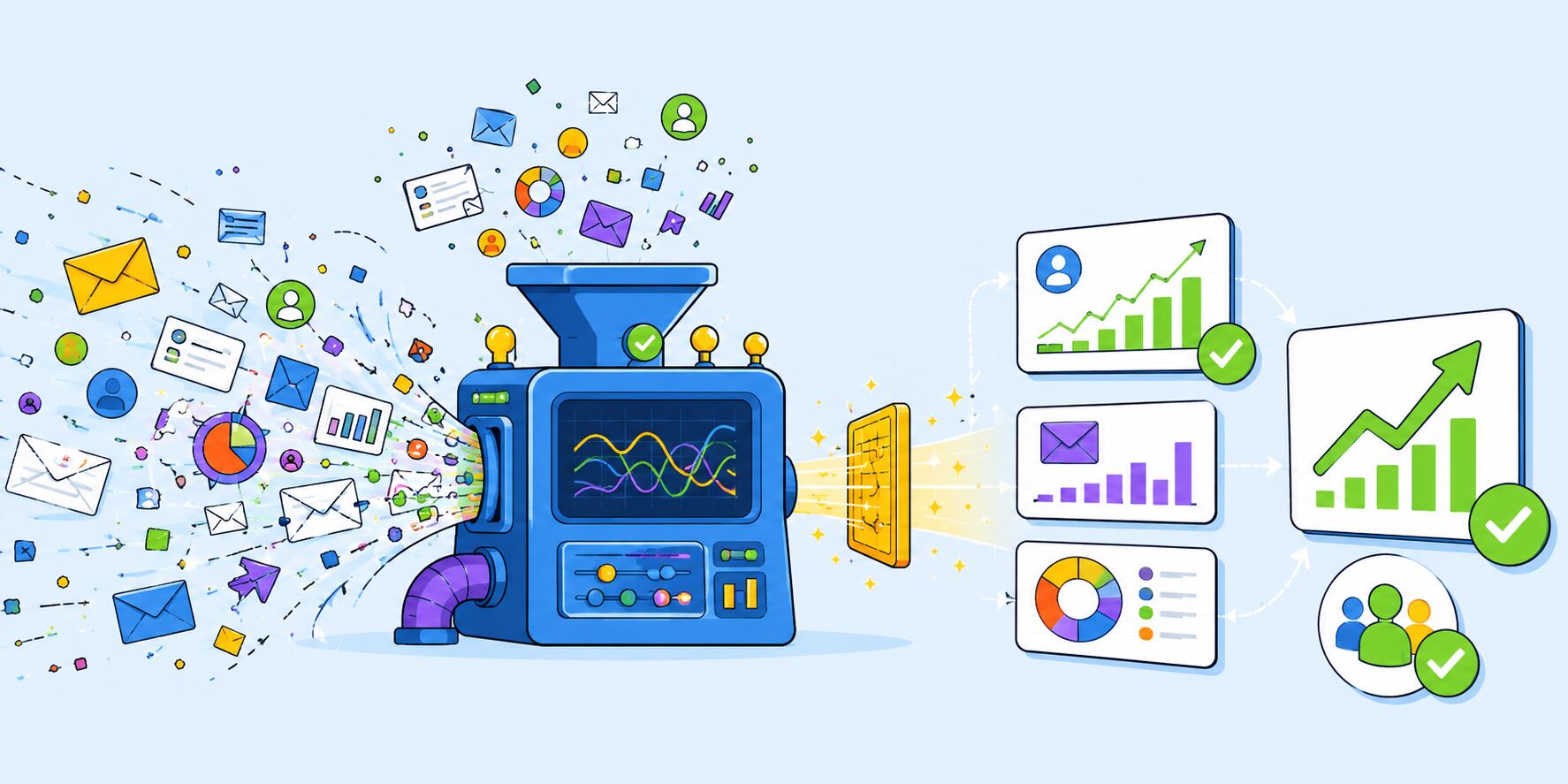
- Click Rate (CR): Clicks divided by total delivered emails. This measures the overall effectiveness of your campaign.
- Click-to-Open Rate (CTOR): Clicks divided by total opens. This isolates the performance of your content design and copywriting.
The magic happens when you correlate these two. If you have a low click rate but a healthy CTOR, your subject lines are likely the culprit—they are failing to generate the curiosity needed to get the reader to open the email. Conversely, if you have high opens but a weak CTOR, your subject line was a success, but the body content failed to deliver on its promise. By isolating these variables, you move from guessing to surgical optimization.
Revenue Per Email (RPE): The Grown-Up Metric
Ultimately, engagement is not a business model; revenue is. "Revenue Per Email" (RPE) is the most critical metric for any serious entrepreneur because it forces a comparison between your most creative campaigns and your most functional, boring automated flows.
RPE allows you to normalize performance across different types of sends. You might be proud of a flashy, high-effort newsletter, but if a simple, automated abandoned-cart email is generating five times the RPE, the data is telling you where to invest your limited time.
Furthermore, you should track email’s contribution to your total store revenue. For high-performing e-commerce brands, email should consistently drive between 20% and 30% of total revenue. If your numbers are hovering in the single digits, you aren’t just missing out on sales—you are leaving money on the table that is already yours to claim.
The "Smoke Detectors": Monitoring List Hygiene
While RPE and CTR are your growth drivers, you must also maintain your "smoke detectors"—the metrics that signal when your infrastructure is at risk.
- Bounce Rate: A hard bounce signifies an invalid email address. If this rate spikes above 1%, you are signaling to internet service providers (ISPs) that your list is unverified or purchased, which can lead to your domain being blacklisted.
- Unsubscribe Rate: A healthy unsubscribe rate (typically 0.2% to 0.5%) is actually a positive signal. It means your list is self-cleaning, removing disinterested subscribers who would otherwise drag down your engagement metrics. A 0% unsubscribe rate is often a red flag that your unsubscribe link is too hard to find, which leads directly to the next, more dangerous metric.
- Spam Complaints: This is the metric with teeth. A spam complaint is a direct hit to your sender reputation. If your complaint rate consistently sits above 0.1%, ISPs will begin filtering your messages directly to the junk folder, regardless of how good your content is.
The Fifteen-Minute Monthly Ritual
The biggest pitfall in analytics is the "monitoring trap"—the belief that observing data leads to improvement. Data only creates value when it leads to a decision.
To turn your analytics into a competitive advantage, adopt the "Fifteen-Minute Ritual." Once a month, sit down and ask four critical questions:

- Which campaigns generated the highest RPE? What common themes, offers, or design elements did they share?
- Which sends had the highest CTOR? Why did those specific pieces of content resonate with the audience?
- What is the quarterly trend? Are your unsubscribes creeping up while your clicks are stagnating?
- Are your automations pulling their weight? Compare your "always-on" flows (welcome, abandoned cart, win-back) against your manual blasts.
Once you have identified the answers, you must execute the "One-Change Rule." Do not try to fix everything at once. Pick exactly one variable to test—perhaps a new subject line style or a more aggressive call-to-action in your welcome flow—and implement it for the following month.
Technology as an Enabler: The Case for Integrated Platforms
The difficulty of this ritual often comes down to the friction of data collection. If you have to spend hours in Excel stitching together data from your e-commerce store and your email provider, you won’t do it.
Modern platforms like Omnisend are designed to solve this by providing a unified view. By tying revenue directly to individual campaigns and automations, these tools turn "spreadsheet archaeology" into a simple, at-a-glance dashboard. When you can see the direct impact of a segment-specific automation compared to a blast campaign, the decision-making process becomes instantaneous.
For many founders, the hesitation to switch platforms is rooted in the fear of migration. However, modern migration services have evolved; many providers now offer full-service transfers of flows, templates, and lists in a matter of days. This transition often allows businesses to lower their overhead while simultaneously upgrading their data capabilities.
Final Implications: From Sending to Steering
The shift in perspective is the most vital step in your journey toward email mastery. You are not a broadcaster sending messages into the void; you are a navigator steering a relationship-based revenue channel.
Your dashboard is not a scoreboard to be watched—it is a feedback loop to be interrogated. When you stop obsessing over "vanity" metrics like open rates and start leaning into the "truth" metrics like clicks and revenue, you change the nature of your marketing. You stop guessing, you start testing, and most importantly, you start growing.
The goal is to reach a state where your email program is so finely tuned that it functions like a silent partner in your business—predictable, profitable, and increasingly automated. Every minute you spend in that fifteen-minute monthly ritual is an investment in that future. Start today, change one thing, and watch the numbers move in your favor.