As corporate learning and development (L&D) departments look toward 2027, a singular, gnawing question looms over the industry: Where will the capacity to learn actually come from?
For years, the mandate for L&D has been to provide more: more content, more platforms, more personalization, and more accessibility. However, a seismic shift in the modern workplace suggests that the era of "more" has reached a point of diminishing returns. Employees are currently caught in a relentless cycle of adapting to artificial intelligence, mastering new digital workflows, navigating organizational restructuring, and meeting heightened performance targets. Individually, these demands are manageable; collectively, they are paralyzing.
The Reality of Workplace Overload
The data confirms that the modern employee is stretched to a breaking point. According to Deloitte’s 2025 research on human capital, the average worker is now subjected to 10 planned enterprise-level changes annually—a fivefold increase compared to 2016. This constant state of flux has created a culture of burnout, with two-thirds of global workers reporting that they feel overwhelmed by the velocity of change. Nearly half live in a state of apprehension, fearing that the pace of transformation will render their current skill sets obsolete.
This anxiety is well-founded. PwC’s 2026 Global AI Jobs Barometer indicates that the skills required in AI-exposed roles are evolving more than twice as fast as those in less-exposed positions. The challenge is no longer about "access" to information; it is about the "absorptive capacity" of the workforce. When employees lack the time, mental bandwidth, and energy to translate new information into performance, the organization’s ability to adapt stalls.
Defining the Capacity Gap: A Chronology of Obsolescence
To understand how we arrived at this impasse, it is helpful to look at the evolution of the L&D mandate:
- Pre-2015 (The Content Era): The primary hurdle was information scarcity. Learning leaders focused on building libraries, procuring Learning Management Systems (LMS), and digitizing instructor-led training.
- 2016–2022 (The Access Era): Focus shifted to personalization and "learning in the flow of work." Micro-learning and mobile accessibility became the gold standard.
- 2023–2025 (The AI Inflection): Generative AI exploded, making the creation of content nearly instantaneous. The constraint moved from "lack of content" to "lack of human attention."
- 2026 and Beyond (The Capacity Era): The new frontier is no longer about delivering content, but about managing the cognitive load of the workforce to ensure that development leads to tangible performance outcomes.
The Misconception of "Continuous Training"
A persistent fallacy in the current corporate landscape is the conflation of "learning activity" with "workforce capability." When an organization identifies a skill gap, the reflexive response is to launch a training program. Employees are then expected to complete these modules while maintaining their existing output.
This model is fundamentally flawed. True capability is not measured by the completion of a course, but by the application of knowledge in a live environment. If an employee completes a module on a new AI tool but has no time to practice, receive feedback, or integrate that tool into their daily workflow, the training is essentially wasted.
The Difference Between Capability and Capacity
- Capability is the "what": Does the employee have the skills required for the job?
- Capacity is the "how": Does the organization provide the environment—the time, energy, and psychological safety—necessary to develop and deploy those skills?
When learning leaders focus solely on capability without considering capacity, they inadvertently contribute to the very performance gaps they are trying to close.
Personalization: The Shift from Curriculum to Friction Reduction
In 2027, personalization remains a priority, but its definition is changing. Historically, personalization meant tailoring the content to the individual. Today, it must mean tailoring the intervention to the gap.
Instead of assigning an exhaustive curriculum, the goal is to identify the shortest credible path between current capability and required performance. This requires a diagnostic approach:
- What is the specific performance problem?
- Is this a knowledge gap or a friction issue? (e.g., Is the technology too complex, or is the workflow redundant?)
- What is the least burdensome intervention?
Sometimes, the "learning" intervention is not a course at all, but a redesigned workflow, a management decision to drop a legacy process, or the implementation of an AI performance-support tool that provides guidance in real-time. By diagnosing before prescribing, leaders can avoid "training bloat" and preserve precious employee energy.
The Essential Pillars of Capability: Safety and Resilience
As we move into 2027, the conversation surrounding L&D must expand to include organizational health factors that were previously siloed under "Wellness" or "Employee Experience." Specifically, psychological safety and resilience are now critical components of the capability agenda.
Psychological Safety
Employees who fear the consequences of a mistake are unlikely to experiment with new technologies or workflows. If an employee feels they must "already know" the answer, they will not ask the questions necessary to bridge their knowledge gap. Without psychological safety, skill deficits remain hidden, preventing the organization from providing support where it is actually needed.
Resilience as a Strategic Constraint
Resilience is often misused as a metric for how much change an employee can "absorb." This is a dangerous expectation. Rather than asking employees to endure endless change, organizations should focus on the cumulative demand placed on their people. If an organization introduces ten enterprise-wide changes a year, it must intentionally remove ten legacy processes to compensate. Failure to do so leads to the inevitable exhaustion of human capital.
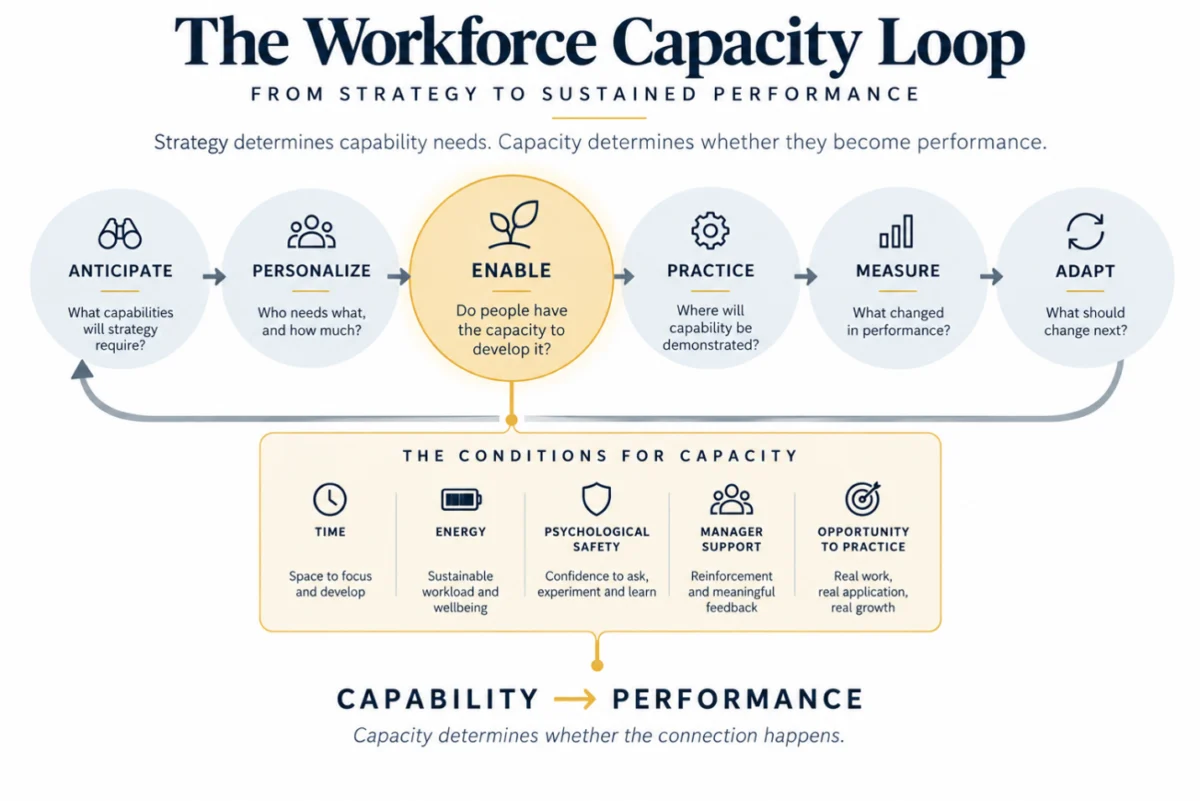
Reimagining Development: The "Workforce Capacity Loop"
For 2027, the industry must adopt a new framework that prioritizes "enablement" over "delivery." The Workforce Capacity Loop begins with strategic alignment but places a heavy emphasis on the environmental conditions required for growth.
The Diagnostic Checklist for Learning Leaders
Before launching any new initiative in 2027, leaders must ask:
- Time: Have we accounted for the time required to practice this new skill, or is it an "add-on" to current duties?
- Support: Are managers equipped to reinforce this behavior, or are they focused solely on legacy metrics?
- Integration: Does the existing workflow support the new behavior, or does it actively discourage it?
- Safety: Is the environment safe enough for employees to admit they don’t know something and to make errors while learning?
- Necessity: Is this a learning problem, or a process/technology problem that should be solved elsewhere?
Implications for the Future
The implications for the industry are profound. We are entering an era where the most effective learning teams may be those that build the fewest programs.
AI’s role in this transition is paradoxical. While it creates the volatility that necessitates continuous reskilling, it also offers the tools to make that development faster and more targeted. We can use AI to generate more content, or we can use it to provide "just-in-time" support, thereby eliminating the need for long-form training on infrequent tasks.
By 2027, the competitive advantage will go to organizations that master the art of capacity management. These companies will distinguish themselves not by the volume of their training catalogs, but by their ability to foster growth without exhaustion. They will recognize that while information is abundant, human capacity is a finite, precious resource. The future of learning belongs to those who understand that to build capability, you must first protect the capacity to grow.