As the landscape of international commerce undergoes a period of profound transformation, characterized by shifting geopolitical alliances, the rapid digitalization of supply chains, and evolving regulatory frameworks, the need for empirical, data-backed intelligence has never been more critical. The International Chamber of Commerce (ICC) is preparing to release its highly anticipated 2026 Global Trade Intelligence Report, a cornerstone publication that serves as the industry’s definitive benchmark for trade and supply chain finance.
For over a decade, this report has acted as a lighthouse for global financial institutions, offering a comprehensive view of risk performance, default probabilities, and emerging market trends. By aggregating data from a consortium of the world’s leading banks, the report provides a unique vantage point on the $25.7 trillion ecosystem that powers global trade.
Main Facts: The Pulse of Global Trade Finance
The ICC Global Trade Intelligence Report is not merely a summary of statistics; it is a strategic asset designed to support the decision-making processes of financial institutions worldwide. The core mission of the report is to provide actionable intelligence that helps banks and corporations navigate the complexities of trade finance with greater precision.
The Scale of the Data
The report is built upon the foundation of more than ten years of meticulously aggregated data. With insights drawn from over $25.7 trillion in transactions, it represents the most comprehensive data set available in the trade finance sector. This depth of information allows for granular analysis that individual institutions, despite their size, would be unable to replicate in isolation.
The Collaborative Engine
The report is the result of a powerful, long-standing partnership between the International Chamber of Commerce, the Boston Consulting Group (BCG), and Global Credit Data (GCD). This tripartite alliance combines the ICC’s global reach and policy expertise, BCG’s strategic consulting prowess, and GCD’s rigorous approach to credit risk data collection.
Strategic Objectives
The report seeks to achieve three primary objectives:
- Benchmarking: Allowing financial institutions to compare their portfolio performance against global industry standards.
- Risk Mitigation: Providing insights into default and loss rates that help banks refine their risk appetite and capital allocation.
- Strategic Opportunity: Identifying high-growth markets and emerging sectors that are ripe for investment, despite the prevailing global economic headwinds.
Chronology: A Decade of Evolving Intelligence
To understand the significance of the 2026 edition, one must look at the historical trajectory of the ICC Trade Register, which has evolved into the current Global Trade Intelligence Report.
- The Foundational Years (2010–2015): The initiative began as a response to the lack of transparent, empirical data on trade finance risks. Early editions were focused primarily on establishing baselines for default and loss rates in traditional trade products like Letters of Credit.
- The Data Expansion Phase (2016–2020): As trade finance digitized, the report expanded its scope to include supply chain finance, open account trade, and the impact of evolving Basel regulatory frameworks on bank capital requirements.
- The Modern Era (2021–Present): With the formal transition toward the "Global Trade Intelligence Report," the scope has widened to include sustainability metrics, the impact of digital trade documents (such as eBLs), and the role of trade finance in closing the $2.5 trillion global trade finance gap.
- The 2026 Horizon: The upcoming report is set to address the post-pandemic recovery, the impact of high-interest-rate environments, and the integration of Artificial Intelligence in risk assessment models.
Supporting Data: Why Benchmarking Matters
In the world of high-volume, low-margin trade finance, data is the only shield against volatility. Institutions that rely on the ICC report do so because it offers a reality check against internal assumptions.
Performance Indicators
The report focuses on critical KPIs that banks use to manage their books:
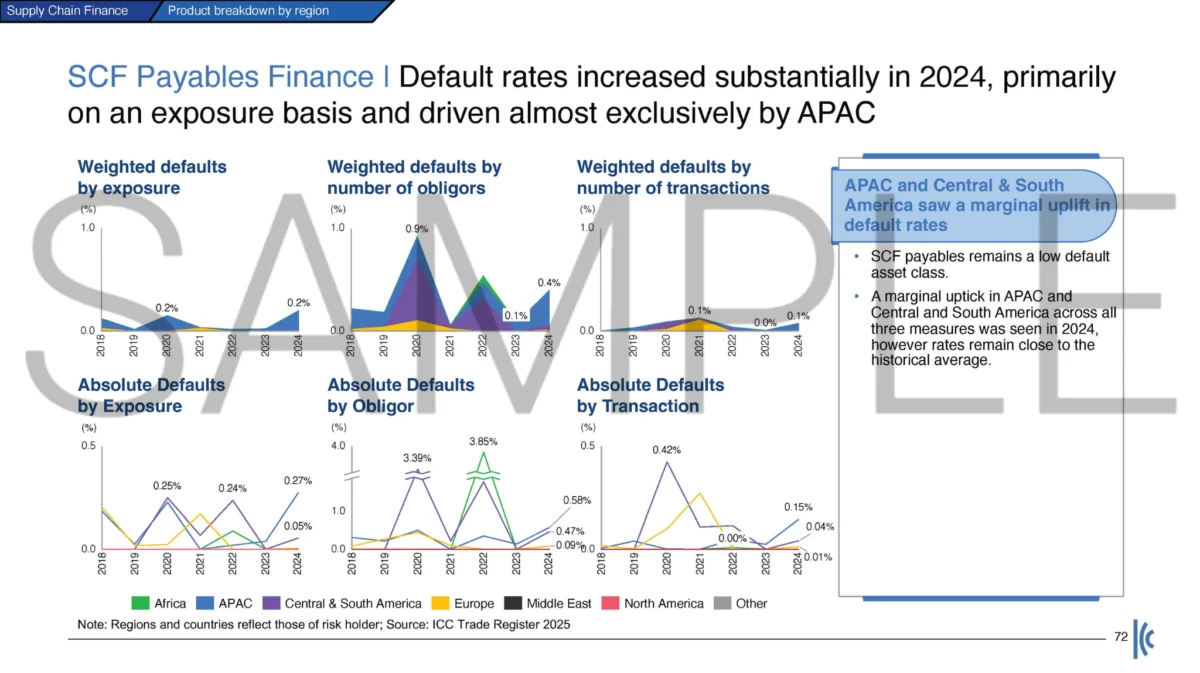
- Default Rates: By analyzing thousands of trade transactions, the report provides a clearer picture of the probability of default (PD) across various geographic regions and product types.
- Loss Given Default (LGD): Understanding not just when a default occurs, but what percentage of the transaction is recoverable, is essential for capital adequacy calculations under Basel III and IV guidelines.
- Portfolio Diversification: The report helps institutions identify whether their exposure is overly concentrated in specific sectors or jurisdictions, enabling them to pivot toward more stable, albeit perhaps less traditional, markets.
The Value of "Actionable Intelligence"
Users of the report have consistently cited its utility in internal strategic planning. For example, by utilizing the benchmark data provided, financial institutions have reported improved accuracy in their internal credit rating models, which in turn leads to more competitive pricing for their clients and more efficient use of capital.
Official Responses: Shaping the Industry
The ICC acts as a bridge between the private sector and regulators. By publishing these reports, the organization provides the "evidence base" required to influence international policy.
"Our goal is to ensure that trade finance is recognized as the low-risk, high-impact asset class that it truly is," stated a spokesperson for the ICC during the lead-up to the 2026 launch. "By providing this level of transparency, we aren’t just helping banks—we are helping to keep global trade flowing by ensuring that regulators understand the safety and stability of these instruments."
The partnership with the Boston Consulting Group and Global Credit Data ensures that the report meets the highest standards of statistical rigor. This validation is vital, as the data is frequently used to advocate for more favorable regulatory treatment of trade finance products. By demonstrating empirically that trade finance has a lower risk profile than other forms of corporate lending, the ICC continues to play a pivotal role in shaping global financial regulations.
Implications: The 2026 Outlook and Beyond
The 2026 report is expected to delve deeper into the intersection of technology and trade. As the industry moves away from paper-based processes, the data contained in the 2026 report will reflect the efficiency gains associated with digital trade.
The Rise of Digitalization
With the adoption of the UNCITRAL Model Law on Electronic Transferable Records (MLETR) in various jurisdictions, the 2026 report will likely highlight how digitized trade flows affect risk velocity. Faster processing times and improved transparency are expected to lead to lower operational risks, a trend the ICC intends to quantify in the upcoming edition.
The Sustainability Mandate
Environmental, Social, and Governance (ESG) considerations are no longer optional. The 2026 report will continue to integrate sustainability data, helping financial institutions assess the "green" risk profile of their trade portfolios. This includes tracking the financing of sustainable supply chains and the transition toward carbon-neutral trade corridors.
Strategic Sponsorship and Membership
The report remains a collaborative effort, sustained by a core group of 22 global member banks. Membership is a mark of prestige and an investment in industry-wide stability. For non-bank corporations, the report provides a unique opportunity to gain visibility among the world’s most influential financial institutions. The sponsorship program serves as a gateway for firms looking to position themselves at the center of the trade finance dialogue.
A Call to Action
As the global economy faces ongoing uncertainty, the 2026 ICC Global Trade Intelligence Report serves as a necessary compass. It offers more than just data; it offers a roadmap for resilience. For institutions looking to optimize their risk-adjusted returns, or for corporations seeking to understand the shifting tides of international trade, the upcoming publication is an essential resource.
"Having a seat at the table," as the ICC describes it, means contributing to and benefiting from the industry’s leading source of intelligence. As the date for the full release approaches, stakeholders are encouraged to engage with the ICC’s expert teams to ensure they are prepared to leverage the insights contained within the 2026 report.
In an era where information is the most valuable currency, the ICC’s commitment to providing a clear, accurate, and comprehensive view of trade finance is the ultimate service to the global trading community. The 2026 report will undoubtedly be the standard against which all other industry analyses are measured.