Sales and marketing misalignment rarely announces itself with a boardroom explosion. It doesn’t typically appear as a sudden collapse in morale or a catastrophic drop in revenue overnight. Instead, it manifests as a quiet, corrosive friction: "qualified" leads that sales representatives instinctively ignore, marketing campaigns that feel disconnected from the realities of the sales floor, and a pipeline that looks deceptively healthy on paper while actual revenue growth plateaus.
In an era where SMBs are fighting for every competitive advantage, the gap between these two vital departments has become an existential risk. A recent comprehensive study by Unbounce, which surveyed over 500 go-to-market (GTM) professionals, reveals a startling reality: while 87% of teams believe that better alignment is the key to unlocking performance, only 56% claim to be truly "highly aligned."
This guide explores the anatomy of this disconnect, the hidden costs of operational silos, and the strategies top-performing organizations are using to turn alignment from a buzzword into a revenue engine.
The Reality Check: Bridging the "Alignment Gap"
When organizations discuss "alignment," they often point to their meeting cadence. They boast about weekly sync calls, shared Slack channels, or the occasional joint training session. However, the data suggests that these rituals are often superficial.
True alignment is not defined by how often teams talk; it is defined by how they operate. Highly aligned organizations share lead data, enforce synchronized handoff protocols, and hold both departments accountable to the same Key Performance Indicators (KPIs). When these structural elements are missing, "alignment" becomes little more than a polite agreement to disagree.

The most common failure point is the "operating model." Teams may communicate frequently, yet they remain fundamentally divided on what constitutes a high-quality lead, the optimal timing for follow-up, and—perhaps most contentiously—who deserves credit for a closed deal. In this fractured environment, marketing celebrates lead volume, sales complains about lead quality, and the revenue gap widens.
The Perception Divide: Why Executives and Frontline Staff Disagree
One of the most revealing findings from the Unbounce research is the "perception gap" between leadership and individual contributors. Nearly 69% of executives report that their organization enjoys strong sales and marketing alignment. In stark contrast, only 47% of non-executive staff share that sentiment.
Why does the view from the C-suite look so different from the reality on the ground?
Executives often view alignment through the lens of strategy documents and organizational charts. They see the intent of alignment. Meanwhile, frontline employees experience the friction of misalignment daily. They encounter the data inconsistencies, the limited communication, and the bureaucratic silos that impede their actual work. This structural information lag is a silent killer of growth; as the organization scales, the distance between the strategy deck and the daily CRM entry grows, leading to a profound disconnection that goes largely unaddressed by those with the power to change it.
The True Cost of Misalignment: Beyond Employee Frustration
While misalignment often manifests as a cultural issue—characterized by bickering or apathy—its true impact is measured in cold, hard cash. According to the report, 29% of GTM professionals cite employee frustration as a primary consequence of poor alignment. However, the financial repercussions are far more severe and often go uncounted.

1. The Revenue Drain of Delayed Follow-Up
When marketing generates a lead, every second that passes before a sales representative reaches out is a second where the prospect’s intent cools. Misalignment causes these leads to sit in limbo, often due to unclear routing rules or a lack of trust in the lead’s quality.
2. The Efficiency Tax
Misalignment inevitably leads to duplicated work. When marketing isn’t privy to the objections sales hears on calls, they build campaigns that miss the mark. When sales isn’t informed about the messaging marketing is using, they struggle to pick up the conversation where the ad left off. This redundancy drains the budget, inflates the Customer Acquisition Cost (CAC), and lowers overall conversion rates.
3. The "Definition" Trap
Perhaps the most damaging symptom is the disagreement over what constitutes a "qualified" lead. When marketing defines an MQL (Marketing Qualified Lead) by vanity metrics like downloads or webinar attendance, but sales requires a decision-maker with a specific budget, the result is a pipeline full of "leads" that will never convert. This isn’t just a communication failure; it is a fundamental breakdown in the business model.
Why "Communication" Isn’t the Silver Bullet
The most common mistake organizations make is believing that more meetings will solve the problem. In fact, 54% of teams prioritize increasing communication frequency as their primary alignment strategy. However, if you are discussing the wrong data, or if you are working from a foundation of conflicting goals, more meetings simply create more opportunities to argue.
High-performing teams understand that alignment must be built into the infrastructure:
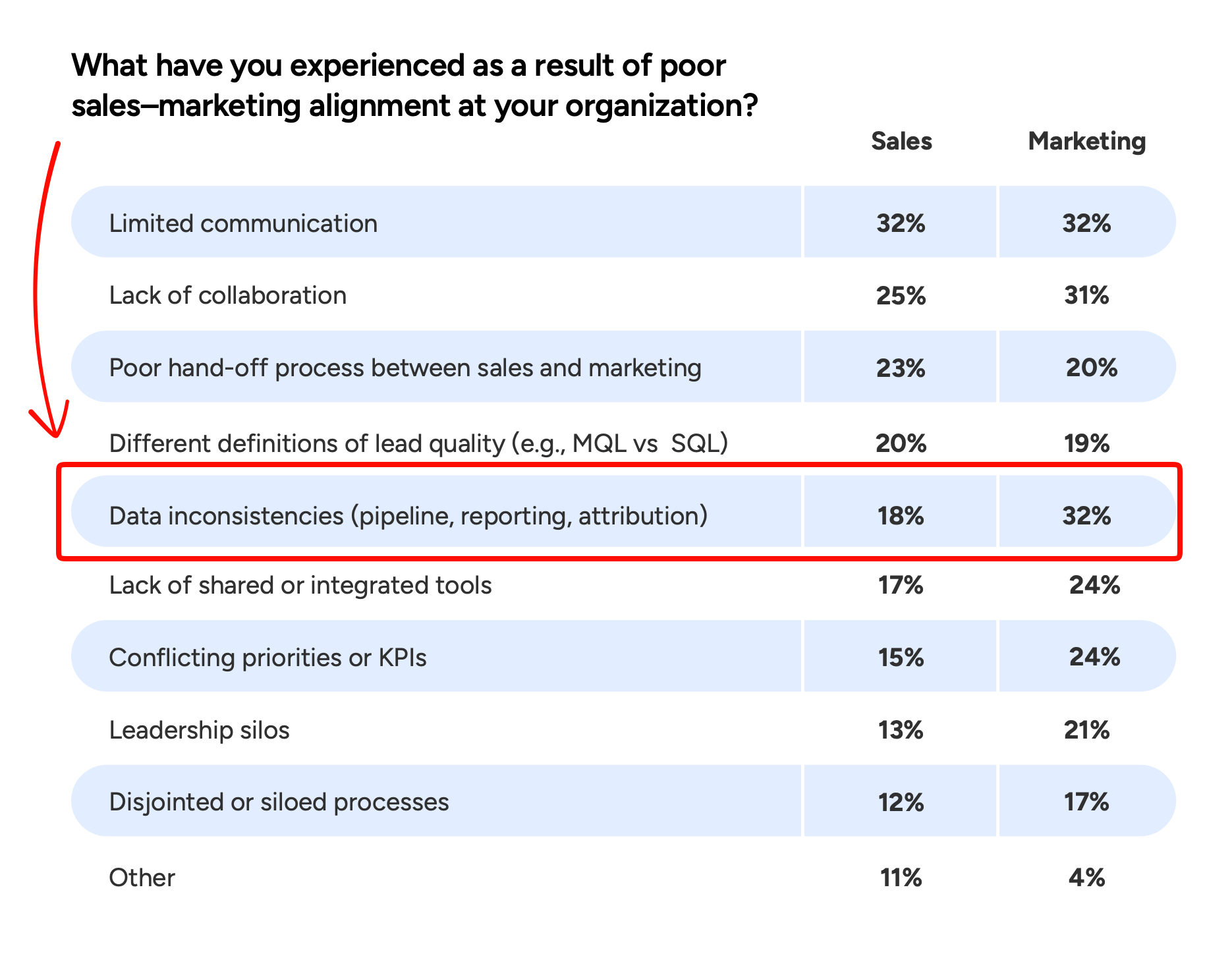
- Integrated Workflows: Automation shouldn’t just exist for marketing; it should feed directly into the sales workflow, ensuring that context follows the lead.
- Shared KPIs: When sales and marketing share the same targets—such as pipeline velocity or total closed revenue—the incentive to collaborate becomes structural rather than optional.
- Coordinated Lead Qualification: Instead of throwing leads over the fence, aligned teams co-author the criteria for what constitutes a "sales-ready" lead.
Root Causes: Operational, Cultural, and Structural
To fix the problem, you must address the root causes. The data highlights four primary culprits:
- Operational (53%): Broken processes for lead handoff and routing.
- Goal and Incentive (43%): Divergent compensation models that reward different, sometimes conflicting, behaviors.
- Cultural (40%): Siloed mindsets where departments view each other as adversaries rather than partners.
- Structural (34%): Organizational charts that physically or digitally prevent teams from collaborating.
A significant issue is "Tool Bloat." Many SMBs attempt to purchase their way out of misalignment by adding more software. In reality, 60% of GTM professionals use less than half of their available tools. Leaner, well-integrated stacks consistently outperform complex, sprawling ecosystems that generate maintenance overhead and data fragmentation.
The Blueprint for Success: What High-Performers Do Differently
The 56% of teams that identify as "highly aligned" share common traits that set them apart from the competition.
1. Data Sharing as a Core Competency
Aligned teams are 3.5 times more likely to have strong cross-functional data sharing. They treat data as a single source of truth. When the CRM reflects the same metrics for both teams, the debate shifts from "whose numbers are right" to "how do we improve these numbers together?"
2. Consistent Messaging Across the Journey
In aligned organizations, the buyer’s journey feels like a continuous conversation. Marketing campaigns reflect the actual language, pain points, and objections that sales reps hear on discovery calls. This consistency builds trust with the prospect, reducing the friction that occurs during the handoff.
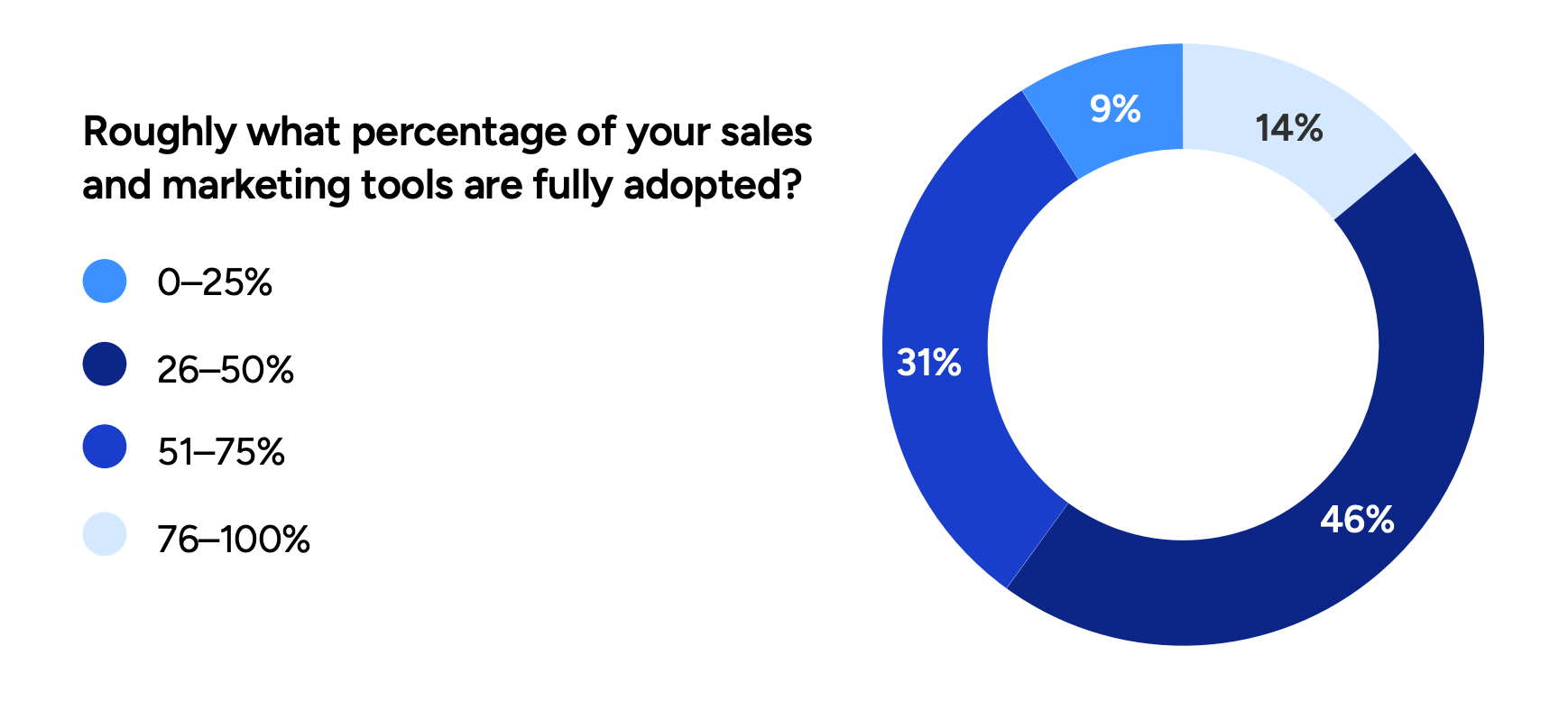
3. Leaner, More Adopted Tooling
Successful teams consolidate. They focus on a small number of tools that both departments actually use. The data is clear: teams that consolidate their tech stack are twice as likely to rate their lead quality as "excellent."
Actionable Steps: Moving the Needle Today
If you are looking to improve your GTM alignment, focus on these three operational shifts:
- Define Joint Personas: Stop letting marketing define the "ideal buyer" in a vacuum. Include sales representatives in the persona-building process so the audience definitions match the reality of the market.
- Formalize the Handoff SLA: Create a Service Level Agreement (SLA) that dictates exactly what information must be included with a lead, how quickly it must be contacted, and what happens if a lead is rejected.
- Unify Reporting Systems: Prioritize the integration of your CRM and marketing analytics platforms. When both teams look at a unified dashboard, the goals naturally begin to harmonize.
Conclusion: The Path Forward
Sales and marketing alignment is not a project with a start and end date; it is an ongoing commitment to a unified operating model. By moving past the "communication layer" and into the "operational layer," SMBs can eliminate the friction that currently stifles their growth.
The evidence is overwhelming: those who align their data, their incentives, and their processes are the ones who win. The question for your team is not whether you are meeting enough, but whether you are operating as one. For those ready to take the next step, evaluating your current tech stack and auditing your lead handoff process are the most critical starting points to transforming your GTM strategy.