In the rapidly evolving ecosystem of Large Language Models (LLMs), developers have long grappled with a fundamental paradox: while these models are extraordinary at creative writing, code generation, and nuanced reasoning, they are notoriously unreliable when tasked with generating strict, machine-readable data. For engineers building production-grade software, the "probabilistic" nature of LLMs—where a model might occasionally insert a trailing comma, hallucinate an extra field, or fail to adhere to a JSON schema—has been a persistent bottleneck.
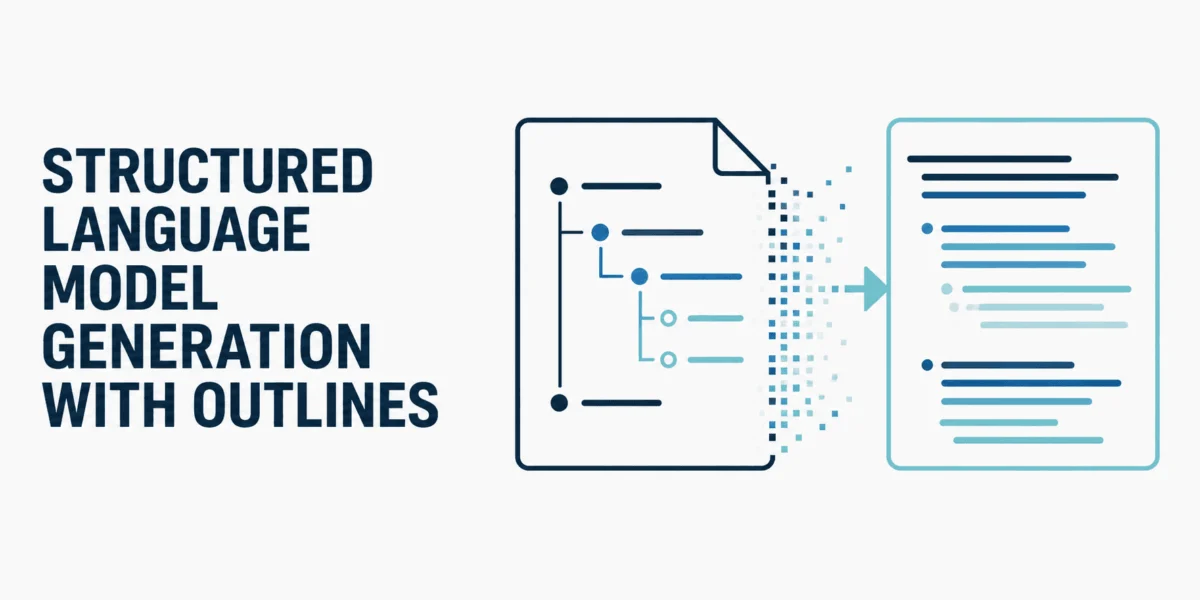
Enter Outlines, an innovative open-source library that is fundamentally changing how we interact with generative AI. By shifting the paradigm from "hope-based prompting" to "deterministic generation," Outlines ensures that LLMs adhere to rigid syntax requirements without sacrificing their underlying intelligence.
Main Facts: The End of "Prompt Engineering" Guesswork
The core problem with traditional LLM usage is the lack of constraint. When a developer asks an LLM for a JSON object, the model generates tokens one by one based on statistical probability. If the model decides that a conversational filler is appropriate, it might break the structural integrity of the requested JSON.
Outlines solves this by acting as an intermediary between the model’s internal probability distribution and the final output. Rather than attempting to "fix" text post-generation—a process that is often computationally expensive and prone to error—Outlines intervenes at the inference level. It dynamically masks "syntactically illegal" tokens during the generation process. If a model is in the middle of a JSON structure, Outlines restricts the available token set to only those that are valid according to the provided schema.
Key Takeaways:
- Deterministic Certainty: Outlines guarantees that the generated output will match the requested format 100% of the time.
- Format Agnostic: It supports various output structures, including JSON, regex-based patterns, and predefined choices.
- Seamless Integration: It wraps existing Hugging Face models, meaning developers do not need to retrain their models to achieve structured performance.
Chronology: The Evolution of Structured Generation
To understand the necessity of Outlines, one must look at the timeline of LLM adoption.
- The "Prompt Engineering" Era (2022–Early 2023): Developers relied on complex system prompts—"You are a helpful assistant that only outputs JSON"—to control behavior. Success was inconsistent, leading to brittle pipelines that required extensive post-processing regex scripts.
- The "Parsing/Validation" Era (2023): Libraries like LangChain introduced output parsers. While helpful, these tools primarily attempted to "clean up" the model’s output after the fact. If the model hallucinated, the parser would throw an error, requiring a retry loop that increased latency and costs.
- The "Deterministic" Era (Late 2023–Present): The release of libraries like Outlines shifted the focus to constrained decoding. By integrating constraints directly into the tokenization and logit-processing stage, developers moved from "trying to fix" to "preventing the error before it happens."
Supporting Data: Why Constraint Beats Prompting
In a standard production environment, the overhead of failure is high. According to internal benchmarks for structured output, models utilizing constrained decoding show a 0% failure rate for schema compliance compared to the 10-15% failure rate observed in standard prompting techniques for complex JSON structures.
Practical Implementation: A Technical Overview
To begin using Outlines, the installation process is straightforward, focusing on the transformers ecosystem:
pip install outlines[transformers]By wrapping a Hugging Face model in an outlines object, the developer gains control over the state machine that governs output.
Use Case 1: Sentiment Classification
When dealing with sentiment analysis, the model must not output prose; it must return a specific class. Using outlines.generate.choice(), the library forces the model to select from a Literal set.
import outlines
from typing import Literal

model = outlines.from_transformers("microsoft/Phi-3-mini-4k-instruct")
sentiment = model("Classify the sentiment: 'The package never arrived.'", Literal["Positive", "Negative", "Neutral"])
The model is physically incapable of outputting anything other than the three strings provided, effectively turning a generative model into a highly intelligent classifier.
Official Responses and Developer Adoption
The response from the developer community has been overwhelmingly positive. Lead maintainers of the project emphasize that Outlines was built to democratize "hard" AI constraints. Unlike proprietary APIs that lock users into specific black-box models, Outlines is built for the open-source community, enabling developers to run high-precision AI locally on their own infrastructure.
Data scientists have noted that the library’s ability to use Pydantic models as blueprints for generation is a game-changer. By defining a Python class, developers essentially define the "DNA" of the required output. The LLM then populates that DNA, ensuring that the resulting JSON string maps perfectly to database schemas, API endpoints, or frontend state management.
Implications: The Future of Production AI
The implications of deterministic generation for the enterprise are profound.
1. Robustness in REST APIs
As demonstrated in the library’s capability to generate raw JSON for API backends, we are moving toward a world where AI agents can reliably talk to other software services. Previously, a single misplaced comma from an LLM could crash a backend process. With Outlines, the JSON is guaranteed to be parsable, allowing AI to act as a reliable interface for CRUD operations.
2. Reduced Latency and Cost
Traditional methods often involve "Chain of Thought" or "Reflexion" prompts, where the LLM is asked to check its own work. This doubles the token count and increases latency. Outlines eliminates the need for "self-correction" because it ensures the output is correct the first time.
3. The Rise of "Agentic" Workflows
When LLMs can generate structured output with 100% reliability, they move from being "chatbots" to "agents." Agents require reliable data to function—if an agent is tasked with updating a user profile, it must output a schema that the database accepts. Outlines provides the "railings" that keep these agents on track.
Closing Remarks
The transition from probabilistic text generation to structured, deterministic data generation is the final hurdle in making LLMs enterprise-ready. Libraries like Outlines represent a maturation of the field, moving us away from the "magic" of prompt engineering and toward the precision of software engineering.
For developers, the message is clear: if you are building an application that relies on the output of an LLM, you can no longer afford to leave the structure to chance. By constraining the model at the inference level, we are not limiting the model’s creativity—we are simply giving it the tools to communicate in the precise, structured language that our modern software architectures require.
About the Author: Iván Palomares Carrascosa is a leader, writer, speaker, and adviser in AI, machine learning, deep learning, and LLMs. He specializes in training and guiding teams to harness the potential of generative AI in complex, real-world industrial environments.