
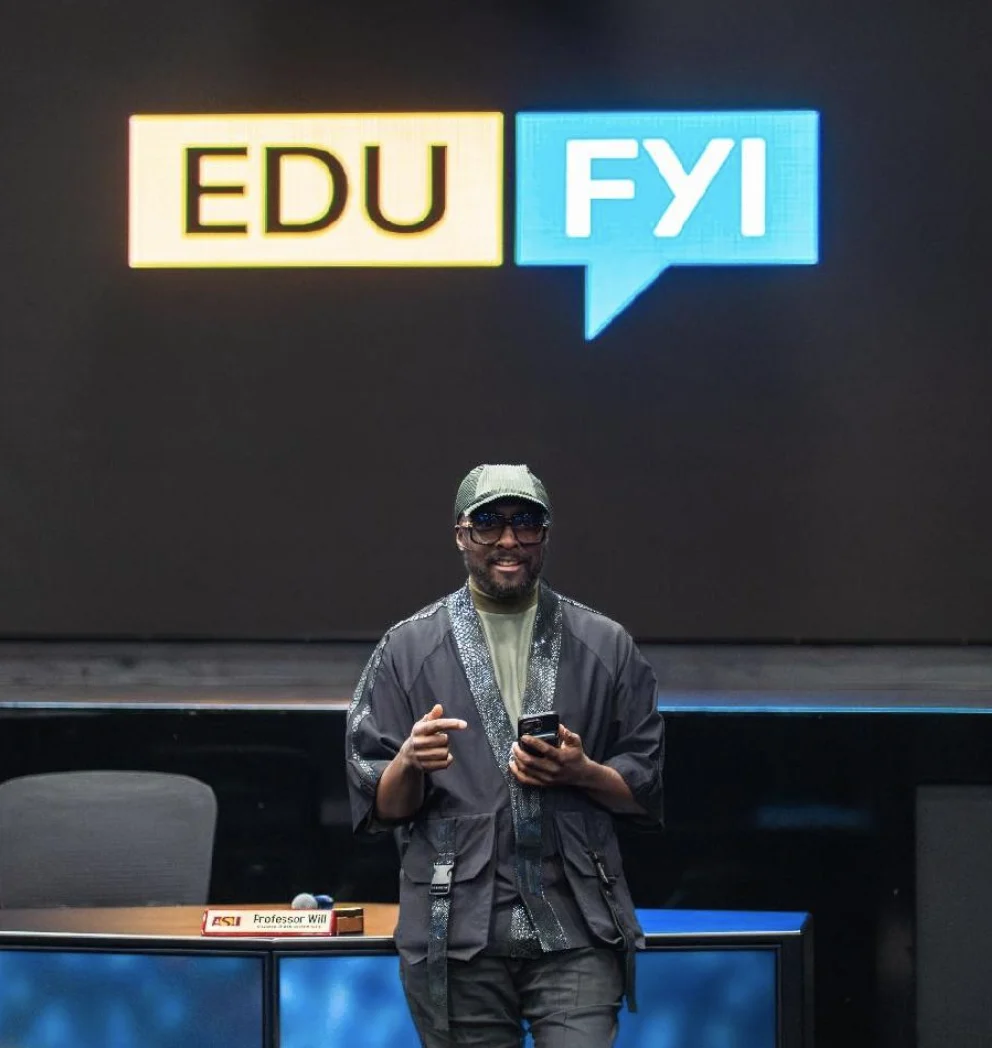
In the rapidly evolving landscape of artificial intelligence, the discourse has largely focused on efficiency, productivity metrics, and the displacement of labor. However, a new educational paradigm is emerging from an unlikely partnership between academia and the creative industry. Arizona State University (ASU), in collaboration with tech visionary and hip-hop icon will.i.am, has pioneered a course titled "The Agentic Self." This initiative is not merely about learning to prompt a machine; it is about reclaiming human agency in an era of algorithmic saturation.
For the first cohort of students, the classroom was not a traditional lecture hall. It was the FYI campus in Hollywood—a space designed by will.i.am to function as a "magical factory" for the digital age. Unlike a traditional academic setting, this environment was specifically engineered to facilitate the fusion of human curiosity and artificial intelligence.
The Genesis: A New Educational Blueprint
The concept of the "Agentic Self" is rooted in a fundamental shift: instead of viewing AI as an external tool, individuals are encouraged to treat it as an extension of their own intellectual and creative apparatus. As will.i.am noted in recent media appearances, an agentic self is defined by the ability of a person to claim their personal data and channel it into an AI agent that reflects their specific beliefs, passions, and interests.
The classroom itself—a U-shaped configuration reminiscent of United Nations chambers—was a deliberate architectural choice. By equipping every student with dedicated microphones and connectivity, the room was designed to integrate virtual guests and global perspectives into real-time dialogue. This structure highlights a critical lesson for modern leadership: the environment in which innovation occurs is just as significant as the innovation itself.
Chronology of an Idea: From Spark to Enterprise
The journey of an idea often suffers from "the valley of death"—the space between a conceptual spark and practical application. For learning innovators, this journey has been tested across four distinct digital environments, each revealing a different facet of what AI-guided mastery can achieve.
Phase 1: The Conceptual Spark (ChatGPT)
Two years ago, the initial spark was simple: Can AI transform how professionals prepare for high-stakes, difficult conversations? Using ChatGPT as a testing ground, the core logic was validated. It provided an open-ended, low-friction environment to determine if the fundamental interaction—practicing scenarios with immediate feedback—was viable.
Phase 2: The Constraint of Scale (Copilot Studio)
Moving the concept to Copilot Studio within the healthcare ecosystem of Providence St. Joseph Health introduced the reality of enterprise governance. Here, the challenge shifted from "Does it work?" to "Can it survive within the complexities of corporate strategy, security, and institutional policy?" This phase was essential for understanding the friction points that prevent AI from moving from pilot projects to full-scale deployment.
Phase 3: The Multimodal Shift (Acolyte)
Innovation requires iteration. By utilizing the Acolyte platform, the project explored the role of avatars and multimodal experiences. This allowed for a more human-centric interface, demonstrating that learning is more effective when it mirrors the nuances of human communication, moving beyond text-based prompts.
Phase 4: The Synthesis (FYI)
The final evolution occurred at the FYI campus. This environment provided a sophisticated, user-friendly platform that bridged the gap between raw AI potential and structured learning. The result was a move from a simple "skill builder" to a model of "AI-guided mastery"—a hybrid space that provides enough structure to guide the user without the stifling rigidity of traditional, static corporate training.
Supporting Data: The Workforce Readiness Gap
While the technology for AI integration is widely available, the human capacity to leverage it remains uneven. Current research indicates that while most organizations have successfully cleared the hurdle of software licensing and AI governance, they have hit a "readiness wall."
A divide has emerged:

- The Early Adopters: A small percentage of the workforce is iterating rapidly, finding new ways to integrate AI into their daily workflows.
- The Cautious Majority: A significant portion of the workforce remains hesitant, uncertain of how to apply AI responsibly or how it aligns with their professional roles.
This is not a technical failure; it is a cultural and architectural one. According to Brad Bigelow, founder of Acolyte AI, organizations are often "heavily invested in AI access while underinvesting in the structures that help people use it with confidence and purpose." Bigelow argues that the organizations that will lead in the coming decade are those that move beyond simply equipping their staff and focus on building the internal environments where exploration is a rewarded, structural necessity.
Official Perspectives and Ethical Frameworks
The leadership behind the "Agentic Self" course emphasizes a moral and ethical compass as a prerequisite for technological development. Professor Will (will.i.am) posits that AI should be used to expand human capacity rather than replace it. This philosophy is embedded in the course’s curriculum, which focuses on:
- Human-Led AI: Maintaining the user as the pilot of the AI agent.
- Curiosity as a Capability: Viewing the willingness to explore not as a "side quest," but as a fundamental professional competency.
- Best-Fit Innovation: Acknowledging that the success of a tool depends on its fit within the cultural and strategic context of the organization.
The implication for leadership is clear: the most successful AI implementations will not be those that dictate usage, but those that foster environments—psychological and physical—where employees feel safe to test, fail, and iterate.
Implications: The Future of Organizational Learning
The transition from "skilled user" to "agentic self" represents the next phase of corporate evolution. For leaders and executives, the path forward requires a shift in how they view their roles.
1. The Death of Compliance-Only Training
Compliance ensures that AI is used safely, but it does not ensure it is used effectively. To move beyond the readiness gap, learning leaders must pivot from training employees on how to follow rules to coaching them on how to explore possibilities.
2. The Power of "Best Fit"
As seen in the evolution across ChatGPT, Copilot, Acolyte, and FYI, a single idea blooms differently in different environments. Organizations must create platforms that are "scaffolded"—offering enough support to prevent the anxiety of a blank prompt, but enough freedom to allow for personalization.
3. Community and Coherence
The "Agentic Self" initiative highlights that the community one builds around innovation is as important as the code itself. By surrounding oneself with thinkers who prioritize ethical, human-first AI, leaders can ensure their organizational strategy remains coherent in a volatile market.
Conclusion: The Invitation to Explore
The lesson of the "Agentic Self" is that exploration is not a luxury afforded only to startups; it is a survival strategy for the modern enterprise. The experience of the first cohort suggests that when you provide people with the right environment, the right tools, and the right community, the distance between an idea and its manifestation closes rapidly.
For those carrying a "spark"—an idea for how AI could revolutionize a department, a workflow, or a business model—the advice is to keep moving it. Test it, expose it to different platforms, and, most importantly, place it in environments that encourage curiosity.
In a world moving at the speed of artificial intelligence, the most successful individuals and organizations will be those who refuse to be passive consumers of technology. Instead, they will be the ones who define their own agency, design their own environments, and ensure that at every step of the technological revolution, the human remains the architect of the outcome.