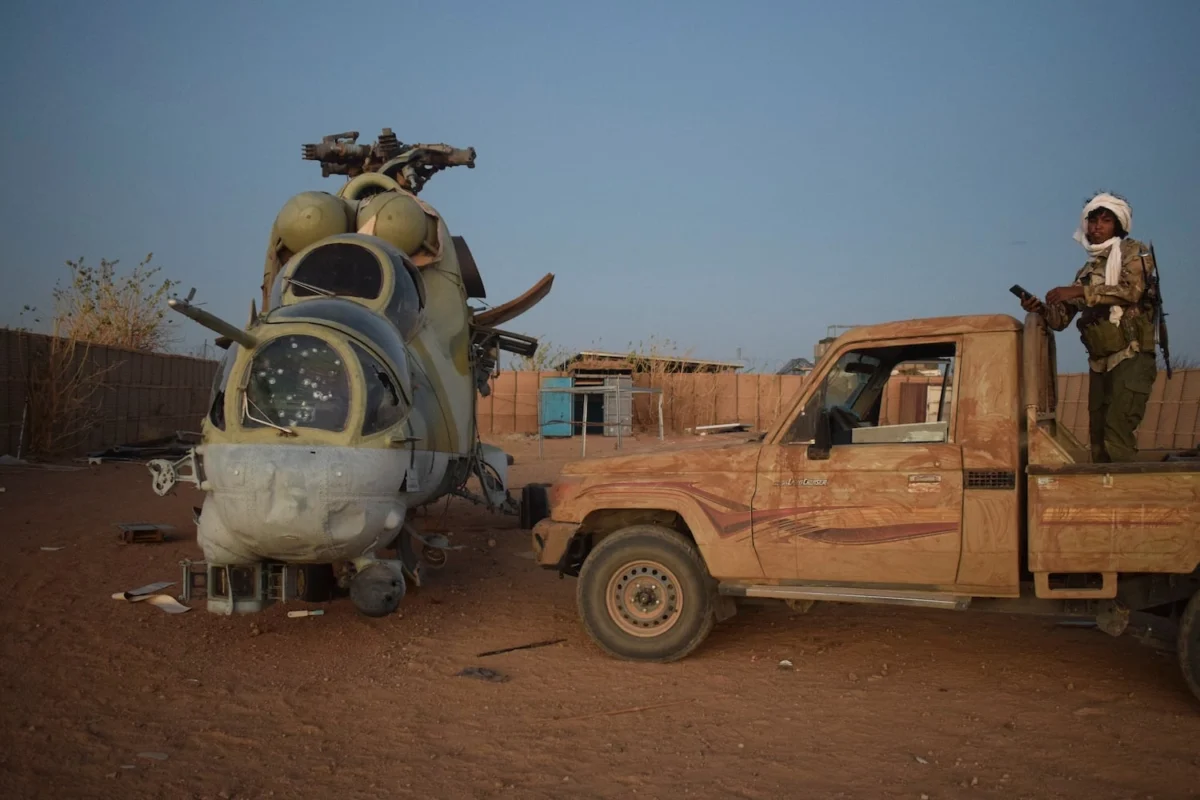
The security landscape of the Sahel underwent a seismic shift on April 25, when a wave of synchronized, high-intensity assaults struck key military installations and urban centers across Mali. The attacks, which caught the ruling junta off guard, resulted in the death of Defense Minister Sadio Camara—a figure widely regarded as the architect of the nation’s pivot away from Western security partnerships and toward the Kremlin.
This coordinated offensive, orchestrated by the al-Qaeda-affiliated Jama’at Nusrat al-Islam wal-Muslimin (JNIM) and the Tuareg-led Azawad Liberation Front (FLA), represents the most significant security crisis to hit the West African nation since the civil war erupted in 2012. The collaboration between these two historically disparate factions—one driven by jihadi ideology and the other by ethno-nationalist aspirations—marks an unprecedented tactical evolution that threatens to dismantle the fragile remnants of state authority in Bamako.
A Chronology of Strategic Miscalculation
The road to the current catastrophe was paved by a series of political and military ruptures beginning in 2020. Frustrated by systemic corruption and the failure of international counterterrorism efforts, Colonel Assimi Goïta seized power in back-to-back coups in 2020 and 2021. Seeking to consolidate power and shed the influence of former colonial master France, the junta expelled French and United Nations forces, turning instead to the Russian paramilitary entity then known as the Wagner Group—later rebranded as the Africa Corps under the direct control of the Russian Ministry of Defense.
The Rise and Fall of the Wagner Model
- 2013-2021: France’s Operation Serval and Operation Barkhane, alongside UN peacekeeping missions, fail to achieve long-term stabilization, fueling public resentment.
- 2021: The Malian junta secures power and initiates a "sovereignty" drive, inviting Russian mercenaries to replace Western forces.
- 2022: The infamous massacre at Moura occurs, where government troops and Russian contractors allegedly kill 500 civilians, intending to deter insurgent support but instead catalyzing radicalization.
- 2023: The failed Prigozhin mutiny in Russia leads to the formal absorption of Wagner into the Africa Corps.
- April 25, 2026: Coordinated attacks by JNIM and the FLA result in the death of Defense Minister Sadio Camara and the exposure of the Africa Corps’ inability to defend key territorial gains, including the previously reclaimed stronghold of Kidal.
The Mirage of Mercenary Security: Data and Reality
The promise held out by the Russian security model was one of "sovereign partnership": military support devoid of democratic benchmarks, human rights conditionality, or the "neocolonial" baggage associated with Western aid. However, empirical data suggests the experiment has been an unmitigated disaster for Malian stability.
According to research by Human Rights Watch and various regional monitoring groups, the government’s shift to a violent, kinetic counterinsurgency strategy has resulted in more civilian deaths at the hands of state-allied forces than those committed by the jihadis themselves. The "Africa Corps" model, designed primarily for regime survival and the extraction of mineral wealth, lacks the sophisticated intelligence-gathering and population-centric counterinsurgency (COIN) capabilities required to win a hearts-and-minds campaign.
Metrics of Failure
- Humanitarian Displacement: The ongoing conflict has produced one of the most acute displacement crises in Africa, with millions of civilians caught in the crossfire.
- Insurgent Expansion: Despite claims of military success, JNIM has effectively blockaded the capital, Bamako, and successfully increased its recruitment efforts by exploiting the grievances caused by the state’s indiscriminate violence.
- Intelligence Gaps: The Africa Corps has demonstrated a lack of tactical reach, frequently abandoning military positions when confronted by coordinated insurgent pressure, as seen in the recent April security fiasco.
Official Responses and Geopolitical Deflection
In the wake of the April 25 attacks, the Kremlin’s response has been one of practiced denial. Despite the death of a key ally and the clear failure of his troops to prevent the assault, Russian officials have deflected responsibility, claiming—without evidence—that the insurgents were trained by Western special forces.
This rhetorical strategy serves a dual purpose: it shields Moscow from admitting its operational failures while reinforcing the narrative that the Malian junta is under "existential threat" from the West. However, the line between the Africa Corps and the Russian state has blurred to the point of erasure. Unlike the early days of Wagner, where the Kremlin could claim "plausible deniability," the Africa Corps is a state-run entity. Consequently, its battlefield setbacks are now direct reflections of the Kremlin’s competence, which is already strained by the ongoing war in Ukraine. Moscow’s muted, defensive reaction highlights a strategic dilemma: the Sahel has become a costly prestige project that the Russian state cannot afford to abandon, yet cannot effectively stabilize.
Implications for the Sahel and Beyond
The current crisis in Mali is not an isolated event; it is the harbinger of a broader, systemic collapse across the Alliance of Sahel States (AES), which includes Burkina Faso and Niger. Like Mali, these nations are governed by military regimes that have expelled Western partners in favor of Russian security, betting their survival on the same flawed model.
1. Transnational Terrorism and the Islamic State
The vacuum left by the collapse of coherent security strategy is being filled by both JNIM and the Islamic State Sahel Province (ISSP). The recent joint attacks have provided an opening for the ISSP to escalate its own territorial grabs. There is now a legitimate, growing concern that these groups could evolve from regional insurgencies into a unified, transcontinental threat that projects violence far beyond the Sahelian borders.
2. The Migration and Humanitarian Crisis
The instability in Mali is a direct driver of mass migration. As civilian protection vanishes, the incentive for families to flee toward the Mediterranean increases, creating significant political and security pressures on European nations. The degradation of trade routes across the Gulf of Guinea further threatens the economic stability of the entire West African sub-region.
3. The "Bad Bet" on Mercenarism
Mali serves as a cautionary tale for fragile states considering the outsourcing of national security. Mercenary forces, by design, prioritize the security of the regime over the security of the state. They are not incentivized to build institutional capacity, conduct professional intelligence operations, or foster civic trust. By prioritizing regime survival, the junta has inadvertently hollowed out the state, making it more vulnerable to the very threats it sought to eliminate.
Conclusion: A Pivot Point
While the death of Sadio Camara and the April 25 attacks represent a humiliating defeat for the junta and its Russian backers, it is unlikely to lead to an immediate change in government policy. Without viable alternatives and having burned their bridges with the West, the ruling regimes in the Sahel are effectively locked into their partnership with Moscow.
However, the "facile nationalism" invoked by the junta is beginning to fray. As battlefield losses mount and the promise of security remains unfulfilled, the military hierarchy in Bamako may eventually find the cost of Russian reliance to be prohibitive. For now, the Sahel remains a theater of competing failures. The gamble on mercenaries was intended to secure the future of a regime, but it has instead accelerated the unraveling of the state. The lessons from Mali are clear: security cannot be purchased from those who treat war as a commodity, and a state that chooses to alienate its own population is a state that cannot be saved by foreign guns.