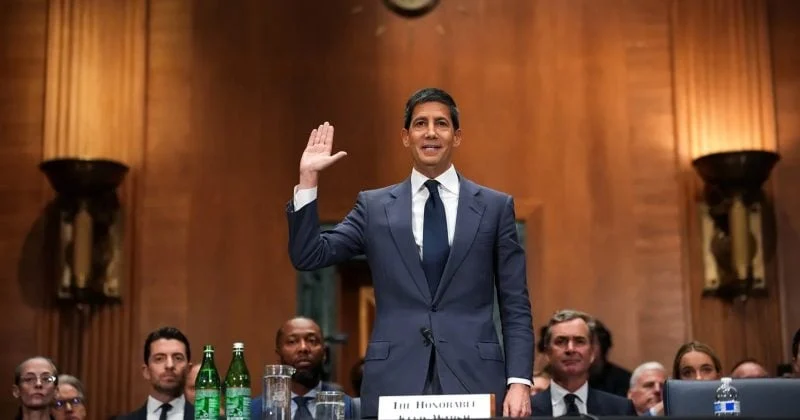
In a historic and highly contentious session, the United States Senate confirmed Kevin Warsh on Wednesday as the next Chair of the Federal Reserve. The 54-45 vote—the narrowest confirmation margin in the history of the central bank—signals a seismic shift in the leadership of the world’s most powerful financial institution. Warsh, 56, steps into the role at a pivotal moment, inheriting a mandate complicated by stubborn inflation, market volatility, and intense pressure from the White House to steer the economy toward lower interest rates.
As Jerome Powell’s tenure officially concludes this Friday, Warsh prepares to lead his first Federal Open Market Committee (FOMC) meeting on June 16–17. He assumes the position not merely as a successor, but as a vocal critic of the very "crisis-era" policies that once defined the Fed’s approach to monetary management.
Chronology: From Governor to Chairman
Kevin Warsh’s path to the chairmanship is rooted in a deep, albeit polarizing, history within the halls of the Federal Reserve. His career trajectory provides a lens through which to view his upcoming policy agenda:
- 2006–2011: Warsh served as a member of the Federal Reserve Board of Governors. His tenure coincided with the Global Financial Crisis, placing him at the center of the Fed’s initial forays into large-scale asset purchases—the precursor to modern quantitative easing.
- The Post-Crisis Pivot: Following his departure from the Fed, Warsh emerged as a prominent critic of the central bank’s bloated balance sheet. He argued that the expansion of the money supply and prolonged low-rate environments distorted market signals.
- 2024: In a high-profile interview with CNBC, Warsh publicly advocated for a "regime change" at the Federal Reserve, positioning himself as an agent of disruption.
- September 2025: The political landscape shifted as the administration prioritized personnel aligned with a more aggressive economic stance, setting the stage for Warsh’s nomination.
- Wednesday: The Senate’s 54-45 confirmation vote officially installed Warsh, with Pennsylvania Democrat John Fetterman serving as the sole cross-party vote in favor of the nominee.
Supporting Data: The Inflationary Reality Check
Warsh’s primary challenge will be reconciling the White House’s desire for loose monetary policy with the cold, hard data of a heating economy. Recent economic indicators suggest that the "soft landing" pursued by the Powell Fed remains elusive.
According to the most recent data from the Bureau of Labor Statistics, the battle against inflation has hit a significant roadblock. Producer prices in April climbed 6% year-over-year, far exceeding market expectations. Simultaneously, consumer price index (CPI) data revealed the most significant surge in three years. These figures have forced a sharp repricing in financial markets. Investors, who had previously priced in aggressive rate cuts, are now recalibrating for a "higher for longer" environment—and, in some corners of the market, bracing for the possibility of another rate hike before the year concludes.
The Federal Reserve’s mandate—to maintain price stability and maximum employment—is under siege. With inflation moving further away from the Fed’s 2% target, Warsh faces the unenviable task of tempering an overheating economy without triggering a recession, a tightrope walk that will be scrutinized by global markets from his very first day in office.
Official Responses and Political Friction
The confirmation has sparked a fierce debate regarding the independence of the Federal Reserve. President Donald Trump has made no secret of his dissatisfaction with Jerome Powell’s "tight" monetary policy, repeatedly calling for lower rates to stimulate growth. While Warsh has avoided making explicit policy commitments during his confirmation hearings, the political alignment is clear.
The Legislative Perspective
Rep. French Hill, a staunch supporter of the nomination, lauded the decision. "Kevin Warsh brings a disciplined approach to the Fed," Hill stated. "By emphasizing price stability and long-term affordability, he is prepared to restore confidence in our monetary institutions and foster an environment conducive to sustainable prosperity."
The Opposition’s Concern
Conversely, Senate Democrats have expressed deep skepticism. Many fear that the Fed’s independence, a cornerstone of American financial stability, is being compromised. Senatorial critics argue that the narrow confirmation vote is a direct reflection of public anxiety regarding the politicization of interest rate policy. The concern is that the Federal Reserve may soon prioritize short-term political goals over long-term economic health, potentially leading to runaway inflation.
The Boardroom Transition
Warsh will assume the seat previously held by Stephen Miran, a Trump adviser confirmed in late 2025. Miran was known for his frequent dissents, consistently pushing for more aggressive rate cuts than the committee was willing to provide. Warsh’s ascension to this seat effectively replaces a dissenting voice with a chairman who shares the administration’s frustration with the status quo, effectively consolidating the "pro-growth" faction within the FOMC.
Implications for the Global Economy
The transition to a Warsh-led Fed carries profound implications that extend far beyond U.S. borders.
1. Market Volatility and Investor Confidence
Financial markets thrive on predictability. Warsh’s reputation as an advocate for "regime change" implies that the predictability of the Powell era is over. Investors are now forced to factor in a higher degree of uncertainty regarding how the Fed will react to incoming data. If Warsh leans too heavily into the administration’s call for lower rates, he risks alienating the bond market and triggering a spike in yields, which would paradoxically tighten financial conditions despite his intent to ease them.
2. The Credibility Gap
The most significant risk for the incoming chair is the potential erosion of the Fed’s inflation-fighting credibility. Should the central bank bow to political pressure while inflation remains at 6%, it risks unanchoring long-term inflation expectations. This could lead to a wage-price spiral, making the ultimate task of curbing inflation far more painful and costly in the long run.
3. Structural Shifts in Monetary Policy
Warsh’s past writings and public statements suggest a skepticism toward the "central planning" aspects of the modern Fed. We may see a push for a more rules-based approach to monetary policy, moving away from the discretionary, data-dependent maneuvering that has characterized the last decade. While this might be welcomed by some economists, it could lead to abrupt shifts in policy that catch markets off guard.
4. The June FOMC Test
All eyes are now fixed on the June 16–17 FOMC meeting. It will be the first opportunity for the committee to coalesce around a new strategy. Will Warsh advocate for a pause to assess the inflationary data, or will he seek to appease the White House by pushing for a rate cut despite the data suggesting otherwise? The answer to this question will define the initial phase of his chairmanship and set the tone for the remainder of the decade.
Conclusion: A High-Stakes Appointment
The confirmation of Kevin Warsh is a watershed moment in the history of the Federal Reserve. By installing a figure who has openly criticized the central bank’s past trajectory, the Senate has signaled a desire for change. However, the economic reality remains as stubborn as ever. Inflation is rising, market sentiment is fragile, and the global economy is increasingly sensitive to the whims of U.S. monetary policy.
Warsh’s challenge is twofold: he must navigate the immediate, treacherous waters of persistent inflation, and he must do so while asserting the independence of his institution against a White House that is increasingly eager to influence its outcomes. Whether Warsh can successfully manage these competing pressures—or whether his tenure will be marked by the very volatility he once criticized—remains the central question of the American economic narrative for 2025 and beyond. As he prepares to take the helm this Friday, the world is watching, waiting to see if the new chair can restore the "disciplined policy" he has long advocated, or if the political pressures of the present will force a different, more turbulent path.