
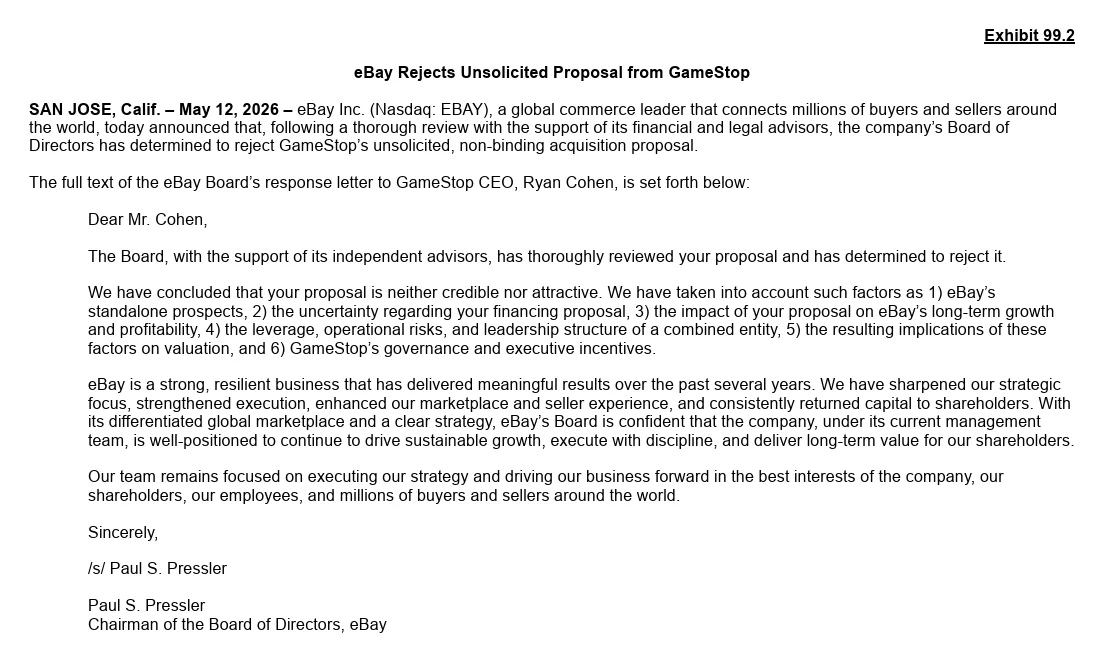
In a move that has sent shockwaves through the retail and e-commerce sectors, eBay’s board of directors formally rejected an unsolicited $56 billion acquisition proposal from GameStop on May 12, 2026. The rejection, delivered with blunt finality, characterized the bid as "neither credible nor attractive," effectively shutting down what many on Wall Street had already dismissed as a delusional attempt by GameStop CEO Ryan Cohen to fundamentally restructure the landscape of modern retail.
The proposal, which had been public for just over a week, sought to marry GameStop’s legacy brick-and-mortar footprint with eBay’s digital marketplace infrastructure. Cohen’s vision—framed as a high-stakes play to dethrone Amazon—was met with immediate skepticism, deep-seated financial concerns, and ultimately, a formal rebuke from the eBay board that leaves the future of the deal, and perhaps Cohen’s tenure, in a precarious position.
Chronology of an Unlikely Bid
The saga began on May 3, 2026, when GameStop unveiled a nonbinding offer to acquire eBay for $125 per share. The proposal was structured as a 50/50 split of cash and GameStop common stock. At the time of the announcement, the valuation discrepancy was glaring: eBay, a behemoth of the e-commerce world, commanded a market capitalization of over $48 billion, while GameStop—a retailer struggling to pivot away from its reliance on physical video game sales—was valued at roughly $10.3 billion.
Following the announcement, Ryan Cohen engaged in a high-profile media tour, most notably appearing on CNBC’s Squawk Box. However, the appearance proved to be a public relations liability. Rather than assuaging investor fears regarding the massive valuation gap and the complexities of the debt-heavy financing structure, Cohen offered vague platitudes and directed viewers to the company’s website. Analysts noted that the lack of concrete operational details during the interview served only to deepen the divide between the market’s perception of the deal and Cohen’s ambitious rhetoric.
By May 12, the eBay board, led by chairman Paul Pressler, had concluded its review of the proposal. In a decisive SEC filing, the board rejected the overture entirely, citing six specific areas of strategic and financial risk.
The Financial Architecture: A House of Cards?
The structural integrity of GameStop’s offer was perhaps its greatest weakness. To fund the $56 billion purchase, Cohen relied on a $20 billion debt commitment from TD Securities, supplemented by the $9.4 billion in cash currently sitting on GameStop’s balance sheet.
However, the fine print of the TD Securities financing letter acted as a catalyst for the deal’s collapse. The commitment was contingent upon the combined entity maintaining an investment-grade credit profile. Financial analysts and credit agencies, including Moody’s Ratings, were quick to point out that the sheer volume of leverage required to execute the merger would inevitably trigger a downgrade. Moody’s explicitly labeled the proposal "credit negative" for eBay, noting that the increased debt burden would cripple the company’s ability to reinvest in its marketplace.

The market’s reaction was swift and unforgiving. Renowned investor Michael Burry, who had previously held a position in GameStop, famously liquidated his entire stake upon the announcement. In a scathing critique, Burry highlighted that the leverage ratio—projected to reach 7.7 times debt-to-EBITDA—would place the company in a "distressed" category, rendering the merger mathematically incompatible with sound corporate strategy.
Official Responses and Strategic Rationale
In his letter to Cohen, Paul Pressler emphasized that the board’s decision was rooted in the strength of eBay’s "standalone prospects." Pressler’s correspondence painted a picture of a company that has successfully navigated the post-pandemic retail environment by sharpening its focus on high-value categories, such as luxury collectibles and specialized authentication services.
"eBay is a strong, resilient business that has delivered meaningful results over the past several years," Pressler wrote. "We have sharpened our strategic focus, strengthened execution, enhanced our marketplace and seller experience, and consistently returned capital to shareholders."
The board’s rejection was not merely a matter of price, but a fundamental disagreement on business models. eBay operates as a lean, inventory-free platform that facilitates peer-to-peer and business-to-consumer transactions. GameStop, conversely, is a traditional retailer that manages massive inventory levels across a declining network of physical stores. The board clearly viewed the integration of these two disparate operational models as a strategic regression rather than an evolution.
Cohen’s Vision vs. Market Reality
Ryan Cohen’s pitch centered on the concept of "synergy." He argued that by leveraging GameStop’s 1,600 domestic locations, the combined entity could solve the "last mile" problem of e-commerce, using stores as local hubs for authentication and order fulfillment. He further promised to extract $2 billion in annual cost savings within the first 12 months post-closing—a figure that many analysts found optimistic at best and impossible at worst, given the overhead costs of physical retail.
Perhaps most controversial was Cohen’s personal commitment to the deal. He offered to lead the merged entity as CEO without a salary or cash bonus, tying his compensation entirely to the performance of the company stock. While this was intended to signal confidence, it was interpreted by institutional investors as a reckless "all-in" gamble that prioritized ego over corporate governance and shareholder stability.
The Broader Implications
The rejection of this bid carries significant weight for both companies and the wider retail sector.

For eBay
The board has reaffirmed its commitment to its current trajectory—a strategy defined by its 2024 partnership with Goldin Auctions and a pivot toward becoming the premier destination for high-end collectibles. By walking away, eBay has signaled to the market that it is not interested in being "fixed" by an outside entity, especially one with a smaller market cap and a vastly different operational philosophy.
For GameStop
The failed bid leaves the company at a critical crossroads. With the stock falling 4% following the rejection and the debt-financing plan exposed as potentially ruinous, Cohen faces an existential crisis. The failure to secure a marquee acquisition leaves the company with few levers to pull in its effort to escape the long-term decline of physical video game retail.
The Specter of a Hostile Takeover
Despite the board’s firm rejection, Cohen has not officially withdrawn the proposal. He has hinted at the possibility of taking the offer directly to eBay shareholders. Such a move would necessitate a proxy battle—a costly and distracting endeavor that would likely be met with fierce opposition from eBay’s institutional shareholders, who have already seen their stock price rise on the promise of the company’s independent turnaround plan.
Conclusion: A Lesson in Corporate Hubris
The attempted takeover of eBay by GameStop will likely be studied as a case study in corporate hubris and the dangers of misaligning ambition with financial reality. While Cohen’s desire to challenge the hegemony of Amazon is a goal shared by many in the retail sector, the mechanics of this particular proposal failed to convince those with the most to lose.
As of May 2026, the silence from GameStop regarding its next steps is deafening. Whether Cohen chooses to double down on a hostile proxy campaign or retreats to reassess the company’s internal strategy, the events of the past two weeks have made one thing clear: the retail market is not in the mood for high-risk, debt-fueled consolidation. For now, eBay remains independent, and GameStop remains a company searching for its identity in a world that has largely moved past the retail model it once defined.