In the traditional corporate architecture, workforce planning was a seasonal ritual—a rigid, spreadsheet-heavy exercise conducted once a year to satisfy the constraints of the annual budget. Finance teams would calculate the "cost of bodies," track headcount against arbitrary caps, and revisit these figures only when payroll expenses drifted dangerously far from target.
Today, that paradigm has been dismantled. In an era defined by economic volatility, rapid technological shifts, and a pervasive talent war, the way an organization manages its human capital has evolved from a back-office administrative task into a core strategic capability. Labor, which often accounts for 40% to 70% of an organization’s operating expenses, is no longer just a cost to be controlled; it is the primary driver of revenue, growth, and operational agility.
The Evolution of Workforce Management: From Budgeting to Strategy
Historically, headcount planning was a subset of finance, defined by a narrow focus on payroll expenditures. It was a reactive, static process that treated employees as line items on a balance sheet. The objective was simple: keep costs low and occupancy within budget.
However, the modern business landscape—characterized by what researchers at BARC call "volatile markets"—has rendered these static assumptions obsolete. Organizations are now facing a complex environment where economic fluctuations, geopolitical instability, and shifting consumer behaviors demand constant, real-time adjustments. Consequently, forward-thinking FP&A (Financial Planning & Analysis) teams are shifting their focus. They are moving away from simple headcount tracking and toward "workforce planning"—a dynamic discipline that treats labor as a strategic lever.
This evolution is reflected in the design of Corporate Performance Management (CPM) implementations. Modern models are no longer generic spreadsheets; they are highly customized, interconnected ecosystems that map talent mix, skills, and productivity directly against revenue targets and growth strategies.
Headcount vs. Workforce Planning: Defining the Divide
To understand this shift, one must first distinguish between the legacy approach of "headcount planning" and the contemporary methodology of "workforce planning."
The Legacy Model: Headcount Planning
Headcount planning is inherently finance-driven and cost-centric. Its primary mission is to answer basic questions:
- What is the total number of employees?
- What is the aggregate cost of salary, benefits, and taxes?
- Are we within our allocated budget for the quarter?
This approach is often siloed, housed within HR platforms or isolated finance spreadsheets. While necessary for compliance and basic fiscal governance, it provides zero insight into the value of the work being performed. It treats a software engineer the same way it treats a customer service representative—as a unit of cost rather than a driver of capacity.
The Modern Paradigm: Workforce Planning
Conversely, workforce planning is a multi-dimensional capability that incorporates capacity, skill-sets, and alignment with organizational goals. It asks more sophisticated questions:
- Do we have the right mix of skills to meet our Q4 product roadmap?
- How does our hiring velocity correlate with our projected revenue growth?
- What is the impact of attrition on our project delivery timelines?
- Can we shift labor resources to higher-margin business units?
For example, a professional services firm utilizing advanced workforce planning can model the impact of staff proximity to clients. By analyzing travel costs and non-billable hours, they can optimize their staffing strategy to improve utilization rates, directly impacting the bottom line. This level of granularity is impossible under the old headcount-only regime.
Supporting Data: The Volatility Factor
The urgency of this transition is backed by compelling data. According to research from BARC, over 70% of organizations report that external factors—economic, geopolitical, and behavioral—are having a disruptive impact on their strategic operations. When external variables are in constant flux, a static annual budget is a liability.
The U.S. Bureau of Labor Statistics notes that wages and salaries represent over 70% of total employer compensation costs. In many sectors, this makes labor the single most significant financial variable. When labor is the dominant cost, even minor miscalculations in hiring velocity, attrition rates, or compensation adjustments can cascade into massive shortfalls in profitability and cash flow.
In a volatile market, the ability to model these outcomes is not just an advantage; it is a survival mechanism.
The Maturity Divide: Leaders vs. Laggards
A critical finding from The Planning Survey 25 by BARC highlights a widening chasm between high-performing organizations and their lagging counterparts. This divide is defined by the maturity of their planning processes.
The Power of Simulation
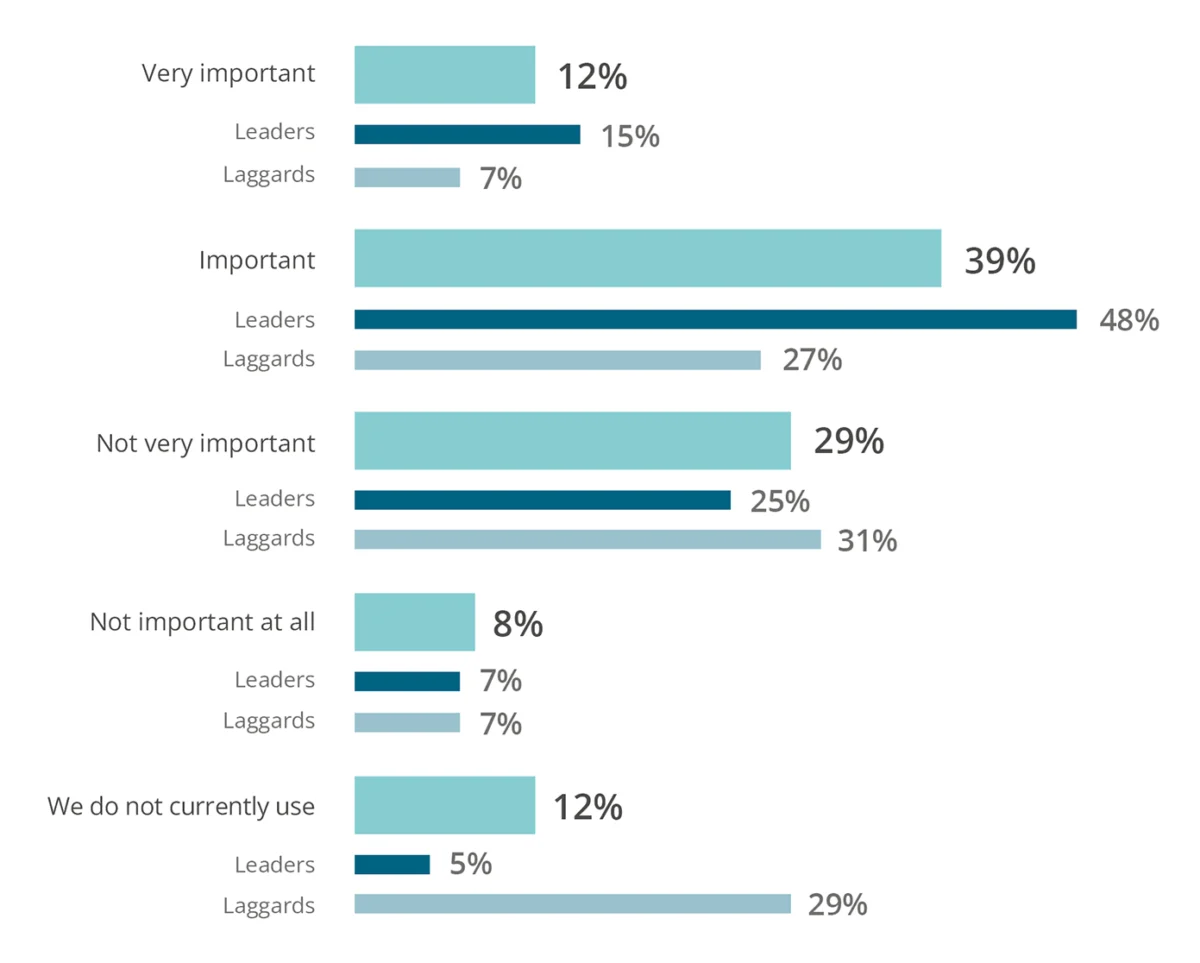
While 51% of organizations claim to use simulations and scenario analyses in their general planning, the intensity of this usage tells a different story. Among the top 10% of organizations—defined as "Leaders"—63% view scenario planning as an essential, non-negotiable component of their decision-making process.
Conversely, 67% of "Laggards" either ignore scenario planning or treat it as an occasional afterthought. This lack of foresight often manifests in:
- Delayed reactions to market shifts: Laggards continue to operate on stale data while Leaders have already pivoted.
- Resource misallocation: Laggards struggle to identify which segments of their workforce are under-performing or under-utilized.
- Operational fragility: When a crisis hits, Laggards are forced into reactive, often panicked, layoffs or hiring freezes, whereas Leaders have already modeled the contingency scenarios.
The Implications of the Gap
This divergence in methodology creates a compounding effect. Leaders are more likely to integrate operational drivers—such as unit-level productivity metrics and skill-based capacity—directly into their financial models. They use data as a strategic asset, effectively bridging the gap between the boardroom and the front-line.
Official Perspectives and Industry Trends
Industry experts increasingly agree that the integration of financial and operational planning is the hallmark of the next generation of finance leaders. The CPM Trend Monitor 2026 confirms this trajectory, placing integrated, data-driven planning at the top of the agenda for modern finance teams.
The move toward integrated planning is not merely a technological upgrade; it is a cultural shift. It requires finance teams to move out of their ivory towers and engage with department heads, HR managers, and operational leads. It requires a unified language where "headcount" is replaced by "talent capacity," and "budgeting" is replaced by "strategic resource allocation."
Strategic Implications for the Future
As organizations look toward the remainder of the decade, the implications of this shift are clear:
- Talent as a Strategic Asset: The "cost-control" mindset must be replaced by a "value-creation" mindset. Every hiring decision should be viewed through the lens of its projected ROI.
- Continuous Planning: The annual budget is dead. Modern organizations must adopt continuous, rolling forecasts that allow for real-time adjustments based on market conditions.
- Technological Integration: Organizations must invest in CPM platforms that allow for the seamless flow of data between HR, Finance, and Operations. Siloed systems are the primary enemy of agility.
- Skills-Based Modeling: Future planning must account for the rapidly changing nature of work. As AI and automation reshape roles, workforce planning must focus on skill availability and re-skilling capabilities rather than just total headcount.
Conclusion
The evolution from workforce planning as a budgeting exercise to a strategic capability is one of the most significant shifts in corporate management today. In a world where labor costs define the majority of the P&L and market volatility is the new normal, organizations can no longer afford to treat their people as a static cost center.
The data is unequivocal: the Leaders of the future are those who have successfully integrated their workforce strategy with their financial and operational realities. By embracing dynamic, scenario-based planning, these organizations are not just surviving in volatile markets—they are using their human capital as a definitive competitive differentiator. For the Laggards, the choice is clear: modernize the workforce planning function or risk being outpaced by the agility of the competition. The era of the spreadsheet budget is over; the era of strategic workforce intelligence has begun.