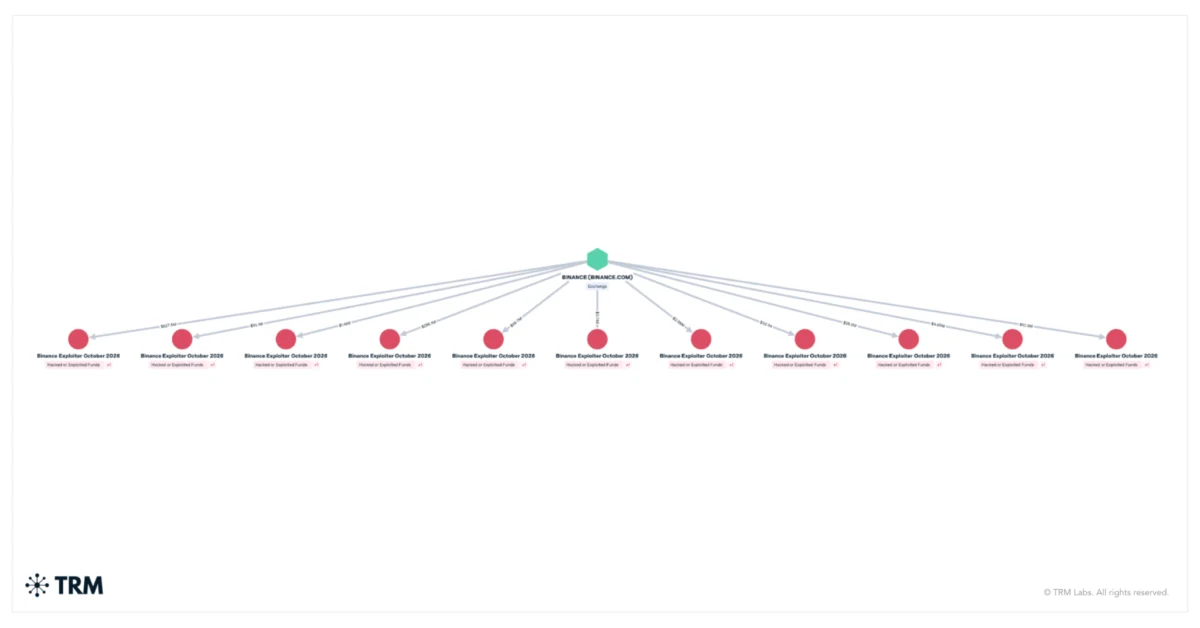
In a watershed moment for the digital asset industry, global cryptocurrency exchange Binance has fallen victim to a catastrophic security breach, resulting in the theft of approximately $6.3 billion in assets. Occurring on October 29, 2026, the incident has been formally attributed by leading blockchain intelligence firms to the Lazarus Group, a state-sponsored hacking collective operating out of North Korea. This breach stands as the largest single crypto theft in history, dwarfing previous exploits and sending shockwaves through the decentralized finance (DeFi) ecosystem.
The Breach: A Coordinated Multi-Chain Assault
The sheer scale and sophistication of the Binance hack suggest a long-term, meticulously planned operation. According to data provided by TRM Labs, the attackers executed a lightning-fast drain of Binance’s hot wallets across 10 distinct blockchains within a 20-minute window.
The technical methodology utilized by the perpetrators—identified as the "TraderTraitor" unit—involved the exploitation of Ethereum’s EIP-7702 standard. By turning a compromised Binance wallet into a controlled "sweeper" contract, the attackers were able to systematically drain funds with ruthless efficiency. Investigators noted that the hackers had prepared 50 pre-signed authorizations in advance, allowing them to bypass typical security protocols and move assets across multiple chains simultaneously.

Chronology of the Attack and Immediate Aftermath
The events of October 29 unfolded with terrifying speed, leaving the global security community scrambling to react.
- T-Minus 0 (The Initial Breach): At approximately the time of the initial unauthorized access, the attackers gained administrative control over key hot wallet parameters.
- 0–20 Minutes (The Execution): Over the next 20 minutes, an estimated $6.3 billion was siphoned across Bitcoin, Ethereum, Tron, and various Layer-2 networks. The precision of the timing suggests an automated script or a highly synchronized team.
- Post-Hack (The Containment Phase): As soon as the anomaly was detected, Binance initiated emergency protocols. Working alongside major stablecoin issuers such as Tether and Circle, as well as analytics firms like Chainalysis, the exchange managed to freeze approximately $3 billion in assets before they could be laundered through decentralized mixers.
- The Laundering Attempts: Within hours, on-chain observers, including the prominent investigator ZachXBT, identified the attackers moving large quantities of Ethereum to laundering services like Tornado Cash.
Supporting Data: The Fingerprints of North Korea
The attribution of the hack to North Korea’s Lazarus Group—specifically the TraderTraitor unit—is supported by a growing body of forensic evidence. Blockchain intelligence firms, including Chainalysis and TRM Labs, have identified clear patterns linking this heist to previous high-profile attacks.
Commingling of Funds
A critical piece of evidence surfaced when analysts discovered that funds stolen from the Binance hack were being commingled with assets derived from the $388 million Bitget exploit that occurred just one month prior. This overlap in wallet addresses and movement patterns provides a "digital signature" that points directly to the same threat actors.

Proven Track Record
TraderTraitor has become synonymous with large-scale institutional theft. Their previous successes include:
- The 2025 Bybit Hack: A $1.5 billion heist that utilized similar multi-chain obfuscation techniques.
- The April 2026 KelpDAO Exploit: A precision strike that netted significant capital and served as a testbed for the tools used in the Binance operation.
Chainalysis CEO Jonathan Levin remarked on the high degree of confidence regarding the attribution, stating, "We live in unprecedented times. But the DPRK are up to their old tricks."
Official Responses and Industry Collaboration
The response to the Binance hack has been defined by unprecedented cross-industry cooperation. In the hours following the breach, the crypto industry demonstrated a unified front that was notably absent during earlier, smaller-scale attacks.

Binance’s Stance
Binance has remained transparent throughout the investigation, working closely with international law enforcement agencies. The exchange has confirmed that it is conducting a comprehensive audit of its infrastructure to identify the initial point of compromise. The exchange has also pledged to compensate affected users, though the sheer magnitude of the loss presents an existential challenge for the platform’s reserves.
The Role of Stablecoin Issuers
The rapid intervention of stablecoin issuers proved to be the most effective deterrent against the hackers. By freezing $2.8 billion in assets within the first 24 hours, companies like Tether and Circle effectively rendered a significant portion of the stolen haul useless to the attackers, forcing them to rely on more volatile, harder-to-launder assets.
Broader Implications for the Crypto Ecosystem
The $6.3 billion breach serves as a stark reminder of the inherent vulnerabilities within centralized exchanges (CEXs). While the industry has made significant strides in security, the potential for catastrophic failure remains high when attackers are backed by the resources of a nation-state.

The Regulatory Fallout
This event is expected to trigger a wave of new regulatory scrutiny regarding the security standards of centralized exchanges. Regulators in the United States, Europe, and Asia are likely to demand more rigorous "Proof of Security" audits and stricter guidelines for hot wallet management. The incident may also accelerate the transition toward decentralized custody solutions, where the risk of a single point of failure is mitigated by user-controlled keys and multi-signature requirements.
The Evolution of State-Sponsored Cyber Warfare
The involvement of the DPRK in such a massive financial attack underscores a shift in how geopolitical conflicts are waged. For North Korea, these hacks are not merely criminal enterprises; they are vital revenue streams used to circumvent international sanctions and fund state projects. The professionalization of these hacking units, as seen in the sophisticated use of EIP-7702 and pre-signed authorizations, suggests that these actors are continuously evolving their offensive capabilities.
Future Security Trends
The incident has ignited a debate over the necessity of "Circuit Breakers" in crypto exchanges. Many experts argue that in the event of an unusual outflow of assets exceeding a certain threshold, exchanges should have automated, protocol-level halts that require human intervention. Additionally, the industry is moving toward a model of "Intelligence-Sharing 2.0," where firms like Chainalysis and TRM Labs provide real-time, automated alerts to exchanges to prevent funds from moving between platforms.

Conclusion: A Turning Point
The Binance hack of 2026 will undoubtedly be remembered as the moment the cryptocurrency industry grew up. While the financial loss is staggering, the industry’s ability to freeze nearly half of the stolen funds in record time demonstrates a maturation of defensive infrastructure. However, the success of the Lazarus Group in executing such a massive theft remains a sobering reality check.
As the investigation continues, the crypto community remains on high alert. The ongoing tracking of the remaining stolen funds serves as a testament to the transparency of blockchain technology—a tool that, in this instance, is proving to be as much of a hindrance to the criminals as it is a target for their greed. For now, the global financial community watches with bated breath, waiting to see if the world’s most prolific hacking group can be brought to justice, or if they will successfully evade the reach of international law once again.
The digital age has entered a new chapter of financial security, one where the battle lines are drawn not between competing institutions, but between the promise of decentralized innovation and the shadows of state-sponsored cyber exploitation.