A few years ago, a mid-sized corporation invested a significant portion of its annual budget into a comprehensive senior leadership development program. The curriculum was robust, the facilitators were industry leaders, and the participants—all seasoned executives—were engaged. By the end of the year, the feedback was glowing. The leaders had mastered new frameworks, adopted a common vocabulary, and left the sessions with palpable enthusiasm.
However, as the dust settled, the company’s CEO posed a blunt, unsettling question: "We invested heavily in this. Everyone loved the program. So, why are we not seeing any actual change in how we operate?"
That question, simple as it was, strikes at the heart of a multi-billion-dollar industry. Across the global corporate landscape, Learning and Development (L&D) programs frequently succeed in delivering knowledge, yet they often fail to manifest behavioral change. When this gap occurs, the corporate instinct is almost always to double down: more workshops, more frameworks, more executive coaching.
But before prescribing more training, organizations must perform a diagnostic shift. The failure to change behavior is rarely a result of a lack of knowledge; it is almost always a result of a failure to navigate the friction between classroom theory and workplace reality.
1. The Knowledge Gap vs. The Behavior Gap
To understand why leadership programs often underperform, we must first categorize the barriers preventing change. It is tempting to assume that if a leader isn’t delegating effectively, they simply don’t know how to delegate. In some cases—particularly with newly promoted managers—this is true. They may lack the technical proficiency in running performance conversations or giving feedback. In these instances, traditional training is the correct remedy.
However, the problem arises when we treat every behavioral deficit as a knowledge deficit. Consider the senior leader who excels in a delegation workshop. She can outline the four steps of delegation—clarifying outcomes, establishing decision rights, setting checkpoints, and providing autonomy—with academic precision. Yet, when a critical client project hits a rough patch and the deadline looms, she immediately reverts to micromanagement. She rewrites the team’s work and takes over the client calls.
She hasn’t forgotten the workshop; she has been hijacked by a high-stakes, high-pressure reality where her reputation and the company’s revenue are on the line. The issue here is not a lack of skill, but a failure to access that skill when the pressure is at its peak.
2. When Pressure Trumps Performance: The Psychology of Stagnation
The most significant oversight in contemporary leadership development is the failure to account for what happens when a leader leaves the training room. Knowledge is static; behavior is dynamic.
When a leader returns to the office, they are not operating in a vacuum. They are operating in an environment of hierarchy, political uncertainty, and intense performance pressure. A leader may intellectually believe in empowerment, but they may "tighten the grip" the moment the consequences of a potential mistake feel significant. Another may know how to deliver candid feedback, but will habitually soften the message to avoid bruising a relationship with a high-value peer.
In these moments, the barrier to change is often internal:
- Competing Commitments: The desire to be a "collaborative leader" battles with the deep-seated fear of being seen as "weak" or "out of control."
- Identity Anchors: The leader who has spent 20 years succeeding by being the "smartest person in the room" will struggle to transition to a coach, as their identity is inextricably linked to their expertise.
- The Weight of Hierarchy: Speaking truth to power is simple in a simulation but terrifying in a boardroom where political capital is at risk.
If we diagnose these issues as a "knowledge gap" and send the leader back to a workshop, we waste time and resources. The critical question for L&D departments should not be "Does the leader know what to do?" but rather "What happens when doing it becomes difficult?"
3. The Need for High-Fidelity Practice
"Practice" is a term frequently used in L&D, yet its application is often shallow. Role-playing and case studies are safe, sterile environments. While they help build foundational comfort, they rarely replicate the adrenaline or the stakes of real-world leadership.
For a behavior to stick, practice must be high-fidelity. If the goal is to teach a leader to speak candidly upward, the practice must involve actual, real-world hierarchies. If the goal is to teach decision-making under uncertainty, the practice must be done with incomplete information and real, tangible consequences.
Application cannot be an afterthought that occurs after the program concludes. It must be woven into the development process. A model of "Try-Reflect-Adjust" is essential. When a leader attempts a new behavior in the real world, sees the outcome, receives feedback, and then iterates, they are not just learning; they are forging new neural pathways. This is how insight translates into lasting behavior.
4. The Systemic Trap: Rewarding Old Habits
Perhaps the most uncomfortable truth for any organization is that the system itself may be actively preventing change. Organizations often suffer from a "dual-message" problem. They mandate collaboration and cross-functional agility while keeping individual business units siloed with separate, competitive P&L statements.
Leaders are told to "take risks" and "empower their teams," yet when a risk results in a failure, the organization’s immediate reaction is to conduct a post-mortem that assigns blame and demands tighter control. When a leadership program advocates for transparency but the corporate culture rewards those who hoard information, the culture will win every time.
Behavior change, therefore, cannot be the sole responsibility of the L&D department. It is a systemic issue. Before launching a program, leadership must ask:
- Does our performance management system reward the behaviors we are teaching?
- What happens to the leader who takes a reasonable risk and fails?
- Does the organizational structure incentivize the very silos we are trying to break down?
If the environment on Monday morning makes the new behavior "risky" and the old behavior "safe," the program will fail regardless of how brilliant the curriculum is.
5. Measuring Impact: Beyond Satisfaction Surveys
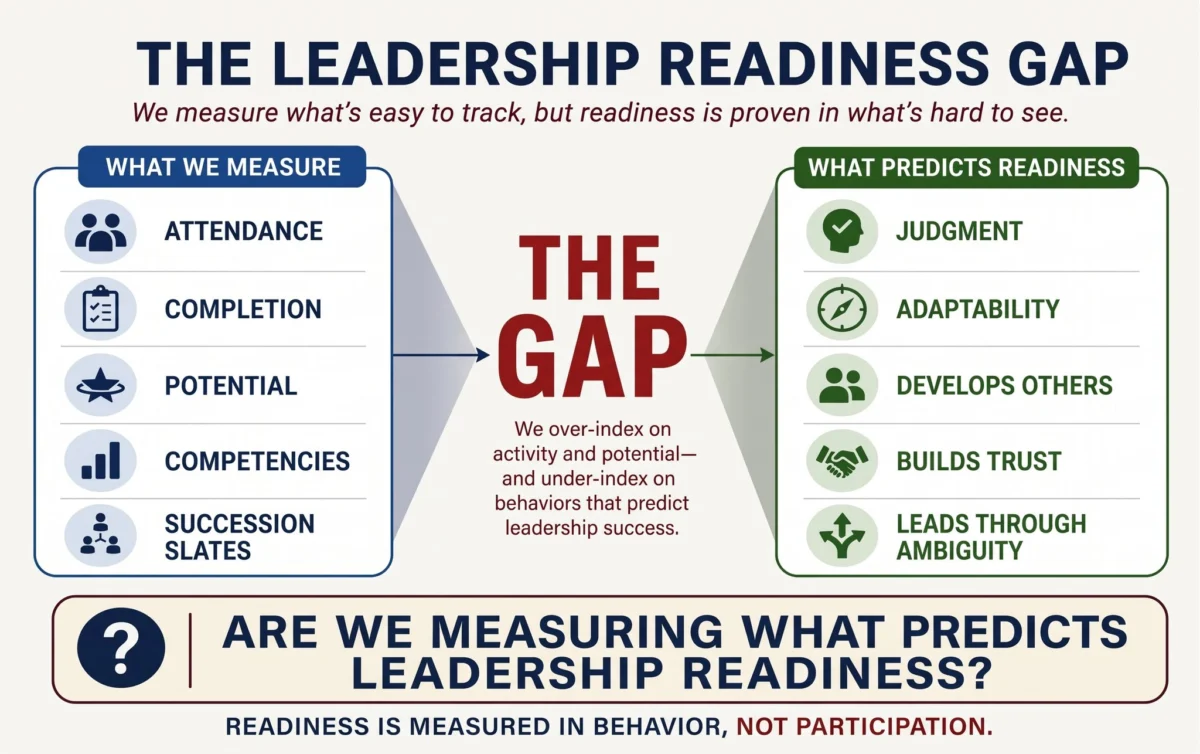
The industry standard for measuring L&D success has long been the "smile sheet"—the post-program survey asking if the participants enjoyed the experience and felt they learned something. While satisfaction is important, it is not a metric for behavioral change.
To accurately measure the ROI of leadership development, organizations must shift their focus to observable outcomes:
- Are difficult conversations happening earlier?
- Are managers escalating fewer trivial issues to their own superiors?
- Are team members demonstrating higher autonomy?
- Are leaders spending more time on strategic delegation rather than tactical execution?
These metrics should be defined before the program begins, not after. Furthermore, the feedback loop should move beyond the participant. Six months after a program, the most accurate data will come from those closest to the work: the leader’s direct reports, their peers, and their own managers. If the people who observe the leader daily don’t see a change, then no learning has occurred.
Implications for Future Development
Returning to the CEO who asked why their investment yielded no change: the subsequent analysis revealed that the program hadn’t "failed" in a traditional sense. The leaders had indeed absorbed the frameworks. However, the organization had neglected two critical areas:
- Contextual Practice: The leaders were never given the space to practice the new skills in the presence of their actual work pressures.
- Systemic Alignment: The organization continued to incentivize siloed behavior, meaning that applying the new skills would have actually made the leaders’ jobs harder within their specific business units.
The lesson for the future of executive development is clear: Diagnose before you develop. Every leadership challenge is not a training problem. Some are cultural, some are structural, and some are psychological.
For talent leaders, the roadmap is simple but demanding. Stop treating leadership development as a discrete event that happens in a classroom. Start treating it as a process that integrates with the daily flow of work. Ask what is getting in the way of the behavior, provide the right scaffolding for when the stakes get high, and ensure that the organization rewards the change it claims to desire.
The evidence of a successful program is not that a leader can recite a framework; it is that something becomes possible in the workplace that was not possible before. If the workplace does not change, the investment was not in leadership—it was merely in education.