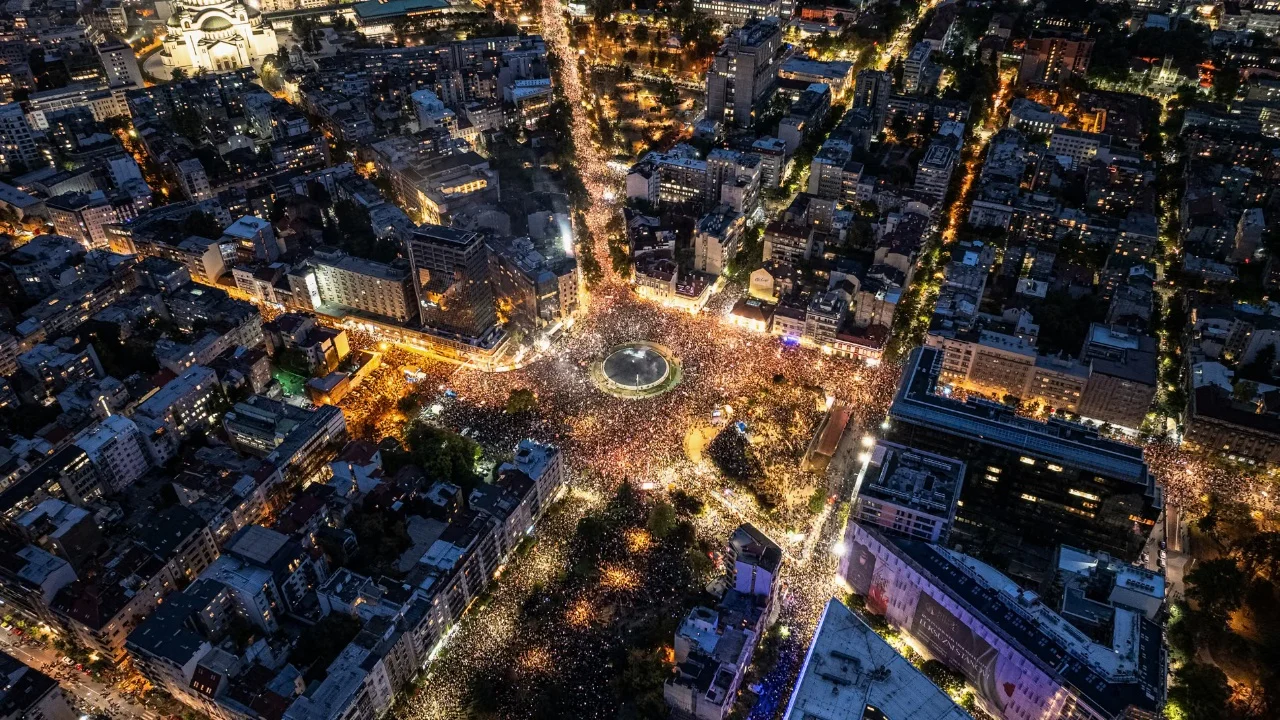
Belgrade, Serbia – Serbia is teetering on the precipice of a significant political shift as massive, sustained protests reach a crescendo just days before snap parliamentary elections are scheduled to be held this Sunday. Hundreds of thousands of students and their supporters have taken to the streets of Belgrade, their unified demand echoing through the capital: the ousting of veteran leader Aleksandar Vučić and his ruling Serbian Progressive Party (SNS).
The "Student List" movement, a leaderless but powerfully organized force, has galvanized public sentiment, drawing crowds exceeding 150,000 to central squares. Their potent slogan, "Students are winning," encapsulates a broader aspiration to dismantle the 14-year grip of the SNS, a right-wing populist party that has dominated Serbian politics under Vučić’s leadership. This weekend’s electoral contest presents the most formidable challenge to their tenure since they first came to power in 2012.
The upcoming vote is the culmination of nearly two years of student-led demonstrations, ignited by a devastating tragedy in Novi Sad in 2024. The collapse of a makeshift shelter at a newly renovated railway station resulted in the deaths of 16 individuals. This catastrophic event, widely attributed to systemic government corruption, has fueled some of the largest protests seen in Serbia since the downfall of Slobodan Milošević in 2000. The anti-corruption movement, spearheaded by university students, rapidly broadened its scope, evolving from demands for a transparent investigation into the tragedy to an outright call for early elections.
Aleksandar Vučić has been an omnipresent figure in Serbian politics for over a decade, serving as Prime Minister before assuming the presidency. Facing mounting pressure from these widespread dissent, Vučić announced snap elections last month, setting the stage for what is shaping up to be his most challenging electoral battle to date.
The Genesis of Dissent: A Tragic Catalyst and a Growing Movement
The current wave of protests and the ensuing snap elections are deeply rooted in a tragic event that shook Serbia to its core. In 2024, the collapse of a poorly constructed shelter at the Novi Sad railway station claimed the lives of sixteen people. Investigations and public outcry quickly pointed towards deep-seated issues of corruption and negligence within governmental bodies responsible for infrastructure projects and oversight. This incident served as a potent symbol of what many Serbians perceive as a systemic failure of governance, where public safety and accountability are sacrificed for personal gain.
The immediate aftermath saw widespread anger and demands for justice. University students, often at the forefront of social and political change, quickly organized demonstrations. Initially, these protests focused on securing a thorough and transparent investigation into the railway station collapse, aiming to identify and hold accountable those responsible. However, the movement’s momentum quickly outgrew its initial objective.
As the student-led demonstrations gained traction, they began to resonate with a broader segment of the Serbian population disillusioned with the perceived authoritarian tendencies and pervasive corruption within the ruling party. The initial calls for accountability broadened into a more encompassing critique of the government’s overall performance and its impact on the lives of ordinary citizens. The chant "Students are winning" transformed from a rallying cry for a specific cause to a broader declaration of intent to challenge the established order.
The "Student List" movement, characterized by its decentralized structure and reliance on social media for organization, proved remarkably effective in mobilizing large numbers of people. Without a singular leader, the movement fostered a sense of collective ownership and empowerment, allowing diverse voices and grievances to coalesce under a shared banner of change. This leaderless approach also presented a challenge for the government to isolate and negotiate with, further amplifying the movement’s disruptive potential.
A Decade of Vučić’s Dominance: Shifting Tides and Growing Opposition
Aleksandar Vučić’s ascent to power has been a defining feature of modern Serbian politics. Since the fall of Slobodan Milošević in 2000, Serbia has navigated a complex transition, marked by periods of instability and reform. Vučić, initially a prominent figure in nationalist politics, strategically reinvented himself as a pro-European reformer, a transformation that allowed him to tap into a desire for stability and economic progress.
His Serbian Progressive Party (SNS) first came to power in 2012, promising to tackle corruption and modernize the country. For over a decade, Vučić has occupied the highest echelons of power, serving as Prime Minister and subsequently as President, effectively consolidating his control over the state apparatus. His leadership style has been characterized by a strongman persona, a mastery of populist rhetoric, and a shrewd ability to manage political crises.
During his tenure, Vučić has overseen a period of relative economic stability, attracting foreign investment and undertaking infrastructure projects. However, critics argue that this progress has come at the cost of democratic backsliding, a crackdown on media freedom, and the entrenchment of cronyism and corruption. Allegations of electoral irregularities, intimidation of opposition figures, and the politicization of state institutions have become recurring themes in the discourse surrounding his government.
The prolonged protests, fueled by the Novi Sad tragedy and a broader sense of discontent, have exposed the vulnerabilities in Vučić’s seemingly unassailable position. The student movement, in particular, has tapped into a demographic that is often more idealistic and less directly tied to the patronage networks that have sustained the SNS. Their persistent demonstrations, often peaceful yet unwavering, have chipped away at the government’s narrative of unwavering public support.
Recognizing the growing pressure and the potential for further escalation, Vučić made the strategic decision to call for early parliamentary elections. This move, while seemingly conceding to demands for a renewed mandate, also serves to shift the focus back to the electoral arena, where the SNS has historically proven adept at mobilizing its base. However, the current political climate suggests that this election will be far from a foregone conclusion, with the opposition, galvanized by the protest movement, presenting a united and determined front.
The Road to the Polls: Key Demands and Electoral Landscape
The "Student List" and its associated protest movements have articulated a clear set of demands that extend beyond the immediate call for an end to the SNS’s rule. At the forefront are calls for a radical overhaul of the justice system, ensuring genuine independence and accountability for all citizens, regardless of their political affiliation or social standing. This includes demands for the thorough investigation and prosecution of corruption cases that have plagued successive Serbian governments.
Furthermore, the protesters are advocating for significant reforms to ensure free and fair elections. This encompasses measures to guarantee media pluralism, dismantle partisan control over state institutions, and prevent the abuse of state resources for electoral gain. The demand for a transparent and competitive electoral process is seen as fundamental to restoring public trust in democratic institutions.
The electoral landscape this Sunday is complex. The SNS, while facing significant challenges, remains a powerful political force with a dedicated voter base. Their campaign has focused on promises of continued economic development, stability, and national pride, often portraying the opposition as destabilizing elements funded by foreign interests.
The opposition, though fragmented in the past, has shown a remarkable degree of unity in response to the protest movement. Several opposition parties have aligned themselves with the students’ demands, forming a broad coalition aimed at challenging the SNS. However, the challenge lies in translating the energy and momentum of the street protests into tangible electoral support across the country. Internal divisions and differing political ideologies within the opposition coalition remain potential hurdles.
The election results will have profound implications for Serbia’s domestic trajectory and its relationship with the international community. A victory for the opposition could herald a new era of democratic reform and a renewed commitment to the rule of law. Conversely, a continued mandate for the SNS would likely see the entrenchment of the current political system, with ongoing concerns about democratic freedoms and institutional integrity.
Official Responses and International Scrutiny
The Serbian government, led by Aleksandar Vučić, has responded to the sustained protests with a combination of appeasement and a firm stance against what it terms "foreign-backed destabilization." While Vučić announced snap elections, a move seen by many as a concession to public pressure, his administration has also consistently criticized the motives and methods of the protest organizers.
Government officials have often characterized the protests as orchestrated by external forces aiming to undermine Serbia’s sovereignty and its independent foreign policy, particularly its close ties with Russia. This narrative seeks to delegitimize the domestic grievances fueling the demonstrations and rally nationalist sentiment behind the ruling party.
During parliamentary debates and public addresses, government representatives have highlighted economic achievements and infrastructure development as evidence of their effective governance, contrasting this with what they portray as the opposition’s lack of a concrete program. They have also emphasized the importance of stability and continuity in navigating regional and international challenges.
However, the persistent nature of the protests and the sheer scale of public participation have made it difficult for the government to dismiss them entirely. The tragic event in Novi Sad, in particular, has resonated deeply, and the government’s handling of the investigation and its aftermath has faced considerable criticism.
Internationally, the situation in Serbia has attracted significant attention. European Union officials, who have been engaged in accession talks with Serbia, have expressed concerns about the state of democratic institutions, media freedom, and the rule of law. While the EU generally refrains from direct interference in domestic elections, it closely monitors the electoral process and the broader political climate in candidate countries.
Human rights organizations and international observers have also voiced their concerns regarding alleged electoral irregularities and the shrinking space for independent media and civil society in Serbia. The upcoming elections are therefore being watched closely by international bodies as a critical test of Serbia’s commitment to democratic principles and its progress towards European integration.
The outcome of these elections will not only shape Serbia’s future but will also serve as an indicator of the broader democratic trends in the Western Balkans. The ability of a determined and mobilized civil society to effect political change, even in the face of entrenched power, will be a significant takeaway from this pivotal moment in Serbian history.
Implications for Serbia and the Region: A Crossroads for Democracy
The snap parliamentary elections in Serbia this Sunday represent a critical juncture, with far-reaching implications not only for the country’s internal political landscape but also for the stability and democratic development of the entire Western Balkan region. The outcome of this electoral contest will reverberate through diplomatic channels, economic relations, and the ongoing efforts towards regional integration.
For Serbia:
- Democratic Reform vs. Consolidation of Power: A victory for the opposition, driven by the momentum of the mass protests, could usher in an era of significant democratic reforms. This would likely involve a concerted effort to strengthen the rule of law, enhance judicial independence, combat corruption, and restore media pluralism. Such a shift would signal a departure from the perceived authoritarian tendencies that have characterized the Vučić era. Conversely, a continued mandate for the SNS would likely see the consolidation of the current political system, with potential implications for civil liberties and the independent functioning of state institutions.
- Economic Trajectory: While the SNS has overseen a period of economic growth, concerns remain about the sustainability of this model and the equitable distribution of its benefits. A change in government could lead to a recalibration of economic policies, potentially focusing more on inclusive growth, investment in public services, and a more transparent approach to public procurement and infrastructure projects.
- Social Cohesion: The prolonged period of protest and the highly polarized political environment have created deep divisions within Serbian society. The outcome of the elections and the subsequent political maneuvering will play a crucial role in either healing these divisions or exacerbating them. A successful transition towards a more inclusive political system could foster greater social cohesion, while a continuation of the status quo might lead to further alienation and discontent.
For the Western Balkans and Europe:
- Regional Stability: Serbia is a key player in the Western Balkans. Its internal political direction has a significant impact on regional dynamics. A more democratic and reform-oriented Serbia could serve as a positive example and a catalyst for similar progress in neighboring countries. Conversely, a Serbia perceived as increasingly authoritarian or unstable could have a destabilizing effect on the region.
- EU Accession Process: The EU’s engagement with Serbia is a critical factor in the country’s foreign policy. The outcome of the elections will undoubtedly influence the pace and trajectory of Serbia’s accession negotiations. A government committed to democratic reforms and the rule of law would be more favorably viewed by Brussels, potentially accelerating the integration process. A continuation of the current trends could lead to stagnation or even a reversal of progress in this regard.
- Geopolitical Alignment: Serbia’s geopolitical orientation, particularly its relationship with Russia and its balancing act between East and West, is a significant consideration for regional and international actors. A shift in government could lead to a re-evaluation of these alignments, potentially impacting the broader geopolitical balance in the Western Balkans.
The upcoming elections in Serbia are more than just a domestic political event; they are a pivotal moment that will shape the future of a nation and influence the broader trajectory of democratic development in a strategically important region. The courage and determination displayed by the students and their supporters in demanding change have already left an indelible mark, regardless of the final electoral outcome. The coming days will reveal whether Serbia is poised for a transformative shift or a continuation of its current path, a decision that will be closely observed by both its citizens and the international community.