Enterprise software giant Workday has officially ushered in a new chapter of its sustainability journey, announcing a robust set of greenhouse gas (GHG) emissions reduction commitments. Following the conclusion of its 2020–2026 climate cycle, the company has recalibrated its strategy, acknowledging both the triumphs of its past initiatives and the sobering realities of supply chain engagement in a volatile global economy.
These new, near-term targets—validated by the Science Based Targets initiative (SBTi)—are designed to align with the company’s 2031 fiscal year. They represent a pivot from broad, aspirational goals to more granular, data-driven "actionable" decarbonization, signaling that for Workday, sustainability is no longer a peripheral corporate social responsibility task, but an integral component of its operational architecture and financial health.
The New Mandate: Setting Sights on 2031
The cornerstone of Workday’s updated climate policy is a dual-track approach focusing on absolute operational reductions and intensity-based supply chain improvements. By fiscal year 2031, using a 2025 baseline, the company has committed to:
- Scope 1 and 2 Reductions: A 42 percent reduction in absolute GHG emissions stemming from its direct operations and electricity consumption.
- Renewable Energy Continuity: A steadfast commitment to matching 100 percent of power consumption across its global office footprint and data centers with renewable energy through 2031.
- Scope 3 Intensity Targets: A 52 percent reduction in emissions intensity per dollar of revenue for its three most significant Scope 3 categories: purchased goods and services, capital expenditures, and business travel.
These targets are not merely public relations maneuvers; they are tethered to the company’s internal financial mechanisms, including a growing internal carbon price that incentivizes departments to choose low-carbon alternatives when procuring services or developing software.
Chronology of a Sustainability Evolution
Workday’s path to these new commitments was forged through a five-year period of trial and error. The company’s 2020 strategy provided a vital blueprint, but the execution revealed the complexities of the modern tech supply chain.
The 2020–2026 Cycle: A Mixed Report Card
In 2020, Workday set three primary goals: matching electricity consumption with renewable energy, reducing business travel emissions, and mobilizing its supply chain to set science-based targets.
- The Successes: Workday successfully maintained its renewable energy matching for six consecutive fiscal years. Furthermore, it outperformed its business travel goal—targeting a 25 percent reduction and achieving a 31 percent decrease. This was accomplished by implementing stricter travel policies and investing heavily in sustainable aviation fuel (SAF) in partnership with a consortium of other corporate buyers and fuel providers.
- The Hurdle: The company fell short on its ambitious goal to help 70 percent of its suppliers set their own emissions reduction targets. By the end of fiscal year 2026, only 24 percent of relevant suppliers had complied. This shortfall highlighted a critical lesson: in a fragmented global market, some organizations lack the maturity, data, or resources to immediately pivot to rigorous climate reporting.
Lessons Learned: Moving Beyond the Silo
The reflection period following the 2026 reporting cycle served as a wake-up call. As outlined in the company’s 2026 Global Impact Report, Workday concluded that corporate sustainability cannot function in a silo. Achieving these goals requires cross-departmental integration, involving everyone from procurement and product engineering to finance and real estate.
Supporting Data and Technical Strategies
The shift toward intensity-based targets is a strategic response to the difficulty of influencing third-party behavior. By focusing on emissions per dollar spent, Workday is incentivizing its procurement teams to prioritize vendors that offer efficiency, effectively turning climate performance into a competitive bid requirement.
Decarbonizing the Physical and Digital Footprint
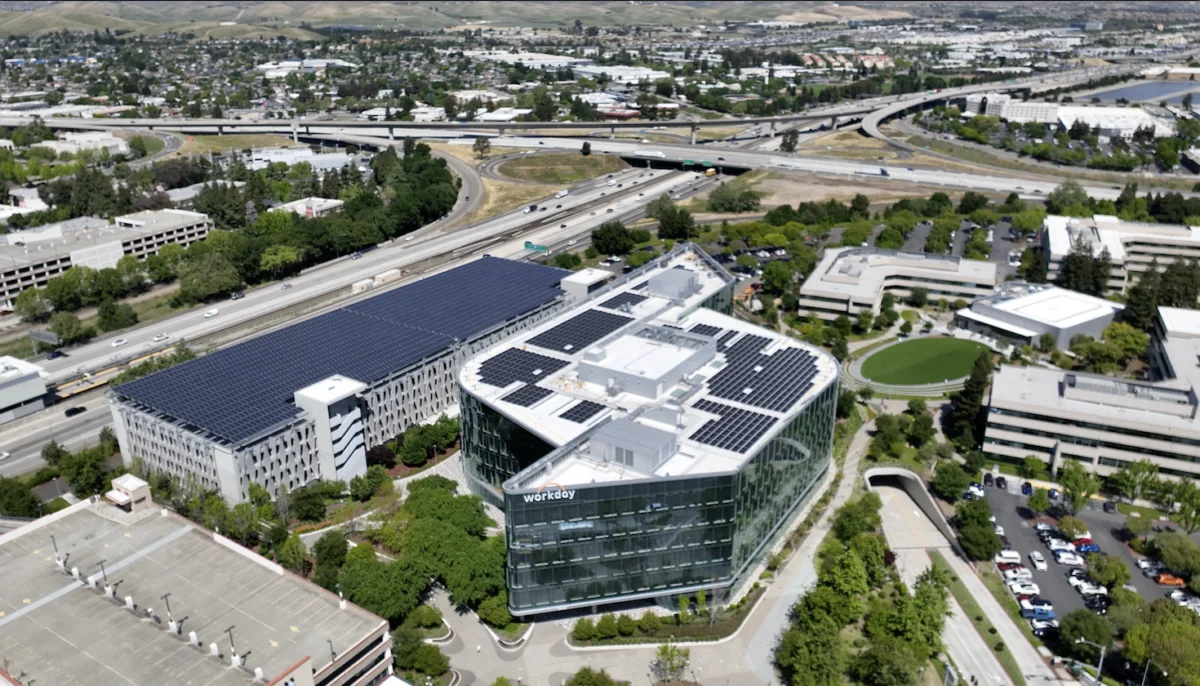
To meet its Scope 1 and 2 targets, Workday is transitioning away from fossil fuels in its physical offices. The company is actively pursuing building electrification, which involves phasing out natural gas for heating and cooking in favor of electric-based infrastructure. Simultaneously, it is doubling down on on-site solar installations and energy storage solutions to ensure that its facilities remain resilient and low-carbon.
Rightsizing and Software Optimization
Perhaps the most innovative aspect of Workday’s strategy is its technical approach to cloud infrastructure. The company’s cloud and data center footprint accounts for approximately one-third of its total emissions—a massive 335,490 metric tons of CO2e reported in 2026.
By conducting rigorous analysis of its cloud usage, Workday identified significant inefficiencies. It discovered that it was over-provisioning capacity, paying for computing power it did not utilize. By "rightsizing" these services and optimizing software code for greater processing efficiency, the company cut 5,000 metric tons of CO2e in 2025 alone, while simultaneously saving millions of dollars in operational costs. This proves that decarbonization, when executed correctly, is often synonymous with operational efficiency.
Official Responses and Strategic Philosophy
Erik Hansen, Workday’s Chief Sustainability Officer, has been candid about the challenges of the last five years. Addressing the supplier engagement gap, Hansen noted, "Some organizations aren’t ready, and they were clear with us about that." This transparency is at the heart of Workday’s refreshed approach.
The AI Ecosystem Challenge
As Workday integrates more artificial intelligence into its platforms, it faces the risk of a ballooning carbon footprint. AI models are notoriously energy-intensive, and the company is taking a proactive stance to mitigate this.
"We need to engage with the AI ecosystem more fulsomely," Hansen stated. To manage its AI-related footprint, Workday is prioritizing "carbon-conscious" models. For example, the company selected Google’s Gemini as the default model for its Sana AI agent platform, specifically citing Google’s commitment to 24/7 carbon-free energy. By choosing providers that prioritize sustainable infrastructure, Workday is essentially outsourcing part of its decarbonization burden to companies with more advanced renewable energy grids.
Implications for the Tech Industry
Workday’s move carries significant implications for the broader enterprise software sector. By institutionalizing an internal carbon price and demanding emissions data as a standard contractual requirement, the company is effectively forcing its vendors to choose: adapt to the reporting requirements or lose access to a major enterprise client.
The Role of Transparency
The "linchpin" of this strategy is the mandatory request for emissions data in contracts. This practice ensures that Workday maintains visibility into its Scope 3 footprint. It is a model that other software companies are likely to emulate as pressure mounts from regulators and investors for more accurate Scope 3 reporting.
The Future of AI and Corporate Climate Policy
Workday is now teaming up with other software peers to demand greater transparency from AI model developers. This collaborative approach suggests that the tech industry is moving toward a standard of "accountability in the cloud." As companies increasingly rely on agentic AI, the energy cost of those agents will become a line item on the sustainability balance sheet.
Conclusion: A Blueprint for the Future
Workday’s journey reflects a broader maturity in the corporate sustainability movement. The transition from the "pledge-driven" era of the late 2010s to the "data-driven" reality of the 2030s is evidenced by the company’s willingness to admit failure in its supplier targets and its subsequent pivot to more effective, intensity-based strategies.
By embedding climate action into the core of its product engineering, financial modeling, and vendor relationships, Workday is demonstrating that sustainability is a business imperative. As the company marches toward 2031, its success will depend on its ability to hold not only its own departments but its entire global ecosystem—from cloud providers to AI developers—accountable to the same high standards of transparency and carbon-efficiency. In doing so, Workday provides a roadmap for how large-scale enterprise firms can navigate the "hard realities" of a warming world while maintaining growth and competitive advantage.