In the modern corporate landscape, the transition from legacy spreadsheet-based planning to specialized enterprise planning software is often viewed through a distorted lens. Many organizations mistakenly attempt to justify the investment solely on the promise of immediate, drastic cost reductions or headcount eliminations. However, according to The Planning Survey 26 by BARC, this narrow focus misses the forest for the trees.
The true value of specialized planning solutions lies not in short-term accounting entries, but in structural enhancements: transparency, planning quality, and increased frequency. As businesses face accelerating market volatility, the ability to pivot based on reliable, traceable data has become a strategic imperative. This article outlines how to synthesize these qualitative gains into a robust, defensible business case.
Main Facts: The Performance Gap
The divergence in user satisfaction between Excel-reliant firms and those utilizing specialized software is stark. The Planning Survey 26 reveals that 87% of users with specialized planning tools would recommend their solution to a peer. In contrast, that figure plummets to 41% among companies where Excel remains the primary planning vehicle.
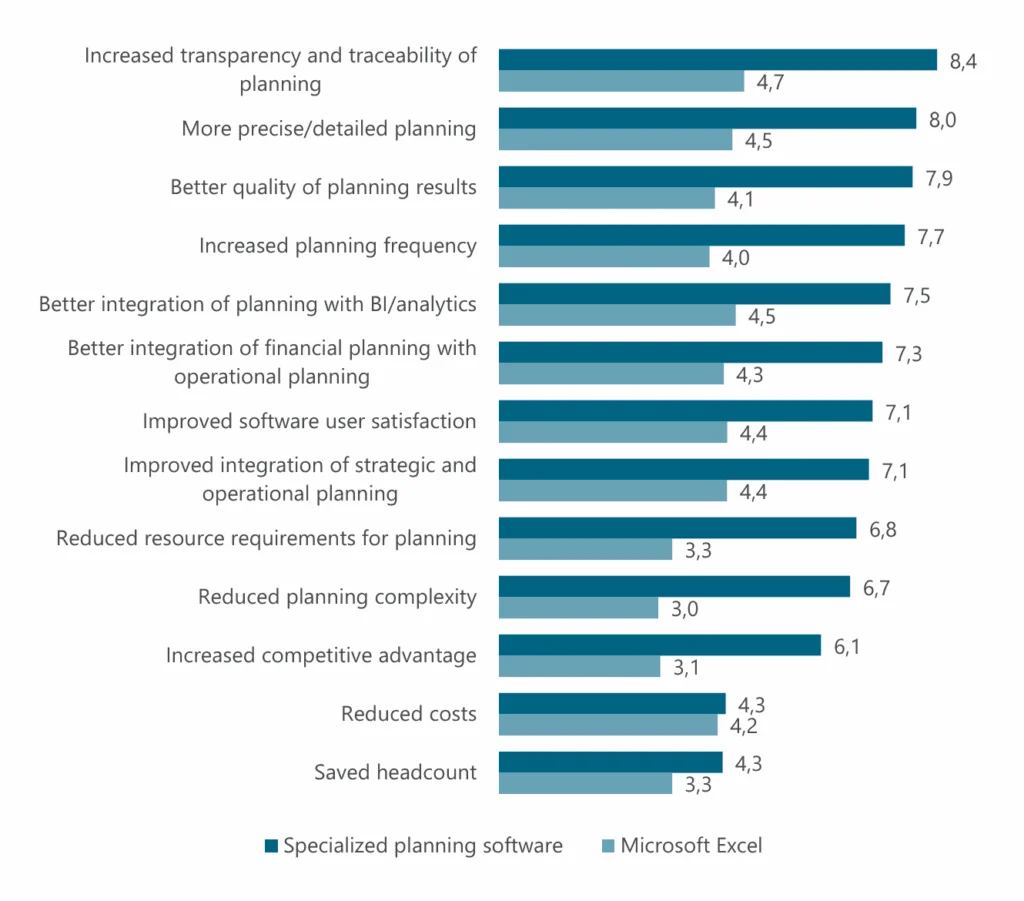
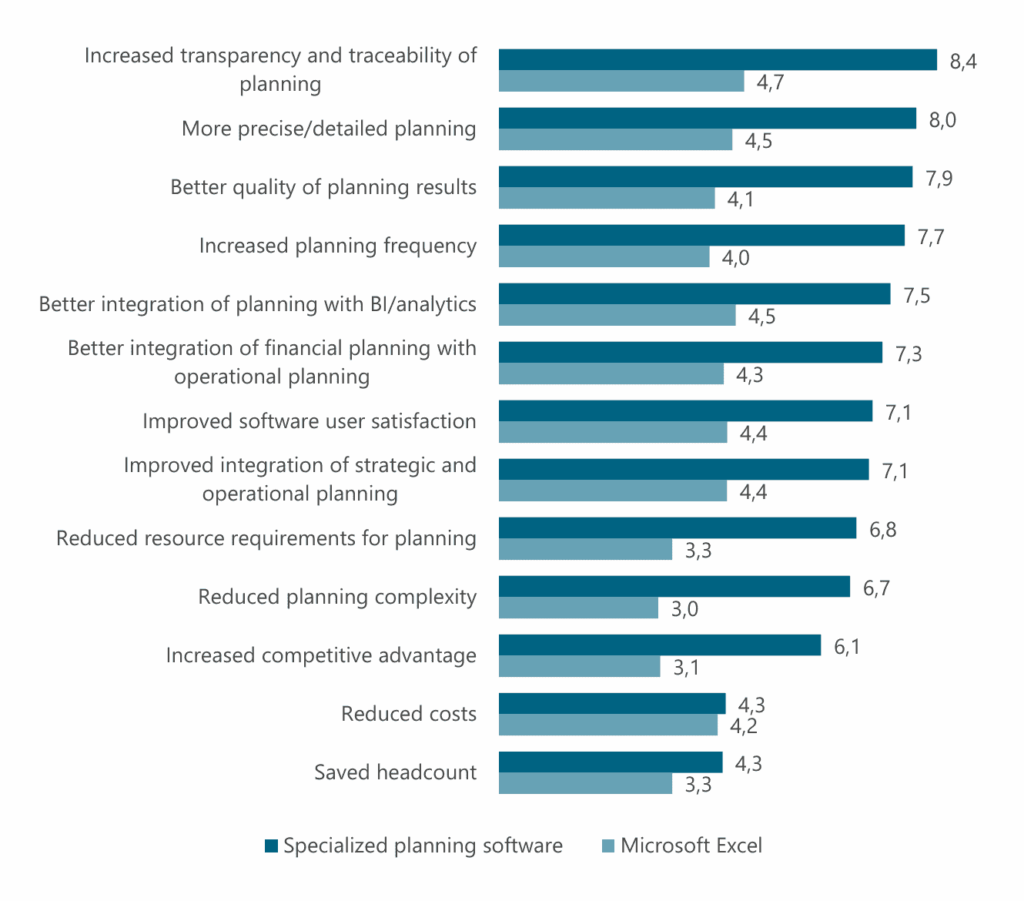
This gap is not merely a matter of preference; it is a reflection of functional utility. The Business Benefits Index (BBI) scores highlight that specialized tools consistently outperform spreadsheets in key operational areas. For instance, in transparency and traceability, specialized tools score 8.4 against Excel’s 4.7. Similar disparities appear in planning quality (7.7 vs. 4.1) and planning frequency (7.5 vs. 4.0).
These figures underscore a critical reality: while Excel is a versatile tool for individual analysis, it lacks the architectural integrity required for enterprise-wide, multi-departmental planning. When actuals, plans, and forecasts are siloed in disconnected files, the "cost" is not just in manual labor—it is in the delay and potential inaccuracy of management decision-making.
Chronology of a Successful Investment
For a business case to succeed, it must be viewed as a lifecycle document, not a static form to be filed before a purchase. The process of building a case follows a logical, phased progression:
- Requirement Definition: Before evaluating vendors, the organization must map its current "pain points." Are forecasts consistently late? Is there a lack of accountability in the planning process? Is the "version control" of Excel files a recurring nightmare?
- The Benefit Architecture: Mapping these pain points to the five core benefit areas (detailed later in this article).
- Scenario Modeling: Developing conservative, realistic, and ambitious projections for ROI.
- Full Cost Assessment: Aggregating not just license fees, but implementation, training, data integration, and ongoing maintenance costs.
- Post-Implementation Benchmarking: Using the original business case as a scorecard to measure whether the anticipated gains in transparency and speed were actually achieved.
Supporting Data: Why "Cost Savings" is a False Metric
The most common mistake in corporate finance is the obsession with "headcount savings." While automating manual data consolidation saves time, it rarely leads to layoffs in the finance department. Instead, it shifts the workload from "data wrangling" to "data analysis."

The BBI data indicates that cost reduction and headcount savings consistently rank at the bottom of the list of benefits reported by users. The real ROI is found in the "soft" benefits that eventually harden into financial results:
- Reduced latency in decision-making: The time between a market shift and a strategic response.
- Improved forecast accuracy: Reducing the variance between the plan and actual outcomes.
- Increased organizational agility: The ability to run multiple "what-if" scenarios without weeks of manual preparation.
Five Pillars of the Business Case
To move beyond the spreadsheet, your business case should be structured around five pillars that provide a comprehensive view of value.
1. Minimizing Process Effort
Focus on the elimination of "non-value-added" tasks. This includes automating data imports, reducing manual reconciliations, and centralizing assumption management. When calculating this, focus on the "reallocation of talent." The goal is to move your finance professionals from being "spreadsheet operators" to "business partners."
2. Quality, Transparency, and Decision Speed
This is the heart of the modern business case. An integrated solution provides a "single source of truth." KPIs here should include the number of iterations required to finalize a budget and the time elapsed from the close of the month to the availability of the forecast.
3. Integration and Scalability
Enterprise planning is not a static endeavor; it grows with the company. A business case must account for the "complexity tax"—the increasing effort required to manage more entities, users, and data sources in a legacy system. A scalable platform allows for growth without a corresponding linear increase in headcount or effort.
4. Risk and Governance
Manual, file-based processes are inherently risky. They are prone to broken links, formula errors, and unauthorized changes. A professional solution provides audit trails, version history, and role-based access control. These are not just "nice-to-haves"; they are essential for regulatory compliance and internal governance.
5. Strategic Agility
This area captures the capability for rolling forecasts, AI-assisted modeling, and high-speed simulation. However, a word of caution: these are only benefits if the organization has the underlying data maturity to support them. As noted in the study, one must first "stabilize the foundation" (data and integration) before attempting to build the "advanced layers" (AI and predictive modeling).
Official Perspectives: The Role of Professional Evaluation
The survey results highlight a significant trend in procurement: 76% of organizations using specialized planning software conducted a formal, competitive evaluation before making their purchase. Conversely, only 13% of Excel users did the same.
This indicates that the act of evaluation is, in itself, a predictor of success. A formal selection process forces stakeholders to align on requirements and performance metrics before the software is even installed. When a company skips this step—often by relying on the "we’ve always used Excel" mentality—they frequently encounter performance bottlenecks and user adoption issues once the system goes live.
Implications for Future Strategy
The implications for finance leaders are clear: the era of relying on unmanaged, disconnected spreadsheets for critical enterprise planning is drawing to a close. However, the move to specialized software is not a "magic button." It is an organizational transformation.
The Need for Rigor
Your business case must be built with a high degree of intellectual honesty. If you cannot explain how a specific feature will improve your planning cycle, you shouldn’t include it in the financial projections. By creating three scenarios—conservative, realistic, and ambitious—you provide leadership with a transparent understanding of the risks and rewards associated with the investment.
The Ongoing Commitment
The business case is not just a tool for approval; it is a tool for management. Post-implementation, the metrics identified during the planning phase should be reviewed quarterly. If the expected reduction in "time-to-forecast" has not materialized, it is a signal to investigate training needs, data integration hurdles, or organizational resistance.
Final Thoughts
Transitioning to specialized planning software is fundamentally about replacing "manual effort" with "intelligent process." While the upfront costs—licenses, implementation, and training—are tangible and immediate, the benefits are structural and enduring. By focusing your business case on transparency, traceability, and the ability to make faster, data-driven decisions, you align your technology investment with the long-term strategic health of your organization.
As The Planning Survey 26 suggests, those who take the time to build a robust, evidence-based business case are significantly more likely to achieve the operational agility required to thrive in an increasingly volatile global market. The question is no longer whether your company can afford to upgrade, but rather how much longer it can afford to be held back by the limitations of the status quo.