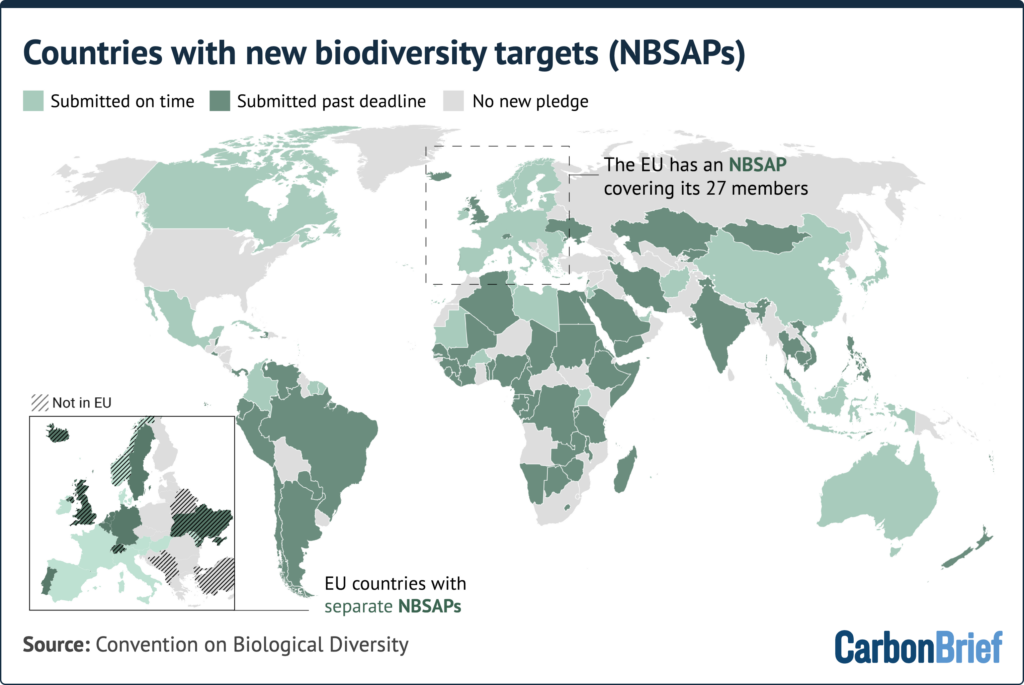
As the international community prepares to convene in Yerevan, Armenia, for the COP17 biodiversity summit, a critical assessment of global commitments reveals a mixed landscape of progress and inertia. Two years past the original deadline set during the landmark 2022 Kunming-Montreal Global Biodiversity Framework (GBF), a new analysis by Carbon Brief indicates that 58% of nations have finally submitted their National Biodiversity Strategies and Action Plans (NBSAPs).
While this represents a significant increase from the dismal 15% compliance rate seen at the initial deadline, the slow pace of institutional response continues to raise alarms among conservationists. With the world at the halfway point toward the 2030 mission to “halt and reverse” biodiversity loss, the pressure on delegates in Yerevan to accelerate implementation has never been higher.
The Core Facts: Status of Global Biodiversity Pledges
The NBSAPs serve as the primary vehicle through which countries translate the high-level goals of the GBF into tangible domestic policy. These documents are intended to be blueprints for action, outlining how nations intend to protect species, restore ecosystems, and integrate biodiversity into national economic planning.
As of the latest tracking data, 113 countries have formally submitted these plans. This is a substantial improvement from the 55 nations that had done so a year ago. However, the absence of several key players remains a significant hurdle. Notably, four of the world’s "megadiverse" nations—those harboring the highest concentrations of unique species—have yet to finalize their NBSAPs: Papua New Guinea, Peru, South Africa, and the United States.

The situation with the United States is unique; as the only UN member country that is not a signatory to the Convention on Biological Diversity, its absence from the formal pledge process is a systemic challenge for global conservation efforts. Similarly, Russia, which holds the largest landmass on Earth and critical carbon-sequestering biomes, has yet to produce a new NBSAP, leaving a massive gap in the global data map.
A Chronological Overview: From Montreal to Yerevan
The trajectory of these pledges has been marked by a series of missed milestones and corrective diplomatic maneuvers:
- December 2022: The Kunming-Montreal Global Biodiversity Framework is signed. Nearly every nation commits to 23 ambitious targets to be achieved by 2030.
- The Original Deadline (2024): Countries were expected to submit their updated NBSAPs by the start of COP16 in October 2024. Only 15% of nations complied, triggering widespread concern that the framework lacked teeth.
- Post-COP16 Adjustment: Recognizing the lack of momentum, delegates at COP16 agreed to a new, urgent text that explicitly "urges" countries to release their NBSAPs "as soon as possible."
- February 2025: The deadline for the seventh national reports—a parallel accountability mechanism—passed, with only half of the countries meeting the requirement.
- October 2026 (Present): With 58% of NBSAPs submitted and 73% of national reports filed, the international community enters COP17 in Yerevan for the first formal "global review" of progress.
Supporting Data: Regional Trends and Financial Hurdles
The data suggests a divide between nations that have managed to mobilize resources and those that remain stuck in the planning phase.
Regional Gains
The last twelve months have seen a surge in submissions from the African continent. Countries such as Algeria, Botswana, Cameroon, Ethiopia, Namibia, Rwanda, and Zimbabwe have all published their new strategies. This progress suggests that targeted capacity-building efforts may be beginning to bear fruit. In South America, the momentum has been bolstered by Brazil—the world’s most biodiverse nation—submitting its plan, signaling a shift in policy that could prove vital for the future of the Amazon.
The Funding Gap
A recurring theme in the delay of these submissions is the lack of adequate financial support. Developing nations have consistently argued that they lack the administrative and technical resources to draft comprehensive biodiversity strategies without external assistance.
The Global Environment Facility (GEF), the primary multilateral fund for this purpose, reports that 120 out of 139 countries requesting support have successfully accessed funding since COP16. However, that leaves 19 countries still waiting. The United Nations Environment Programme (UNEP) has publicly stated that they are working to resolve these "outstanding issues," but for those 19 nations, the delay in funding translates directly into a delay in protecting their unique natural heritage.
Official Responses and Strategic Pivot
In the absence of a completed NBSAP, the UN allowed nations to submit "national targets" instead. These are essentially stripped-down lists of goals without the accompanying implementation strategy. While this has helped boost the overall reporting figures—with 175 countries, or 89% of parties, having now submitted at least one national target—it is widely acknowledged that targets alone are insufficient to trigger the structural changes needed to reverse biodiversity loss.
The upcoming COP17 in Yerevan is being positioned as a "moment of truth." The summit will facilitate the first global review, utilizing the seventh national reports and the submitted NBSAPs to create an honest assessment of where the world stands.
"We are not just looking at a checklist of documents," a UN spokesperson noted recently. "We are looking for evidence of integration. Are these targets reflected in national budgets? Are they influencing land-use laws? That is the threshold for success."
Implications: The High Cost of Inaction
The implications of failing to meet these 2030 targets extend far beyond the conservation community. The Kunming-Montreal GBF is not just about protecting wildlife; it is about protecting the systems that provide food, water, and economic security for the global population.
1. The Financial Reality
As explored in recent reports, developed nations are currently falling "far short" of their commitments to nature finance. If developing nations are expected to protect biodiversity, they require the promised capital to transition away from extractive industries. Without this, the targets remain aspirational rather than operational.
2. The Credibility of Multilateralism
The failure to meet deadlines is damaging the perceived credibility of the UN Convention on Biological Diversity. When nations see major powers like the U.S. or Russia opting out or dragging their feet, it creates a "free-rider" problem where smaller nations feel less inclined to prioritize biodiversity over short-term economic growth.

3. The 2030 Tipping Point
Scientific consensus suggests that the next few years represent a final window of opportunity to prevent irreversible tipping points in major ecosystems. The "halt and reverse" mission of the GBF is not merely a political slogan; it is a biophysical necessity. If the global review at COP17 reveals that the submitted plans are insufficient in ambition or scope, the world will have little time to recalibrate before the 2030 deadline arrives.
Looking Toward Yerevan
As the delegation heads to Armenia, the focus will be twofold: reviewing the quality of existing NBSAPs and pushing for the remaining 42% of countries to complete their plans.
The summit will also serve as a barometer for international cooperation. With the geopolitical climate increasingly fragmented, the ability of nearly 200 nations to agree on a path forward for the planet’s life-support systems remains a critical test of modern diplomacy.
The progress made in the last year—moving from 15% to 58%—proves that movement is possible when the framework is clear. However, the transition from paper pledges to on-the-ground reality remains the final, and most difficult, frontier. Whether the Yerevan summit will be remembered as a turning point or a stalling point depends on the willingness of nations to commit not just to their targets, but to the funding and transparency required to make them a reality.
As the world gathers in Armenia, the message from the scientific community is clear: nature cannot wait for the next reporting cycle. The time for drafting is ending; the era of implementation must begin.