In the high-stakes environment of modern business, the difference between a thriving enterprise and a struggling startup often comes down to a single, unglamorous concept: workflow improvement. At its core, this practice is the scientific method applied to operations—running a repeatable process consistently, analyzing the resulting metrics, and systematically pruning ineffective steps rather than relying on the precarious crutch of intuition.
While the boardroom may seem worlds away from the living room, the principles of operational excellence are surprisingly universal. To understand the mechanics of workflow improvement, one must first understand the necessity of consistency—a lesson often learned in the most chaotic of environments: pet training.
The Unexpected Laboratory: Lessons from the Household
The journey toward professional efficiency often begins with a personal reality check. When I first adopted my dog, Leia, I was greeted with a masterclass in the dangers of inconsistent feedback. Within 24 hours, my living room had been transformed into a shredded monument to poor planning, and my mornings were dictated by a 60-pound "furbeast" with zero regard for household norms.
My initial approach—a mix of good intentions and erratic, unstudied training techniques—was a failure. I was a "bleeding heart" operating without a system. Every time I changed the cue, the reward structure, or the environment, I introduced noise into the data. Because my approach was unstructured, I had no way of knowing whether Leia’s lack of progress was due to the training method, the environment, or my own inconsistency.
This is the exact trap that many organizations fall into. When teams rely on "natural ability" or "gut feeling" rather than a standardized playbook, they are not actually performing work; they are improvising. And in business, improvisation is the enemy of optimization.
The Core Philosophy: Why Consistency Makes Results Measurable
The central tenet of workflow improvement is simple: You cannot improve what you cannot measure, and you cannot measure what you do not repeat.
In a professional setting, workflows function exactly like training protocols. When a team executes a process—be it lead qualification, content creation, or software deployment—the success of that process must be tied to specific, repeatable metrics. If every team member approaches a task differently, the resulting data becomes useless. You cannot compare the effectiveness of two sales emails if one was sent after a discovery call and the other was sent cold.
The Problem of Variable Execution
When workflows are performed inconsistently, you lose the ability to perform a true "process analysis." Process analysis requires a baseline of stable, repeatable runs. By maintaining consistency, you create a trail of "comparable evidence."
If you change your methodology every time you perform a task, you will never know if a positive outcome was a result of your new strategy or merely a stroke of luck. By locking in a standard operating procedure (SOP), you isolate variables. When you finally decide to change one step in the workflow, you can compare the post-change results against your stable baseline. If the metrics improve, you have successfully optimized the process. If they decline, you have a clear indicator of a failed experiment.
The Death of the "Exception": Establishing a Baseline
For the first month of Leia’s training, I was my own worst enemy. I would alternate between strict discipline and "aww, screw it" moments of indulgence. By allowing exceptions to the rule, I was inadvertently teaching her that the rules were negotiable.
In business, "exceptions" are the silent killers of productivity. When a sales rep bypasses the CRM to close a deal "their way," or when a project manager skips a QA step to save time, they aren’t just cutting corners—they are breaking the feedback loop.
Transitioning from Improvisation to Routine
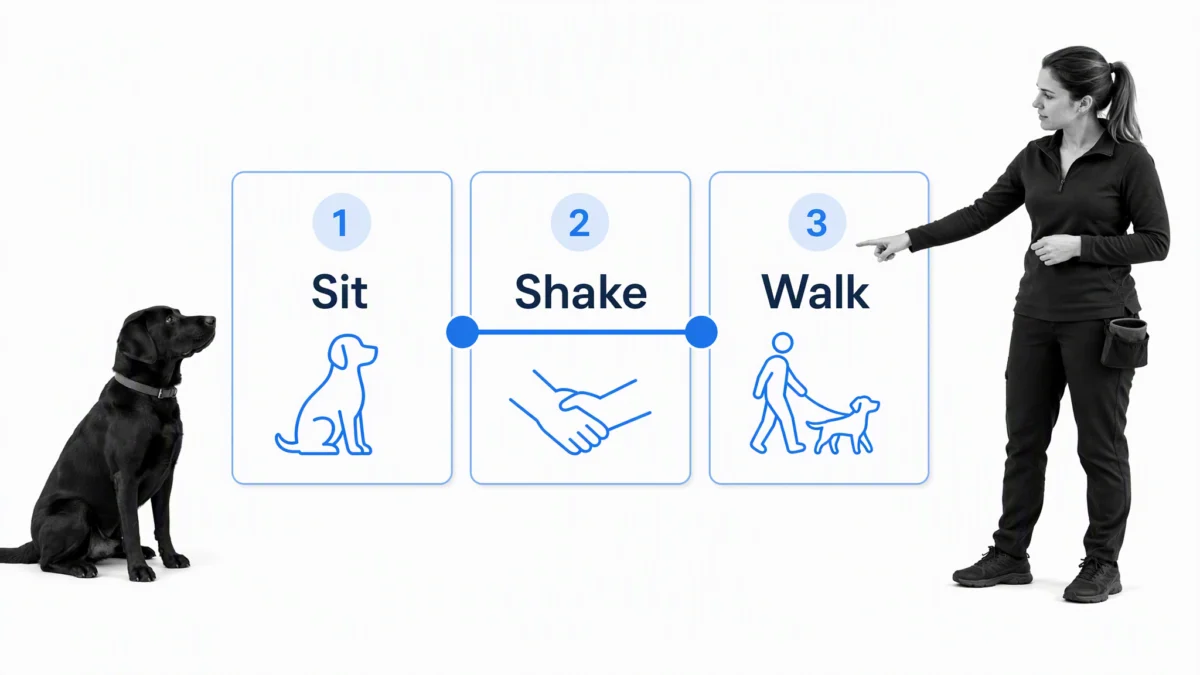
To achieve true operational maturity, one must replace improvisation with a rigid routine. In the case of my training, this meant:

- Standardizing the Cues: Using the exact same word for the exact same action every time.
- Standardizing the Reward: Using the same incentive structure to reinforce the desired behavior.
- Predictability: Creating an environment where the boundaries were clear and unchanging.
Within 32 days of implementing this rigid, "boring" routine, the results were transformative. The accidents ceased, the household dynamic stabilized, and the training became predictable. In business, "boring" is synonymous with "scalable." The goal of a well-designed workflow is not to provide excitement; it is to provide a visible, predictable path to success.
Putting the Lesson into Practice: The Sales Qualification Model
The transition from pet training to professional strategy is seamless when applied to sales management. Many sales organizations suffer from a lack of qualification rigor. They allow reps to use "short, unstructured calls" to gauge prospect interest. This is the equivalent of trying to train a dog by shouting random commands at it.
Implementing the BANT Framework
To move from chaos to clarity, consider the BANT framework (Budget, Authority, Need, Timing). While BANT may not fit every industry, the principle is the key:
- Ask the same core questions: Every prospect goes through the same discovery gate.
- Centralize data: Capture answers in a unified system (a CRM or a dedicated workflow tool).
- Explicit next steps: Ensure the transition from qualification to demo or proposal is documented and consistent.
The results are often profound. In one observed transition, a pipeline of 50 loosely qualified, "ghosting" leads was distilled into a high-intent list of 20 prospects. By enforcing a repeatable process, the team was able to inspect the pipeline, identify where handoffs were stalling, and refine the questions that weren’t yielding high-quality evidence.
Implications for Modern Operations
The implications of this shift are far-reaching. When an organization moves away from "hero culture"—where success relies on the talent of individual superstars—to "process culture," it gains the ability to scale.
- Scalability: New hires can be onboarded faster because the "doctrine" is documented and repeatable.
- Accountability: When the workflow is standard, it becomes clear when a team member deviates from the path.
- Continuous Improvement: The organization stops guessing and starts engineering.
Trusting in "professional experience" is a valid starting point, but it is not a strategy. As the business world continues to digitize and automate, the organizations that will win are those that treat their workflows as living, evolving, and—most importantly—consistent pieces of architecture.
Frequently Asked Questions
What is the primary barrier to workflow improvement?
The primary barrier is the human desire for "flexibility." Most professionals believe their unique intuition is superior to a rigid process. However, without a baseline, intuition is just an untested hypothesis.
How do I know when a workflow is ready to be changed?
A workflow is ready for optimization only after it has been executed consistently enough to produce a reliable set of baseline metrics. If you haven’t run the process at least 10-20 times in the exact same way, you lack the data to make an informed decision about changing it.
Why does consistency reduce stress?
Consistency removes the "decision fatigue" that comes with improvising under pressure. When the process is automated or standardized, the professional is free to focus on the high-level strategy rather than the mechanics of the task itself.
Can over-standardization stifle creativity?
On the contrary. By standardizing the repetitive, low-value tasks (the "training" of the workflow), you clear mental bandwidth for the creative problem-solving that machines and rigid processes cannot handle. You standardize the routine so you can innovate on the exceptions.
Conclusion: The Path Forward
The lesson learned from a 60-pound furbeast is a lesson for the Fortune 500: Excellence is not an accident. It is the product of consistency, measurement, and the courage to stop guessing. By turning your daily operations into a repeatable, measurable process, you are not just improving your output—you are building a foundation upon which a truly efficient, scalable, and successful organization can be built.
Stop improvising. Start documenting. And watch as your results move from erratic to exceptional.