In the rapidly evolving landscape of Large Language Models (LLMs), Google’s latest release—Gemini 4 Argon—arrives with a promise to redefine the boundaries of reasoning, analytical precision, and creative output. Launched on October 13, 2026, Argon is positioned as a powerhouse for professionals grappling with document-heavy workflows and complex data synthesis. But as with any major AI release, the transition from marketing claims to real-world utility requires a rigorous, hands-on examination.
Is Gemini 4 Argon truly the reasoning engine it claims to be, or is it merely a more polished iteration of its predecessor? In this comprehensive report, we dissect Argon’s performance across four distinct domains—creative video generation, rapid web development, data auditing, and document reconciliation—to determine its place in your professional toolkit.
The Core Offering: What is Gemini 4 Argon?
Gemini 4 Argon represents a significant shift in how Google integrates its frontier models. Unlike previous iterations that were primarily text-centric, Argon is designed as an ecosystem-aware reasoning engine. It operates within the Gemini app interface, the Google AI Studio for developers, and via a paid API for enterprise integration.
A critical nuance for users is distinguishing the model from the app. When you interact with the Gemini app, you are utilizing an orchestration layer that includes "Canvas"—a dedicated workspace for coding and drafting—and a separate video generation model (Gemini Omni). Argon serves as the "brain" for these tools, handling the logic, while the accompanying modules manage the specific modalities of creation.
Key Capabilities
- Enhanced Reasoning: Optimized for high-complexity tasks, such as multi-step logic and constraint satisfaction.
- Cross-Modal Integration: Seamlessly shifts between text, code, and structured data environments.
- Long-Context Handling: Designed to maintain coherence across massive document packets, making it ideal for legal and technical review.
Access, Pricing, and the Cost of Intelligence
Google has maintained a bifurcated access model for Argon. For casual power users, it is bundled under the Google AI Pro/Ultra subscription. For developers and businesses looking to build products on top of the Argon architecture, the route is through Google AI Studio or the standard API.
The Financial Landscape (As of October 2026)
| Route | Access Tier | Primary Use Case |
|---|---|---|
| Gemini App | AI Pro/Ultra Subscription | General reasoning, creative tasks |
| Google AI Studio | AI Ultra / Paid API | Rapid prototyping, prompt engineering |
| Gemini API | Consumption-based | Production applications, custom workflows |
Standard API Pricing (Per Million Tokens):
- Input: $2 (rising to $4 on Dec 1, 2026).
- Output (including thinking tokens): $10 (rising to $20 on Dec 1, 2026).
It is important to note that these costs reflect the raw computational expense. In real-world applications, "thinking tokens"—the internal processing time the model uses to reason before providing an answer—can significantly impact the total cost of a project. Users should treat these figures as a baseline, not a final estimate.
Performance Audits: Four Practical Stress Tests
To test the model’s reliability, we subjected Argon to a series of tasks designed to expose both its logical reasoning and its propensity for "hallucinations."
1. Creative Synthesis: 8-Second Product Video
Task: Create a hyper-realistic 8-second video of a white ceramic mug with a red handle on a walnut table, incorporating rising steam and specific camera movements.
Results: Argon succeeded in delivering a coherent, visually appealing asset. The output adhered strictly to the "no text or logos" constraint. However, it is vital to remember that this task utilizes the Gemini Omni backend. While Argon directs the creative intent, it does not "generate" the video natively. This is a crucial distinction for developers; Argon provides the instruction set, but the underlying generative architecture is a separate process.
2. Rapid Development: The "Clay Saturday" Booking Site
Task: Build a responsive one-page website using Canvas for a fictional pottery workshop. Requirements included a hero section, class filters (Beginner/Advanced), and an interactive booking form that updates the total cost in real-time.
Results: The model excelled. By using Canvas, Argon didn’t just offer code snippets; it generated a functioning, browser-ready prototype. The interactivity—specifically the dynamic price updates—worked flawlessly. This highlights Argon’s strength: it is excellent at translating complex, multi-layered requirements into functional artifacts rather than just abstract text plans.
3. Analytical Auditing: The Conversion Drop
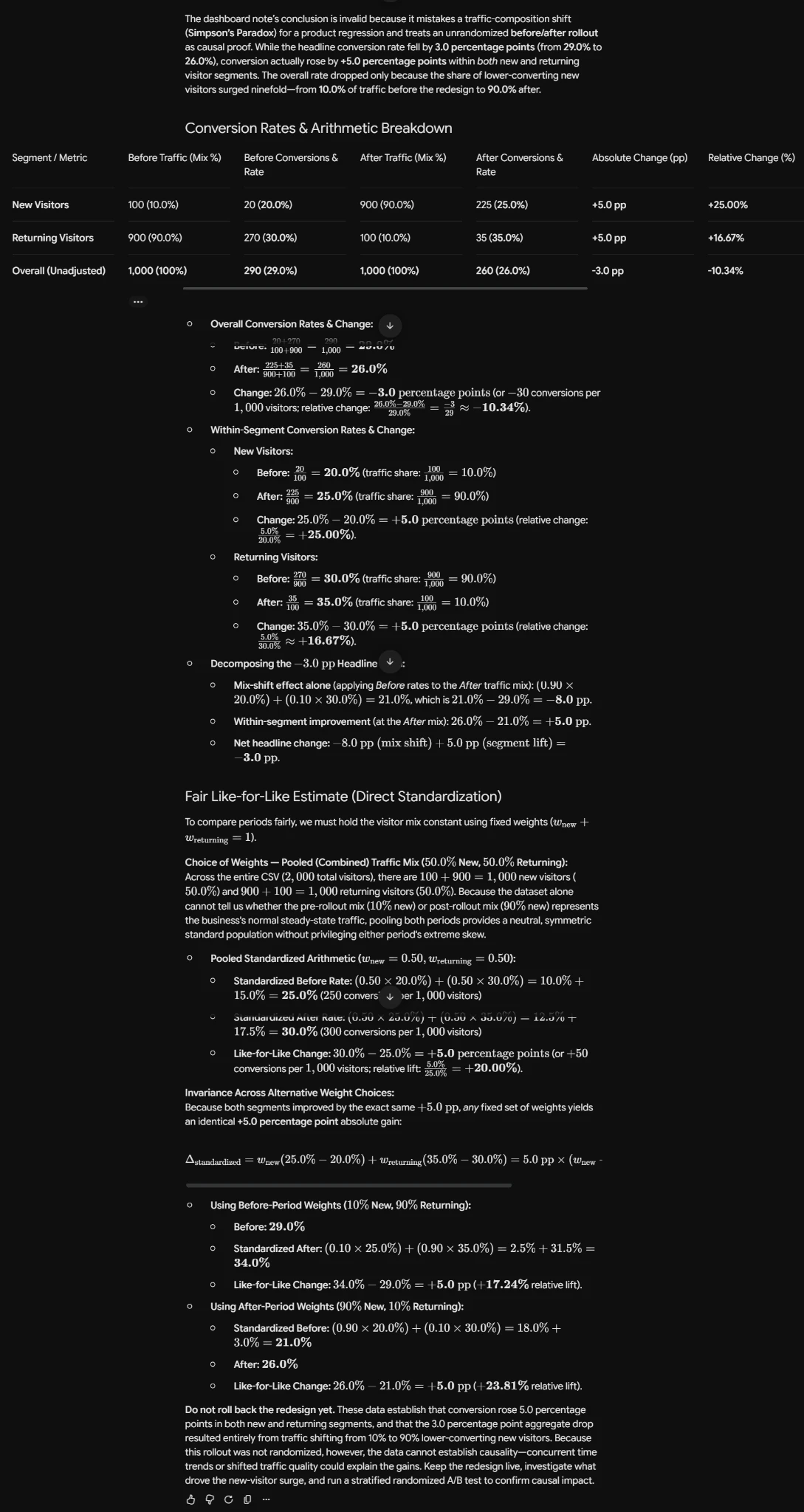
Task: Audit a fictional dataset regarding a website redesign that led to a drop in conversion rates. The goal was to see if the model could identify the flaw in the dashboard’s recommendation to "roll back" the redesign.
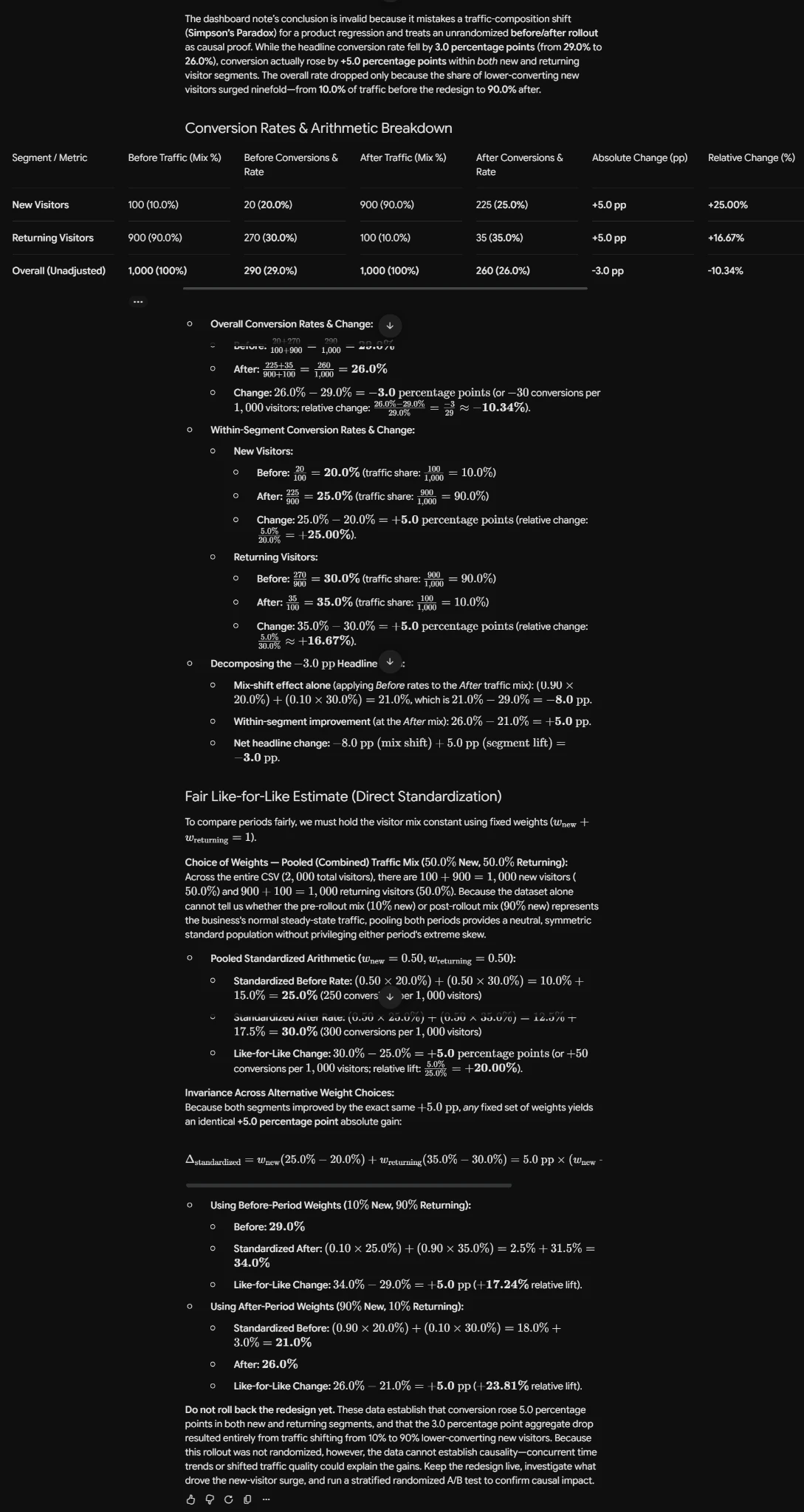
Results: Argon correctly identified that the overall conversion drop (29% to 26%) masked an underlying improvement in both "New" and "Returning" visitor segments. By performing a correct weighted average calculation, it proved that the redesign was actually performing better, but the composition of the visitor traffic had changed. This demonstrated high-level analytical reasoning that could save a business from making a catastrophic tactical error.
4. Document Reconciliation: The Launch Packet
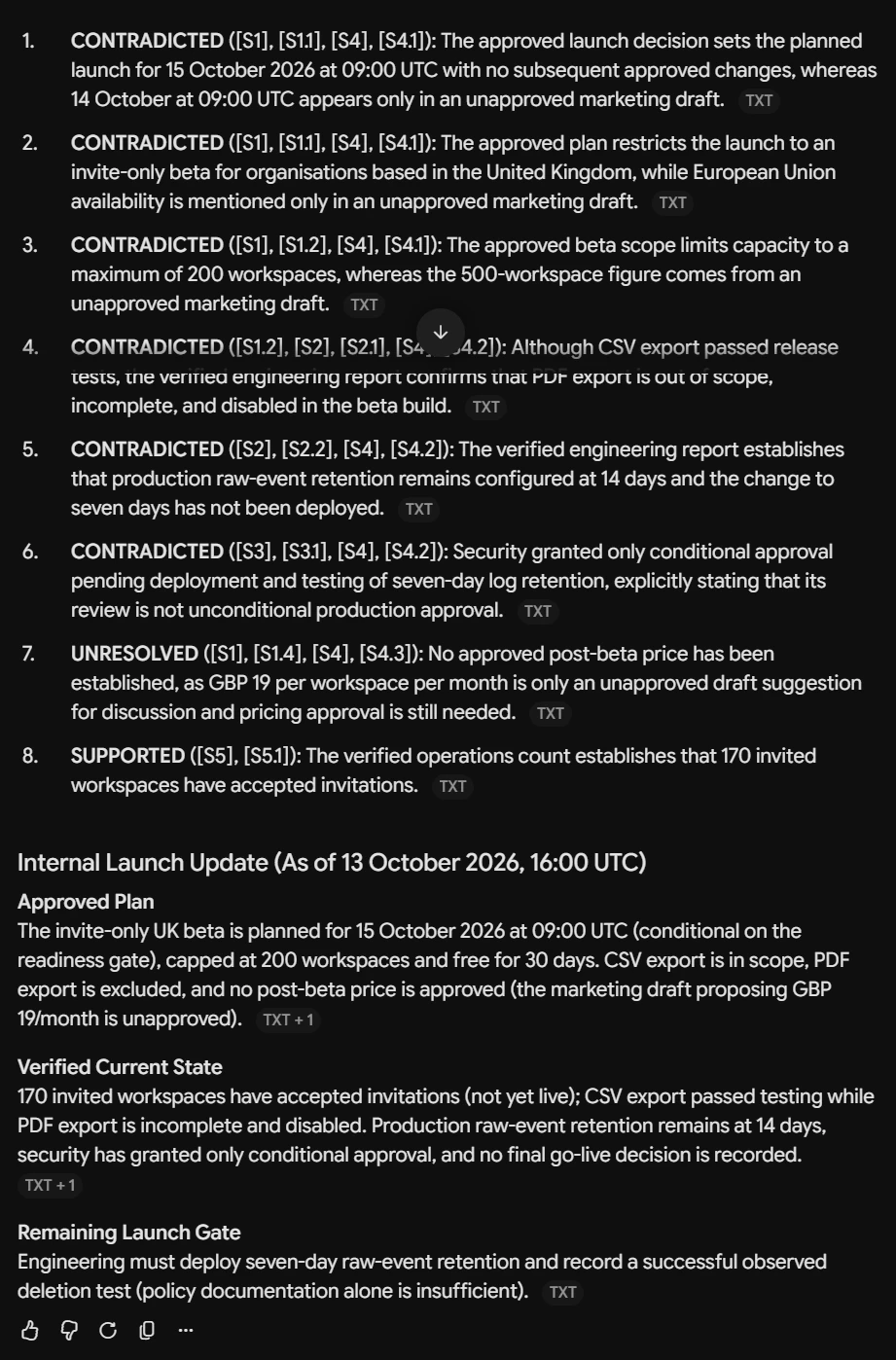
Task: Reconcile eight conflicting claims across a fictional launch packet, including engineering reports and marketing drafts.
Results: Argon demonstrated remarkable accuracy in labeling the claims (SUPPORTED, CONTRADICTED, or UNRESOLVED). It successfully navigated the temporal constraints of the documents. However, in the final summary, it introduced an unsupported claim regarding the status of "live" workspaces. This serves as a cautionary tale: while Argon is a masterful auditor, the final output—especially when it involves summarizing conclusions—still requires human oversight.
Benchmarks: What the Data Says
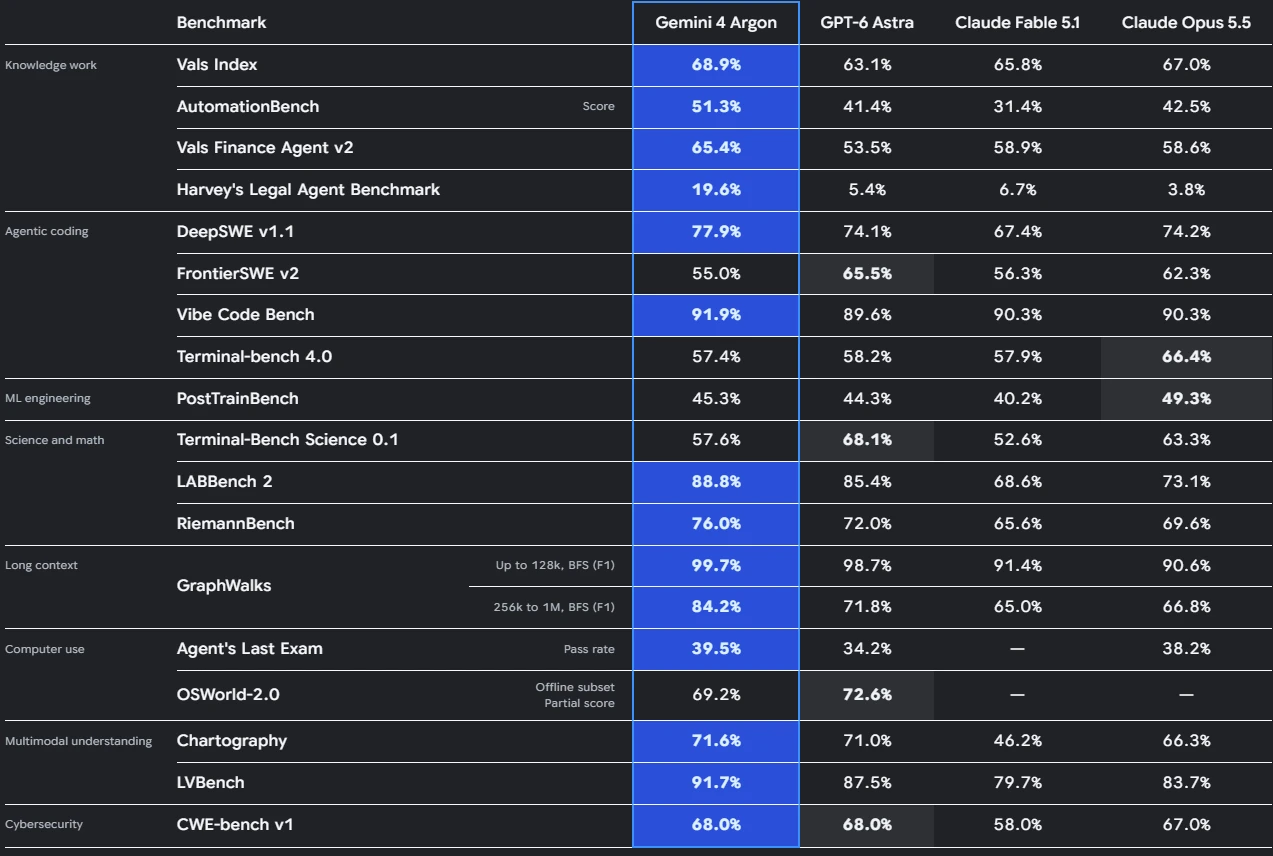
Argon is currently leading several industry benchmarks, including the Vals Index, AutomationBench, and the GraphWalks long-context test. These figures validate its "knowledge work" potential.
However, a word of caution regarding the "coding split." While Argon dominates DeepSWE and Vibe Code Bench, it is not the universal winner. GPT-6 Astra maintains a lead in FrontierSWE, and Claude Opus 5.5 remains the gold standard for Terminal-bench. The takeaway for developers is clear: choose your model based on your specific environment. If your workflow is heavily tied to deep software engineering (DeepSWE), Argon is your best candidate. If your needs are more terminal-centric, look elsewhere.
Implications for the Future of AI Workflows
The release of Gemini 4 Argon marks a transition point in the AI lifecycle. We are moving away from models that simply "chat" and toward models that "act." The integration of Canvas and Video generation tools suggests a future where the barrier between human intent and finished output continues to shrink.
The "Human-in-the-Loop" Mandate:
Despite the model’s impressive reasoning, the error in our launch document test underscores a fundamental truth: The model is a processor of evidence, not a judge of business risk. It can tell you what the data says, but it cannot tell you whether a risk is acceptable.
Strategic Recommendations:
- Prioritize Deliverables: Do not use Argon for "brainstorming" alone. It shines when it has a concrete goal—a code file, a data report, or a document audit.
- Verify the Thinking: In the API, monitor the "thinking tokens." If the model is taking a long time to "think," it is likely performing complex logical maneuvers that you should verify with independent arithmetic.
- Cross-Reference: Always treat the model’s summary as a draft. In our tests, the audit was perfect, but the synthesis contained a slight error. Use the model to find the evidence, but write the final conclusion yourself.
Conclusion
Gemini 4 Argon is a powerful addition to the Google ecosystem. It bridges the gap between raw, LLM-based reasoning and functional, application-driven output. While it is not infallible—as evidenced by the minor hallucination in our document test—its ability to handle complex data and build interactive prototypes makes it a formidable tool for knowledge workers.
As we look toward the end of 2026, the competitive gap between models is narrowing. Argon’s success will not be defined by its ability to answer questions, but by its ability to integrate seamlessly into the professional lives of those who demand precision, speed, and reliability. For now, it earns a spot on your shortlist, provided you treat its outputs with the professional skepticism that all high-level analytical work requires.
Frequently Asked Questions (FAQ)
Q1. Who can use Argon in Gemini?
Access is currently granted to all Google AI Pro and Ultra subscribers, providing an immediate pathway for non-technical users to access the latest reasoning engine.
Q2. Can Argon’s API generate video directly?
No. The API is text-based. Video generation within the Gemini ecosystem is powered by a separate underlying architecture (Gemini Omni) that Argon orchestrates.
Q3. What is the most significant benefit of the "Canvas" feature?
Canvas provides a dedicated, persistent workspace for developers and creators. It allows for iterative coding and web-design projects, moving the model from a chatbot into an active development partner.
Q4. Did Argon pass the "real-world" test?
Yes, with caveats. It successfully performed complex data audits and document reconciliations. However, users should remain vigilant; even with high-level reasoning, the model can occasionally introduce unsupported claims in summary text. Always verify the "last mile" of your AI-generated content.