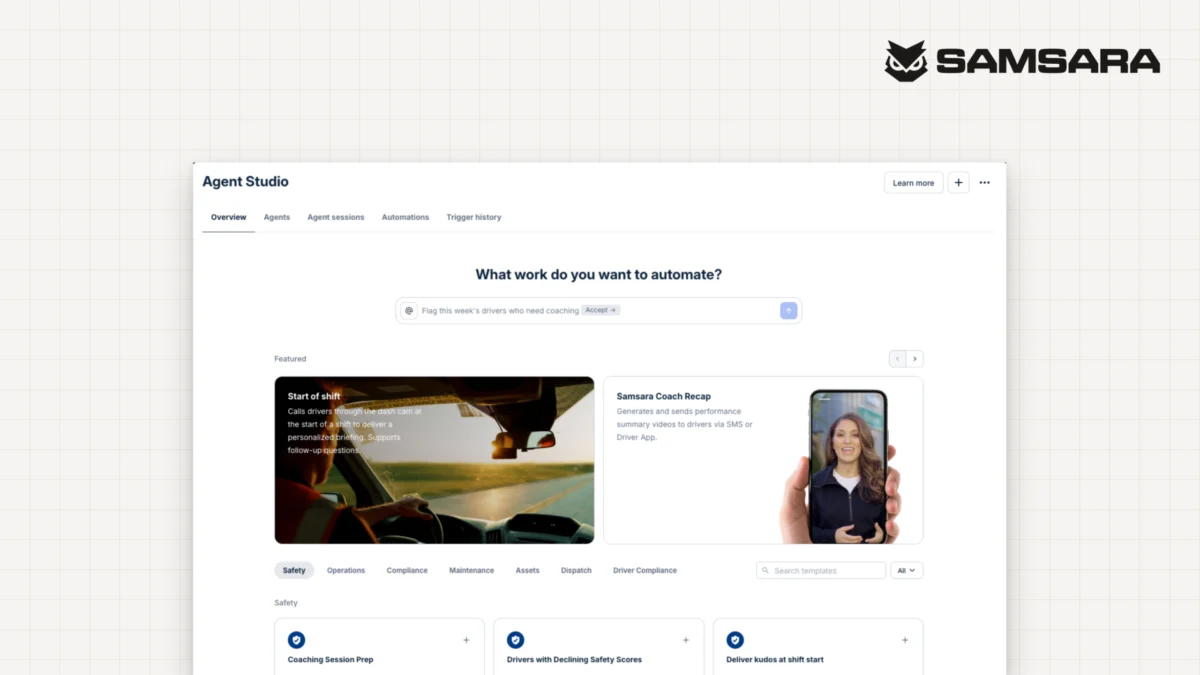
In the rapidly evolving landscape of industrial technology, Samsara has officially transitioned its Agent Studio platform from a limited release to general availability for its entire customer base. This move marks a significant pivot in how logistics companies, fleet operators, and industrial enterprises interact with their own operational data. By democratizing access to a no-code AI agent builder, Samsara is positioning itself as the central nervous system for autonomous, data-driven decision-making in the transportation sector.
As the logistics industry faces mounting pressure to move beyond experimental AI "pilot programs" and toward tangible, scalable financial returns, Samsara’s latest rollout serves as a litmus test for the viability of AI agents in real-world, high-stakes environments.
The Evolution of Agent Interaction: A Velocity Shift
The speed at which Samsara’s platform has gained traction is arguably its most compelling metric. Since the initial launch of its AI tools in June, the company has observed a massive acceleration in adoption. To measure this, Samsara tracks "interactions"—defined as a complete, self-contained agent session, whether conducted via chat or voice.
The growth curve is striking: the company’s most recent 500,000 interactions were accumulated over just 16 days. By comparison, that same volume of interaction took 112 days to achieve at the product’s launch. This sevenfold increase in velocity indicates that organizations are not just experimenting with the technology; they are integrating it into their daily operational workflows.
Crucially, the medium of interaction is shifting. Within four weeks of its launch, voice-based agents surpassed chat-based interactions in total volume—a lead they have maintained every single week since. This suggests that for field-heavy industries, the ability to engage with AI hands-free is not just a novelty, but a primary requirement for efficiency.
Chronology: From Concept to Universal Access
The journey to general availability for Agent Studio has been one of iterative development and strategic feedback loops:
- Pre-June 2026: Samsara develops a suite of AI-driven tools, focusing on the synthesis of telematics data, safety logs, and administrative requirements.
- June 2026: Samsara launches Agent Studio in a limited capacity, allowing early adopters to build custom agents that could perform tasks like compliance flagging and automated reporting.
- July 2026: Data reveals that voice agents are becoming the preferred interface for drivers and fleet managers, confirming the need for hands-free, in-cab AI integration.
- August 2026: The company refines its backend, allowing for more complex, multi-step workflows.
- October 2026: The official announcement of general availability. Agent Studio is now included as a standard component of existing Samsara subscriptions, signaling a move to make AI a baseline feature rather than a premium add-on.
Supporting Data: Real-World Efficiency Gains
While the broader logistics market remains skeptical about AI, Samsara has provided a series of case studies to demonstrate that its agents can indeed move the needle on key performance indicators (KPIs).
Streamlining Administrative Burdens
Grand Isle Shipyard has utilized Agent Studio to automate the compilation of inspection reports and asset data. By consolidating these tasks into a single agent-led workflow, the company reduced its report-generation time by 99%, bringing a task that previously consumed hours down to roughly five minutes per division. Samsara estimates this has freed up approximately $100,000 in annual specialist capacity, allowing human personnel to focus on strategic oversight rather than data entry.
Proactive Compliance Monitoring
S. Bertram Foods has deployed an agent to monitor real-time vehicle telematics, specifically tracking remaining drive time and shift limits. The agent proactively flags potential hours-of-service (HOS) violations three hours before they occur, allowing dispatchers to make adjustments before a driver is forced to stop. This has resulted in an 84% reduction in weekly manual review time, a significant win for operational efficiency.
Reducing Unassigned Driving
StreamTech Industrial leveraged the platform to tackle the "ghost fleet" problem: drivers failing to log into their assigned vehicles. By using an agent to flag trips lacking an associated driver, the company reported a reduction of 500 hours in unassigned driving over a two-month period, ensuring better accountability and data integrity.
Voice Agents: AI in the Driver’s Seat
Perhaps the most innovative aspect of the platform is the deployment of voice agents through dash cams. Federal regulations strictly prohibit commercial drivers from interacting with mobile phones while behind the wheel, yet the demand for real-time information at the facility level is high.
Samsara’s voice agents provide a hands-free solution. When a truck approaches an unfamiliar facility, the agent can initiate a call to the driver, delivering critical information such as entrance locations, parking protocols, yard speed limits, and mandatory personal protective equipment (PPE) requirements. Because these agents can be configured to trigger automatically upon entering a geofenced area, the driver receives the right information at the exact moment it is needed, without ever taking their eyes off the road or their hands off the wheel.
Official Perspective: The Human-Machine Synthesis
Johan Land, Samsara’s chief product officer, emphasizes that the success of these agents lies in their contextual awareness. "AI is quickly adopted when it’s useful," Land stated. "In physical operations, that means an agent has to understand the operation and meet people where the work happens."
For Samsara, "meeting people where the work happens" means moving AI from the static dashboard of a back-office PC to the mobile environment of the vehicle cab. By providing tools like Samsara Assistant (for dashboard queries) and Samsara MCP (which connects to third-party tools like ChatGPT or Claude), the company is creating an ecosystem where data is not just stored, but actively managed and communicated.
The Industry Context: Crossing the "AI Chasm"
The general availability of Agent Studio arrives at a critical juncture for the freight and logistics industry. Despite the hype surrounding artificial intelligence, adoption remains fragmented.
A March 2026 survey by the Boston Consulting Group (BCG) of over 180 logistics providers highlighted a significant gap between ambition and reality. While 40% of providers had moved beyond pilot programs, only 10% had successfully scaled AI across their core operations. Furthermore, only 13% reported achieving measurable financial value. Barriers such as unclear return on investment (ROI) and a lack of internal technical expertise continue to stifle widespread adoption.
Similarly, a September 2026 study by Descartes found that only 19% of shippers and 15% of logistics providers were using AI at scale. These figures underscore the "chasm" that Samsara is attempting to bridge. By bundling Agent Studio into existing subscriptions and utilizing a no-code interface, Samsara is effectively lowering the barrier to entry, attempting to turn the 40% of companies currently in "pilot limbo" into active, scalable users.
Implications and Future Outlook
The implications of Samsara’s move are twofold. First, it marks a shift toward "commodity AI" in logistics. When high-level capabilities like predictive compliance and automated reporting become standard features, companies that do not adopt these tools risk falling behind on cost and efficiency metrics.
Second, the shift toward voice-first interfaces suggests that the future of fleet management will be increasingly conversational. As agents become more sophisticated, the role of the fleet manager may evolve from an overseer of data to an architect of agent behavior—configuring the AI to handle routine interactions so that the human team can manage exceptions and complex strategy.
However, challenges remain. While Samsara’s case studies are compelling, the broader industry is looking for sustained, multi-year evidence of financial impact. As companies weigh their 2027 budgets, the ability to demonstrate a clear path from "number of interactions" to "bottom-line savings" will be the deciding factor for whether these AI agents become a permanent fixture or another fleeting tech trend.
For now, the rapid increase in interaction volume suggests that the logistics industry is ready to listen to what its data has to say—provided the AI can deliver the message in a voice they understand. As the industry gathers for upcoming events like the Future of Freight Festival in Chattanooga, these early adopters will likely be the center of conversation, providing the data points that will define the next chapter of AI in transportation.