Executive Summary: The Illusion of Adoption
For many Chief Learning Officers (CLOs), the mandate to integrate generative AI is measured in binary metrics: licenses deployed, training modules completed, and certification badges issued. On the surface, the rollout of an AI copilot across three business units appears to be a success story of digital transformation. However, a deeper look into the operational reality reveals a fractured landscape.
Eighteen months post-launch, organizations often find themselves in a state of "stagnant adoption." While some high-performing teams have fundamentally rewritten their workflows—using AI to draft, review, and iterate at breakneck speeds—others treat the tool as a mandatory annoyance, keeping the application open but rarely engaging with its transformative potential. The critical failure point is not a lack of technology, but a lack of circulation. In the modern enterprise, knowledge is failing to move through the organization at the speed of technological evolution, leaving teams isolated in their own struggles and discoveries.
The Chronology of a Stalled Transformation
The lifecycle of a failed AI rollout typically follows a predictable, downward trajectory:
- Phase 1: The Mandate (Months 1-3): Leadership pushes a top-down curriculum. Dashboards track completion rates, and managers are pressured to ensure 100% certification. The focus is entirely on compliance and output.
- Phase 2: The Silence (Months 4-9): As employees encounter the inevitable friction of new technology, they remain silent. Admitting, "I don’t know how to use this," feels like an admission of incompetence. Conversely, those who discover innovative "workarounds" fear being labeled as "going rogue."
- Phase 3: The Obsolescence Gap (Months 10-15): The AI tool evolves through two or three feature updates. Because the organization lacks a mechanism to share insights, the initial training material becomes outdated. The "early adopters" are effectively siloed, and the "wait-it-out" group remains stuck in legacy workflows.
- Phase 4: The Strategic Disconnect (Months 16-18): Management schedules a "refresher course," but it is too little, too late. The gap between those using the tool to gain a competitive edge and those ignoring it has become an unbridgeable chasm.
Supporting Data: The Cost of Misalignment
The disparity between investment and return is becoming a defining challenge of the mid-2020s. According to BCG, 72% of CEOs are now personally directing AI strategy, with overall AI investment expected to double as a share of revenue. Yet, the returns remain elusive.
Deloitte’s Global Human Capital Trends report highlights a startling reality: while 70% of business leaders identify speed and organizational nimbleness as their primary competitive advantage through 2029, 59% of organizations are still approaching AI with a purely tech-focused mindset. These organizations are 1.6 times more likely to fall short of their performance targets compared to those that prioritize human-centered design.
The employee sentiment reflects this friction. Udemy’s 2026 Global Learning and Skills Trends Report indicates that while 88% of employees believe effective leadership is the key to AI success, only 48% feel their managers are actually "AI-ready." The very individuals tasked with reinforcing learning—the middle managers—are often the least supported and the most afraid to expose their own knowledge gaps.
Implications: The Shift from Cascade to Circulation
The traditional L&D model operates on a "cascade" architecture: knowledge is created at the top, pushed downward, and reinforced through static intervals. This is a "single-loop" system—it can adjust outputs, but it cannot question the underlying logic of the work itself.
The Rise of Double-Loop Learning
To succeed, organizations must pivot to "double-loop" learning—a circulatory model where the frontline is not the end-point of a command chain, but a primary source of institutional intelligence. This requires a transition from a mechanistic mindset to a systems mindset, prioritizing multidirectional feedback loops over top-down directives.

Psychological Safety as Infrastructure
The circulatory model runs on trust, not tools. If an employee fears that surfacing a struggle will lead to performance reviews or that sharing a "rogue" success will be viewed as non-compliance, the knowledge stays trapped. A humanizing mindset requires leaders to model vulnerability. When a senior leader admits, "I am still fumbling my prompts," they provide the psychological safety necessary for the rest of the organization to experiment openly.
Official Perspectives: Redefining the Role of the CLO
The role of the CLO is undergoing an existential shift. They are moving from "curriculum owners" to "learning architects." This requires three fundamental changes in strategy:
1. Judgment as the New Curriculum
With AI capable of drafting financial models and communications plans, the "how" is increasingly handled by the software. The new, critical skill set is judgment. Employees must be trained to interrogate AI outputs, detect bias, and understand when to override machine-generated logic. Soft skills like reflexivity, critical thinking, and the ability to navigate ambiguity are now the most valuable "power skills" in the enterprise.
2. Rapid-Cycle Inquiry
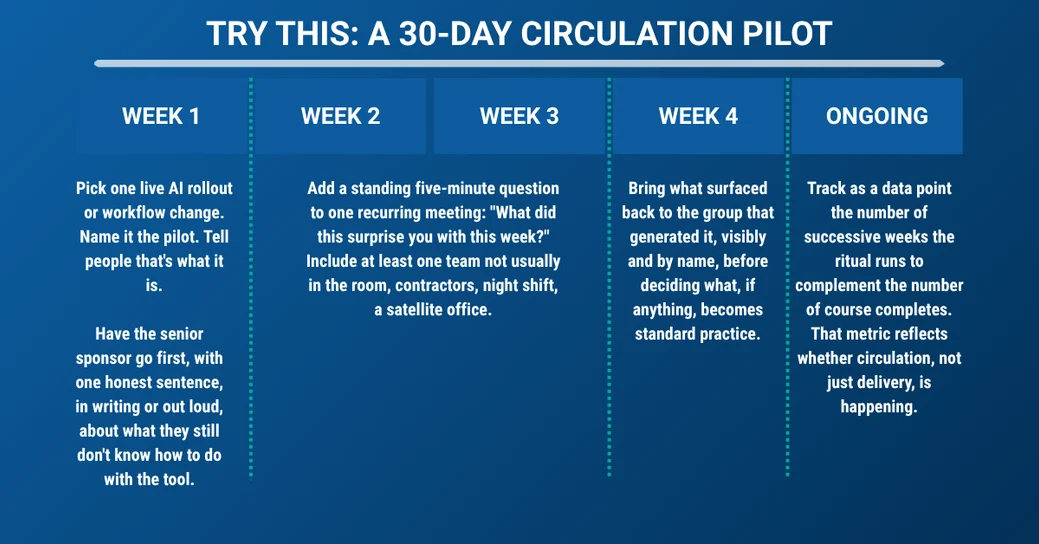
Rather than waiting for quarterly reviews, organizations are finding success in "rapid-cycle inquiry"—short, structured bursts of listening. By integrating a standing question into meetings—“What are we assuming about this tool that we haven’t tested?”—leaders can surface successful workarounds and bottlenecks in real-time. This turns the organization into a sensing machine, capable of adjusting its strategy at the pace of the technology itself.
3. Agentic AI as a Listening Partner
Leading organizations are now using Agentic AI to act as an "early-warning system" for organizational learning. Instead of just monitoring completion rates, these tools can analyze communication patterns or identify unconnected teams solving the same problems in isolation. However, this comes with a caveat: the moment this monitoring feels like surveillance, the candor required for learning disappears. AI must be used to surface trends, not to police individuals.
Structural Recommendations for the Next Two Quarters
To bridge the gap between investment and impact, leaders should adopt the following framework:
- Implement "Listening Loops": Replace the annual survey with five-minute "inquiry slots" in standing team meetings. These should involve a cross-section of employees, including those from frontline and non-traditional roles.
- Map Strengths to Projects, Not Roles: Move away from rigid job descriptions. Use trait-mapping to assemble teams based on specific strengths—such as future-focus, idea generation, or interpersonal sensitivity—relative to the active project.
- Model the "Inquiry Mindset": Senior leadership must be the first to demonstrate uncertainty. By making "What surprised you about the tool this week?" a standard fixture of leadership meetings, you signal that the goal is not perfection, but exploration.
- Ensure Equity in Circulation: Design learning systems that intentionally include marginalized or less-visible staff. Knowledge is often trapped in power structures; actively seek input from those furthest from the decision-making table to ensure that your "circulatory system" doesn’t just reinforce existing hierarchies.
Conclusion: The Competitive Advantage of Connection
The organizations that will thrive in the age of AI are not necessarily those with the most advanced algorithms, but those with the most fluid internal knowledge networks. In a landscape defined by constant disruption, the ability to circulate what is learned—and to do so without fear—is the ultimate competitive advantage.
The task for the modern CLO is to foster an environment where people feel safe to say, "I found this, but I don’t fully understand why it works yet." When that becomes the most respected sentence in the room, the organization has finally moved from a cascade of mandates to a system of true, adaptive intelligence. AI has opened a portal for organizational transformation; whether that portal leads to obsolescence or evolution depends entirely on the human networks that hold it open.