
Property taxes are among the oldest forms of government revenue, tracing their lineage back to the feudal systems of medieval Europe. Once a simple levy on the agricultural output of land, the modern property tax has evolved into a complex, multifaceted instrument of fiscal policy. Today, it serves as the primary engine for local government funding, financing essential public services ranging from road maintenance and infrastructure development to education and public safety. Yet, as governments worldwide grapple with the dual challenges of fiscal solvency and economic competitiveness, the structure of these taxes has become a flashpoint for debate.
The core tension lies in the design: should taxes be levied on the value of land alone, or should they encompass the improvements—the buildings, factories, and commercial structures—built upon that land? While the former is often praised for its economic efficiency, the latter is frequently criticized for acting as a penalty on investment. As nations across Europe and North America calibrate their tax codes, the disparity in approaches offers a masterclass in how fiscal policy can either catalyze growth or stifle development.
The Evolution of Property Tax: A Chronology of Fiscal Policy
To understand the contemporary landscape of property taxation, one must first look at its historical trajectory.
The Feudal Origins
In the medieval period, land was the primary repository of wealth. Sovereigns levied taxes on the land itself, often paid by farmers in the form of crops or labor. This system was localized and relatively straightforward, reflecting an era where capital was almost exclusively tied to agrarian output.
The Industrial Transition
As the Industrial Revolution took hold, the concept of "property" shifted. Wealth became increasingly tied to factories, machinery, and urban real estate. Governments responded by expanding the definition of taxable property to include these assets. This transition transformed the tax from a land-based levy into a broader tax on private capital stock.
The Modern Era and Global Reform
In recent years, the global approach to property taxation has seen a move toward decentralization and modernization.
- 2016: Research highlights the systemic shift from land-only taxes to broad-based real estate levies, emphasizing the economic trade-offs inherent in taxing physical improvements.
- 2025 (Germany): A pivotal shift occurred as Germany devolved its property tax base to the state level. This move allows individual states to tailor their fiscal policies to regional economic realities. Notably, the state of Baden-Württemberg seized this opportunity to shift toward a land-value-based tax model, prioritizing the economic efficiency of land use over the taxation of building improvements.
- 2025 (Croatia): In a move to broaden its revenue base, Croatia introduced a new recurrent property tax. Unlike traditional value-based models, Croatia’s system utilizes a physical-measurement approach, taxing based on the square footage of land and floor area, thereby simplifying the administrative burden of valuation.
Supporting Data: The Global Tax Landscape
The administration of property taxes varies significantly across international borders. While some nations forgo them entirely, others rely on them as a cornerstone of state revenue.
The Efficiency Leaders
At one end of the spectrum are Liechtenstein and Malta, which impose no recurrent taxes on property. This stance serves as a significant attractor for capital investment, as it removes a recurring annual cost from the balance sheets of both businesses and individuals.
Estonia stands alone among its European peers as the only nation to tax land exclusively. By exempting buildings and structures from the tax base, Estonia encourages property owners to improve their assets without fear of increased tax liability. This makes Estonia’s property tax system the most economically efficient in Europe, as it minimizes the distortionary effects on construction and development.
The Burden of Double Taxation
Of the 32 European countries that do levy property taxes, 28 allow businesses to deduct these costs from their corporate income tax. This provision is vital for maintaining a competitive business environment, as it acknowledges that property tax is a legitimate cost of doing business.
However, four countries—Austria, Iceland, Italy, and Slovenia—prohibit this deduction. This policy creates a "double taxation" scenario, where businesses pay taxes on the property itself and are then taxed again on the income that was used to pay those property taxes. This creates a significant drag on capital investment in these regions.
Comparative Revenue Stakes
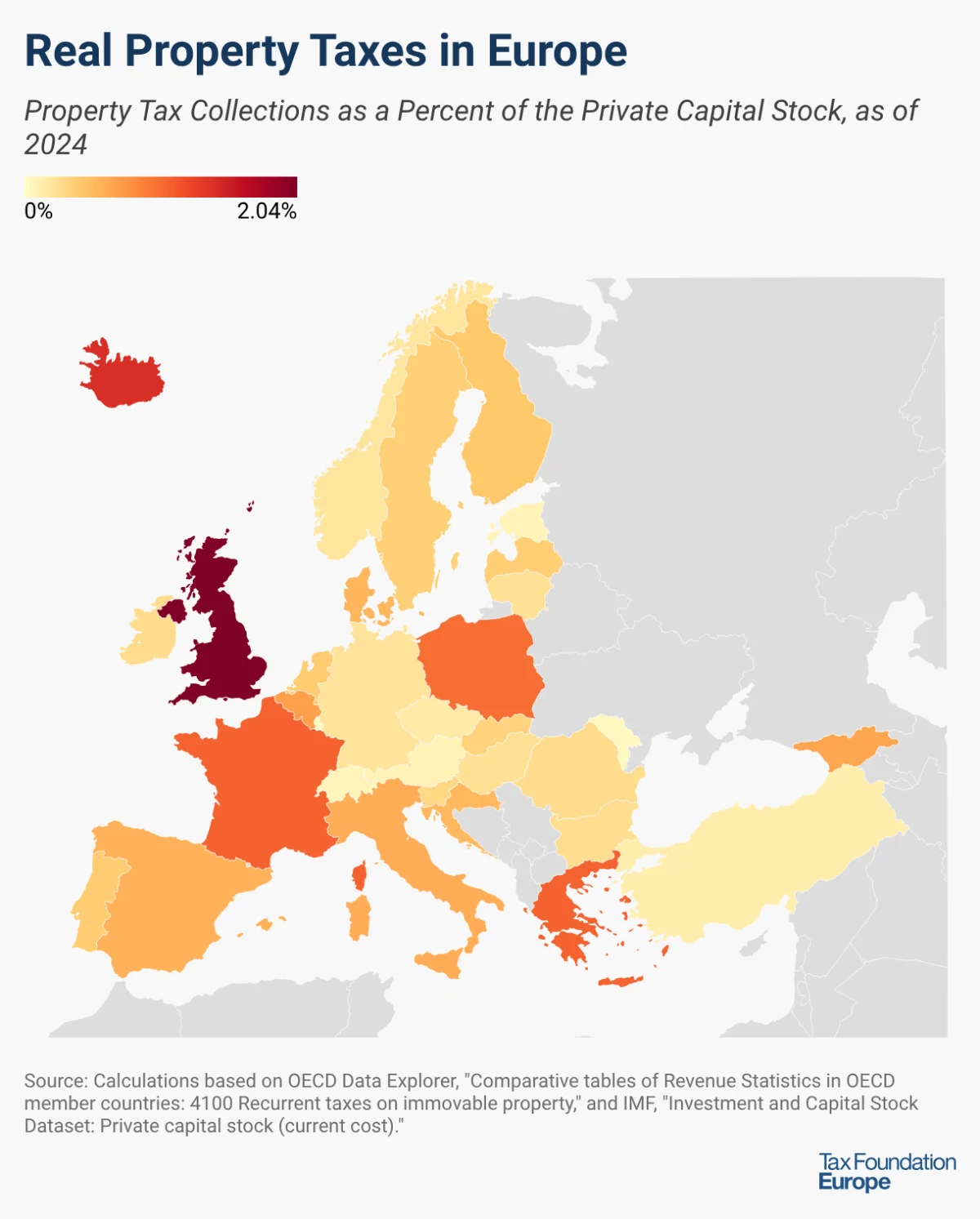
The revenue raised from property taxes as a share of private capital stock serves as a key indicator of the "tax bite" in different regions:
- Low Revenue Producers: Luxembourg and Moldova (0.05%), Switzerland (0.08%), and Estonia (0.09%).
- High Revenue Producers: The United Kingdom (2.04%), Iceland (1.43%), and France (1.08%).
When contrasted with the United States, the disparity is stark. The U.S. raises an average of 1.88 percent of its private capital stock in property taxes—a figure significantly higher than the European average of 0.45 percent. This suggests that American businesses and households operate in a much more aggressive fiscal environment regarding real estate ownership compared to their European counterparts.
Official Perspectives and Economic Implications
The design of a property tax system involves balancing competing interests: the need for local government revenue versus the desire to foster a pro-growth business environment.
The Incentive for Development
Proponents argue that property taxes provide a stable, predictable revenue stream for local governments. When the value of public services—such as well-maintained roads, parks, and high-quality school systems—is "capitalized" into property prices, the tax effectively allows governments to capture a portion of the value they have helped create. This creates a valuable fiscal incentive for municipalities to permit new development, as an increase in the tax base leads to a corresponding increase in local funding.
The "Penalty" on Improvements
Conversely, economists frequently point to the "deadweight loss" associated with taxing buildings and structures. When a business builds a new office complex or adds an extension to a factory, they are increasing the value of their property. If the property tax is high, this improvement triggers a tax hike.
This mechanism acts as a disincentive for capital improvement. Businesses, acting rationally, may choose to relocate to jurisdictions with more favorable tax codes, or they may refrain from necessary upgrades to avoid the tax burden. This is why the Estonian model—taxing land only—is frequently cited as the "gold standard" for economic growth, as it encourages the densification and improvement of urban spaces without penalizing the developer.
The Household Impact
The burden is not shared equally between businesses and families. In the 16 European nations that track the split, households bear the brunt of the load, remitting approximately 60 percent of total property tax revenue. This ranges from a low of 7.4 percent in the Slovak Republic to a staggering 71.4 percent in France. This data highlights that while business taxes are often the focus of policy debates, property tax reform is, in many nations, fundamentally a debate about the cost of housing for the average citizen.
Looking Ahead: The Future of Fiscal Policy
As the global economy becomes increasingly digitized and mobile, the traditional land-based tax model faces new challenges. The shift toward decentralization in countries like Germany signals a growing recognition that "one-size-fits-all" tax policies may no longer be viable in a diverse economic landscape.
The recent introduction of square-footage-based taxes in Croatia suggests a return to simplicity, moving away from the complex and often contentious process of market-value appraisals. By focusing on physical attributes, governments can reduce administrative costs and provide taxpayers with greater transparency and predictability.
However, the persistent gap between the U.S. and European tax burdens remains a point of contention. As the United States continues to rely heavily on property taxes to fund local education and infrastructure, the economic implications—both positive and negative—will continue to be a subject of intense scrutiny. For policymakers, the challenge remains clear: designing a tax system that provides sufficient revenue for public goods while ensuring that the tax itself does not become a barrier to the very economic activity that creates the value being taxed in the first place.
In conclusion, property tax is far more than a simple line item on a budget; it is a structural determinant of economic behavior. Whether through the lens of history, the scrutiny of current data, or the shifting policies of the 21st century, it is evident that the way a nation taxes its land and buildings speaks volumes about its priorities. As countries like Germany and Croatia chart new paths, the rest of the world would do well to watch closely, as the lessons learned today will shape the fiscal landscape for generations to come.


