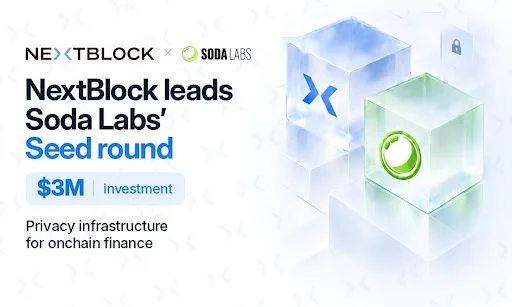
In a significant move that underscores the growing demand for institutional-grade privacy in decentralized finance, blockchain infrastructure developer Soda Labs has successfully closed a $3 million seed funding round. The investment, led entirely by NextBlock, serves as a strategic fuel injection for the company’s mission to bring programmable privacy to public blockchains—an essential requirement for the integration of traditional financial institutions into the digital asset ecosystem.
This capital infusion arrives at a pivotal juncture for Soda Labs. After more than two years of rigorous R&D focused on cryptographic privacy, the firm is pivoting from its inaugural "gcEVM" privacy layer toward a more ambitious, chain-agnostic architecture: Soda Bubble. By enabling private computation across disparate networks, the company aims to solve the "transparency paradox" that has historically kept regulated financial entities at arm’s length from public blockchain technology.
The Evolution of Private Computation: A Chronology of Innovation
Soda Labs’ trajectory has been defined by a methodical transition from niche technical experimentation to scalable, production-ready infrastructure.
The Genesis (2022–2023):
For the past 30 months, the Soda Labs engineering team has been focused on perfecting a cryptographic solution built upon the foundation of garbled circuits and multiparty computation (GC-MPC). Unlike many zero-knowledge proof systems that require heavy specialized hardware, Soda’s approach was designed to be lean. By utilizing established cryptographic standards such as AES and SHA256, the company ensured its protocol could operate efficiently on standard cloud CPUs.
The Proving Ground (2023–2024):
The company first put its theory to the test on the COTI network. The deployment of the gcEVM privacy layer acted as a real-world stress test, successfully processing over 100 million transactions. During this period, Soda Labs onboarded key commercial partners, including the tokenization platform Zoniqx and the perpetuals exchange PriveX. The latter, in particular, demonstrated the system’s robustness, having processed over $20 billion in cumulative trading volume, providing the empirical data necessary to secure investor confidence.
The Shift to Interoperability (2024–Present):
With the recent seed funding, Soda Labs is now transitioning to its next phase: the "Bubble" ecosystem. Moving away from a single-chain focus, the company is developing a coprocessor that allows for private computation regardless of the underlying blockchain network. This shift represents a transition from a siloed privacy tool to a universal layer for on-chain confidentiality.
Supporting Data: Why GC-MPC is a Game Changer
The technical barrier to entry for institutional finance on public ledgers is the "open book" nature of the technology. While transparency is a core feature of blockchain, it is often a liability for corporations bound by privacy regulations, trade secrecy, and competitive data protection.
Soda Labs argues that their GC-MPC architecture is uniquely positioned to bridge this gap. According to internal performance benchmarks, the company’s solution is vastly more efficient than existing privacy-preserving alternatives. The company claims its latest architecture offers:
- Throughput Advantage: Approximately 10 to 100 times greater transaction throughput than comparable privacy solutions.
- Cost Efficiency: A reduction in transaction costs by a factor of 100 to 1,000 compared to current alternatives.
- Hardware Agnosticism: Because the system runs on standard cloud infrastructure, it avoids the high capital expenditure and supply chain vulnerabilities associated with specialized hardware or Trusted Execution Environments (TEEs).
Recent testing conducted on the Arbitrum network, which measured the full transaction lifecycle—from initial encryption to MPC computation, consensus, and final settlement—showed a five- to tenfold improvement in performance compared to the company’s previous benchmarks. While the formal report is pending public release, these metrics have already provided a compelling value proposition to Soda’s investors.
Official Perspectives: The Strategic Rationale
The decision by NextBlock to fund the entirety of the seed round signals a high-conviction bet on both the technology and the commercial viability of Soda Labs.
"What attracted us to Soda was not only the underlying cryptography, but the practicality of the technology for the financial workloads we believe will matter most on-chain," said Pieter van Poecke, Founder and General Partner of NextBlock. Van Poecke emphasized that his firm was particularly impressed by the existence of a working product and an established customer base—a rarity in the early-stage blockchain infrastructure sector. "They possess the rare trifecta of technical intellectual property, a high-caliber founding team, and tangible commercial capabilities," he added.
For Soda Labs’ leadership, the goal is simple: to make public blockchains invisible to those who need privacy, without sacrificing the benefits of the public ledger.
"Public blockchains already have the liquidity, users, and financial applications," says Avishay Yanai, Co-Founder and CEO of Soda Labs. "What they lack is a way for regulated money to move without showing everyone everything." Yanai notes that the Bubble architecture is designed specifically to provide banks and payment processors with "controlled disclosure"—the ability to prove that a transaction is compliant without revealing the sensitive underlying data to the public or even to the infrastructure provider itself.
Implications for the Financial Landscape
The expansion of the Bubble Validator Network, which allows participants to mathematically verify that private computations were performed correctly without exposing the raw data, carries profound implications for the future of finance.
1. Institutional Onboarding
By providing a mechanism for privacy, Soda Labs is effectively removing the primary hurdle for institutional adoption. Banks can now leverage the efficiency of public networks for cross-border payments, inter-bank settlement, and asset tokenization without violating client confidentiality or anti-money laundering (AML) reporting standards.
2. Cross-Chain Privacy
The current roadmap involves expanding Bubble across major EVM-compatible ecosystems, including Ethereum, Polygon, Arbitrum, and Base. However, the company’s sights are set further afield, with active development underway for non-EVM networks like Solana. This chain-agnostic approach ensures that liquidity and privacy-protected assets can move fluidly across the fragmented blockchain landscape.
3. The Path to Commercialization
Over the next 12 to 18 months, the $3 million in capital will be aggressively deployed to scale the company’s go-to-market strategy. Beyond technical team growth and validator network expansion, Soda Labs is actively engaged in undisclosed pilots with major financial and infrastructure organizations. The transition of these pilots into production deployments will be the ultimate test of the company’s technology.
4. Regulatory Compliance as a Feature
Perhaps the most significant implication is how Soda Labs frames privacy: not as a way to circumvent regulation, but as a prerequisite for it. By integrating privacy with the ability for authorized parties to perform audits or verify compliance, Soda Labs is positioning its tech as a "compliance-first" infrastructure.
As the blockchain industry moves away from the "wild west" era of speculation and toward a more regulated, institutional-grade environment, the infrastructure that can guarantee both high-performance computation and absolute data confidentiality will likely become the backbone of the next generation of global finance. With this successful seed round, Soda Labs has firmly positioned itself as a frontrunner in that transition, moving beyond the theoretical promises of privacy and into the practical, scalable implementation of it.