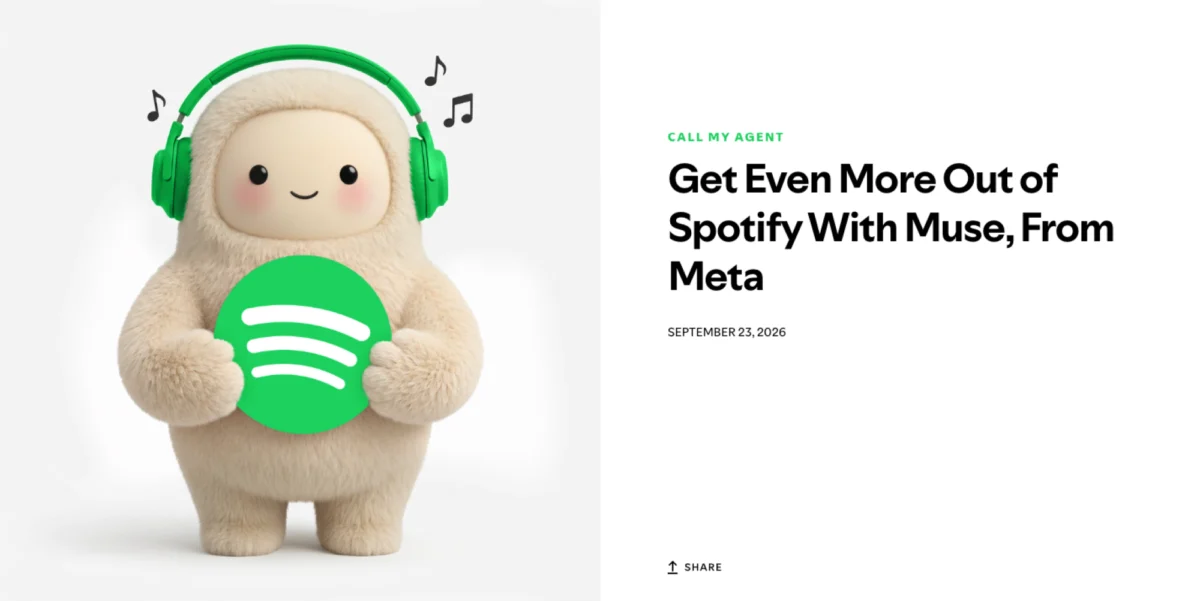
In the rapidly evolving landscape of generative artificial intelligence, the goal has shifted from simple chatbot interactions to the creation of "agentic" systems—AI that doesn’t just answer questions, but actively executes tasks across disparate software ecosystems. The latest milestone in this transition is the integration of Meta’s personal AI agent, Muse, with Spotify. This partnership represents a fundamental shift in how users interact with digital audio: moving from manual curation to ambient, context-aware orchestration.
While users have long enjoyed Spotify’s native AI features—such as "Prompted Playlists" and "Talk to Spotify"—the arrival of Muse signals a move toward a unified personal digital assistant that understands your calendar, your location, and your preferences simultaneously.
The Core Concept: Context-Aware Audio
The premise behind the Meta-Spotify integration is simple yet transformative: your digital assistant should know what you are doing, where you are going, and what you need to hear before you even think to ask.
For instance, if you mention an upcoming road trip to Muse, the agent doesn’t just suggest a playlist. It analyzes your destination, curates a journey-appropriate soundtrack, and then—anticipating your departure time—automatically initiates playback as you head to your vehicle. This goes far beyond the traditional "search and play" functionality. By tethering music playback to your actual life schedule, Muse attempts to blur the line between a music streaming service and a life management tool.
Beyond travel, Muse can synthesize your daily briefings and notes into a "Personal Podcast," effectively turning your schedule into audio content. It can recognize your morning workout routine, automatically triggering your high-intensity playlist at exactly 7:00 a.m. each day. The friction of opening an app, searching for a mood, and pressing play is effectively eliminated.
Chronology of Integration
To understand the significance of this move, one must look at the recent trajectory of AI-audio integration:
- October 2025: Spotify officially launches its integration with OpenAI’s ChatGPT, allowing users to request personalized music recommendations via conversational text without opening the Spotify app.
- January 2026: Spotify rolls out "Prompted Playlists," a feature enabling users to describe a specific vibe or scenario, which the platform then translates into a curated tracklist.
- May 2026: Spotify debuts "Personal Podcasts," utilizing generative AI to read out daily summaries and news briefings tailored to the user’s specific interests.
- July 2026: The "Talk to Spotify" beta launches, allowing Premium users to use natural language commands to control their listening experience directly.
- September 2026: Meta announces the expansion of its Muse agent ecosystem. Simultaneously, Spotify announces deep-linking capabilities with Muse, marking the first time a major third-party agent has been given "write" access to a user’s Spotify library and scheduling functions.
Supporting Data and Ecosystem Synergy
The vision for Muse is not limited to music. Meta has architected the agent to act as a central nervous system for a user’s digital life. By partnering with companies like Ticketmaster for live event discovery and Plaid for financial account management, Muse is designed to be a "do-everything" interface.
The data suggests that users are increasingly suffering from "app fatigue"—the need to switch between dozens of individual platforms to manage daily tasks. Meta’s strategy is to position Muse as the universal layer that sits atop these services. By allowing Muse to "talk" to your bank account, your calendar, and your music library, Meta is betting that the convenience of a single interface will outweigh the privacy concerns inherent in centralizing personal data.
Spotify’s recent expansion of its "Taste Profile" in the United States provides the necessary metadata for this integration to function. By building a robust understanding of user preferences, Spotify has created a "recommendation engine" that Muse can query to ensure that the music it selects is not just background noise, but highly personalized audio that aligns with the user’s specific history and current mood.
Official Responses and Strategic Rationale
In an official statement released on September 23, 2026, Spotify representatives emphasized the "seamlessness" of the experience: "Your agent can play music on Spotify, save songs to your Library, build playlists, help you find a book or podcast. We are moving toward a world where the music meets the moment, rather than the user having to hunt for the music."

For Meta, the partnership is a cornerstone of its "Connect" initiative, which aims to move the company beyond social networking and into the realm of utility-based computing. The goal is to make the Muse agent indispensable. If Muse is the only entity that knows you have a budget meeting at 10:00 a.m. and that you listen to lo-fi hip-hop to focus, it creates a "stickiness" that is difficult for competitors to replicate.
Implications: The Privacy Paradox
Despite the convenience, the integration of Muse with personal accounts raises significant security questions. Granting an AI agent the ability to "write" to your Spotify library, interact with financial data via Plaid, and read your notes requires a high level of trust.
The Security Risks
Security researchers have pointed out that AI agents, including Meta’s Muse, remain vulnerable to "prompt injection" attacks and other zero-day exploits. When an agent has the authority to make decisions on your behalf, the scope of a potential security breach expands exponentially. If a bad actor gains control over your agent, they could theoretically gain insights into your location, your habits, and your financial standing.
The Future of Choice
There is also a philosophical implication regarding "algorithmic curation." When an AI agent decides what you listen to, does it narrow your musical horizons? If Muse defaults to your established tastes to ensure "successful" recommendations, users may find themselves in an audio echo chamber, rarely discovering music that challenges their existing preferences.
Furthermore, the "agentic" nature of these tools creates a dependency. As users offload the task of playlist curation to an AI, the act of "discovering" music—once a social or deliberate hobby—becomes a passive experience. The role of the human listener is relegated to that of a spectator, watching their digital assistant "manage" their life.
The Verdict: Convenience vs. Autonomy
As of late 2026, the Muse-Spotify integration is a testament to the power of modern LLMs (Large Language Models) to perform complex, multi-step tasks. For the average user, the ability to simply say, "I’m going to the airport, play something for the drive," and have the agent handle the rest, is a significant quality-of-life upgrade.
However, the technology is still in its infancy. There will inevitably be moments where the agent misinterprets the prompt, plays the wrong track, or fails to sync with the calendar. As the press release noted, if the AI gets the timing and music right, you might never need to manage a playlist again. But if it gets it wrong, the user is left with the manual burden of overriding the system.
For now, the play button still works. The question for the coming years is whether we will even remember where that button is, or if we will have fully surrendered our daily soundtrack to the algorithms. As these agents become more sophisticated, the challenge will not be the technology itself, but maintaining the human element of choice in a world increasingly managed by digital proxies.
As with any tool that bridges the gap between private data and public services, the advice remains clear: proceed with caution. The convenience of an automated life is enticing, but the cost of that convenience is a surrender of control that users must weigh carefully before granting their AI agents keys to the kingdom.