
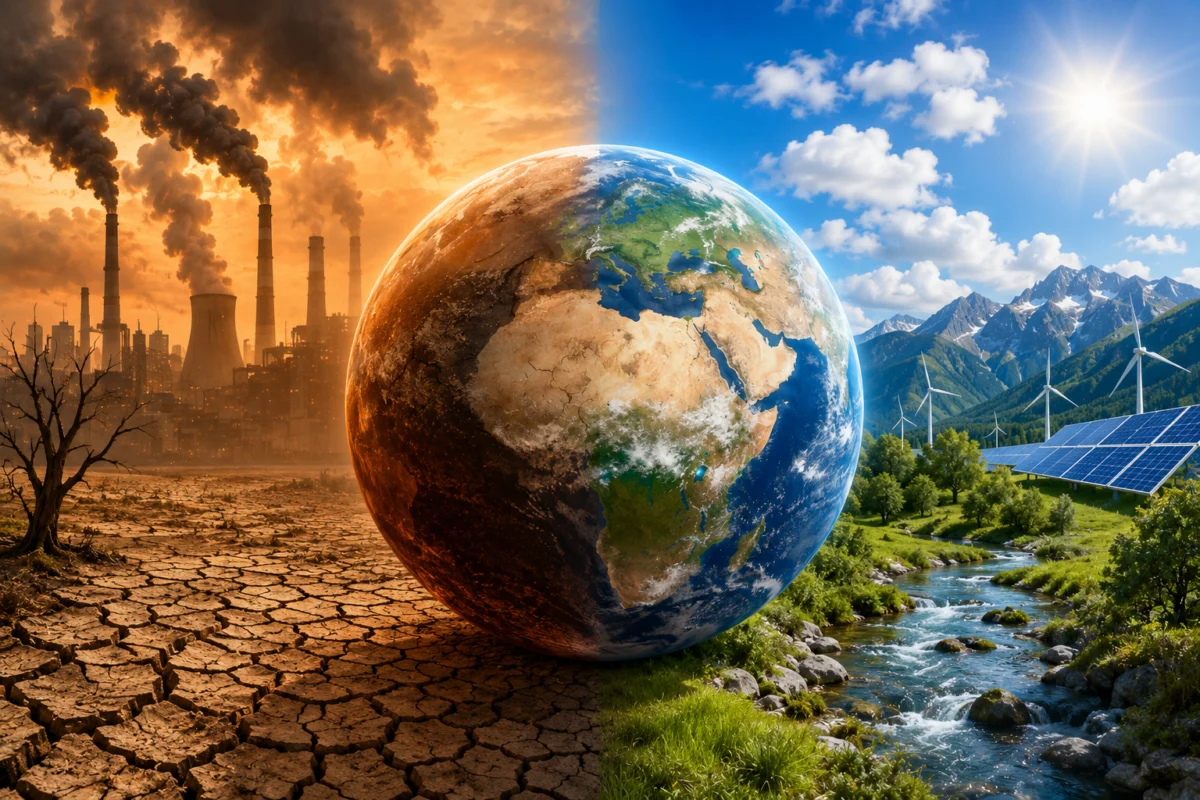
The Earth’s climate is governed by a delicate, invisible balance of energy. At the heart of this system lies the greenhouse effect—a natural phenomenon that has, for millennia, kept our planet habitable. However, the rapid alteration of the atmosphere’s chemical composition, primarily through the accumulation of carbon dioxide (CO₂), has shifted this balance. As we navigate the 21st century, the discourse surrounding climate change has evolved from a theoretical concern into an urgent global imperative.
The Science of the Greenhouse Effect
To understand the current climate trajectory, one must first appreciate the mechanism of the greenhouse effect. The Earth is constantly bathed in solar radiation. While a portion of this energy is reflected back into space, the remainder is absorbed by the planet’s surface, warming it. The Earth then radiates this energy back toward space as infrared radiation.
Greenhouse gases—most notably CO₂, methane, and water vapor—act as a thermal blanket. They absorb this outgoing infrared radiation and re-emit it in all directions, including back toward the surface. This process is essential; without it, the Earth’s average surface temperature would plummet, rendering the planet unable to support life as we know it. The crisis today is not the existence of these gases, but the anthropogenic disruption of their concentration. By injecting billions of tons of CO₂ into the atmosphere, humanity is thickening this "blanket," trapping excess heat and forcing the climate system into a state of disequilibrium.
A Chronology of Anthropogenic Change
The trajectory of atmospheric CO₂ is inextricably linked to the history of industrialization.
- 1750–1850: The Industrial Dawn. The transition from agrarian societies to industrial powerhouses marked the beginning of large-scale coal combustion. For the first time, carbon that had been sequestered underground for millions of years was liberated into the atmosphere.
- 1900–1950: The Era of Oil and Internal Combustion. The widespread adoption of the automobile and the expansion of global shipping networks cemented the reliance on petroleum-based fuels, accelerating the carbon accumulation rate.
- 1950–Present: The Great Acceleration. Post-WWII economic expansion, the rise of industrial agriculture, and global urbanization led to an exponential increase in greenhouse gas emissions. In 1958, the Keeling Curve began recording consistent, year-over-year increases in atmospheric CO₂ at Mauna Loa, confirming a trend that continues to break records today.
Supporting Data: The Indicators of a Warming World
The empirical evidence of a warming planet is multifaceted and derived from rigorous, long-term observation.
- Atmospheric Concentration: Pre-industrial CO₂ levels hovered around 280 parts per million (ppm). Today, they regularly exceed 420 ppm—a level unprecedented in at least 3 million years.
- Surface Temperatures: Global average surface temperatures have risen by approximately 1.1°C since the late 19th century. Each of the last four decades has been successively warmer than any decade that preceded it since 1850.
- Oceanic Heat Content: Over 90% of the excess heat trapped by greenhouse gases is absorbed by the world’s oceans. This has led to consistent warming of the upper 2,000 meters of the sea, which drives thermal expansion and contributes to sea-level rise.
- Glacial Retreat: Satellite imagery and field measurements confirm the mass loss of the Greenland and Antarctic ice sheets, as well as the retreat of mountain glaciers globally, providing a visible testament to the stored energy in the climate system.
Official Responses and Global Policy
The scientific consensus on the urgency of climate action has prompted unprecedented international cooperation. The United Nations Framework Convention on Climate Change (UNFCCC) serves as the primary forum for these discussions.
The Paris Agreement (2015) remains the landmark policy framework, aiming to limit global warming to well below 2°C, preferably 1.5°C, compared to pre-industrial levels. Governments worldwide are now integrating these goals into national legislation, often referred to as "Net-Zero" commitments. These policy shifts involve phasing out coal-fired power, incentivizing the adoption of electric vehicles, and implementing carbon pricing mechanisms to reflect the true cost of emissions. Furthermore, organizations like the Intergovernmental Panel on Climate Change (IPCC) provide the authoritative synthesis of science that guides these political negotiations, ensuring that policy is rooted in the latest findings.
Implications for the Global System
The implications of climate change are not merely restricted to "warmer weather." They represent a systemic shift in the Earth’s physical, biological, and economic foundations.
The Oceanic Crisis
The oceans are suffering a "double whammy." First, they are warming, which disrupts marine ecosystems and contributes to rising sea levels. Second, they are acidifying. As oceans absorb CO₂, the water undergoes a chemical reaction that lowers its pH. This makes it increasingly difficult for calcifying organisms—such as corals, mollusks, and some plankton—to build their protective shells. Because these organisms sit at the base of the marine food web, their decline threatens the entire oceanic ecosystem.
Extreme Weather and Human Security
While climate change does not "cause" every individual weather event, it alters the "loading of the dice." A warmer atmosphere holds more water vapor, leading to more intense precipitation events and flooding. Simultaneously, higher temperatures exacerbate droughts and dry out vegetation, creating the conditions for more frequent and severe wildfires. For coastal populations, the combination of sea-level rise and more intense storm surges represents a direct threat to infrastructure, agriculture, and human habitability.
Biodiversity and Ecosystem Pressure
Species distribution is governed by climate. As temperature bands shift poleward or toward higher altitudes, many species are forced to migrate. However, many ecosystems, such as coral reefs and mountain forests, are "trapped" by geography or lack the evolutionary speed to adapt to the rapid pace of current changes. The loss of biodiversity is not just a conservation issue; it is a threat to the ecosystem services we rely on, including pollination, water purification, and natural pest control.
The Long-Term Challenge: Why Persistence Matters
Perhaps the most daunting aspect of CO₂ is its atmospheric longevity. Unlike pollutants that wash out of the air in days or weeks, a significant portion of emitted CO₂ remains in the atmosphere for centuries. Even if we were to cease all emissions tomorrow, the heat already "in the pipeline" would continue to influence the climate for generations.
This reality shifts the focus of climate policy toward two complementary pillars:
- Mitigation: Drastically reducing current emissions through energy efficiency, renewable energy, and carbon capture technology to prevent the worst future outcomes.
- Adaptation: Acknowledging that some level of change is already locked in, and proactively upgrading infrastructure, designing resilient cities, and securing food systems to survive the changes that are now unavoidable.
Conclusion: Decisions for Tomorrow
The story of CO₂ is the story of modern civilization’s impact on the only home we have. While the challenges are profound, the path forward is illuminated by innovation and global resolve. The transition to a low-carbon economy—defined by the electrification of transport, the decarbonization of the grid, and the protection of natural carbon sinks—is underway.
However, the speed of this transition remains the critical variable. Because CO₂ affects the climate for centuries, the decisions made in this decade will ripple forward, determining the climatic conditions for the remainder of the century and beyond. The scientific challenge has been met with clarity; the remaining challenge is the societal commitment to implement the systemic changes required to stabilize our planetary future. We are no longer merely observers of the climate; we are its architects, and the blueprints we draw today will dictate the resilience of the world we leave behind.


