

The convergence of traditional finance (TradFi) and decentralized infrastructure has entered a new, volatile, and highly speculative phase. In 2026, the crypto-asset landscape is witnessing a profound shift: while the broader crypto-native futures market has experienced a modest cooling, "TradFi perps"—perpetual futures contracts tracking legacy assets like Tesla [TSLA] and Apple [AAPL]—have exploded in popularity.
According to the latest data from Binance Research, this trend is not merely a cyclical fluctuation but a structural migration of capital. As investors pivot toward synthetic exposure to equity markets, the composition of the digital asset economy is fundamentally changing.
The Ascent of TradFi Perpetuals: A 10x Growth Story
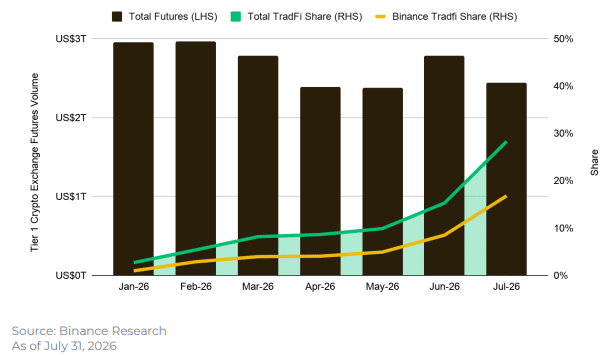
The data paints a striking picture of investor behavior in the current fiscal year. Since January 2026, the trading volume for TradFi perpetual contracts has surged from a modest $80 billion to a staggering $691 billion. This represents a nearly 10x expansion in just seven months, marking TradFi perps as one of the most aggressive growth narratives of the year.
By contrast, the traditional crypto futures market—which encompasses perpetuals and futures on native assets like Bitcoin and Ethereum—has softened. Volumes across the industry’s top-tier exchanges dipped from $2.95 trillion in January to $2.44 trillion by August.
When placed side-by-side, these figures reveal that TradFi perps now command approximately 28% of the total crypto futures market share. In July alone, derivatives tied to major tech equities accounted for 28.3% of the sector’s volume. This suggests that the current crypto-asset ecosystem is increasingly functioning as a 24/7 global clearinghouse for traditional market exposure, effectively bridging the gap between legacy equities and blockchain-based settlement.
Chronology of the Shift: From Asset Class to Market Migration
To understand this trend, one must look at the timeline of the 2026 market cycle:
- Q1 2026 (The Inception): Markets began the year with high expectations for a "tokenization super-cycle." While native crypto assets saw high volatility, liquidity began flowing into decentralized venues offering perpetual contracts for stocks, fueled by the desire for high-leverage exposure outside of traditional brokerage hours.
- Q2 2026 (The Divergence): As regulatory pressures and market uncertainty affected native crypto-asset volumes, TradFi perps began to decouple. The volume growth rate of TSLA and AAPL perps significantly outpaced that of major altcoins.
- Q3 2026 (The Consolidation): By August, the market reached a critical juncture. The Binance Research report confirmed that the cooling of native crypto volume, coupled with the rapid expansion of TradFi perps, indicates a formal "asset-class migration."
Binance Research analysts noted, "One category expanding while the other cools is the signature of an asset-class migration, not an ordinary volume cycle." This transition highlights a shift in investor sentiment, where the primary utility of crypto exchanges is being redefined as a secondary market for global financial instruments.
The "Tokenized Stock" Paradox
While perpetuals are soaring, the "spot" version of these assets—tokenized stocks without leverage—has seen a significantly more tempered reception. The Real-World Asset (RWA) segment, which covers tokenized equities, grew by only 3.2% month-on-month.
Despite the slow relative growth, the adoption figures are noteworthy. The total value locked or traded in tokenized stocks has expanded from $700 million to $2.3 billion since the start of the year—a 3x increase. Perhaps more significantly, the user base for these instruments has crossed the 1 million-holder milestone for the first time. This suggests that while speculators are flocking to high-leverage perps, a growing cohort of investors is interested in the long-term, non-leveraged utility of holding tokenized equities on-chain.
Generational Shifts: Debunking the Speculative Myth
One of the most compelling insights provided by the 2026 data concerns the demographic breakdown of these traders. There is a long-standing assumption in financial literature that younger investors, specifically Gen Z, are inherently more prone to high-leverage, hyper-speculative trading behavior.
However, Binance Research’s findings challenge this narrative. When analyzing exposure to leveraged tokenized ETFs, Gen Z investors allocated only 5.9% of their total trading volume to these high-risk instruments. In stark contrast, Millennials and older generations consistently held a higher percentage, ranging between 7% and 8%.
"The prevailing assumption about young, first-time investors is that they trade aggressively and speculatively," the report stated. "The cohort most associated with risk-seeking behavior allocates the smallest proportion of its activity to leveraged instruments."
This indicates that younger participants are perhaps more deliberate in their portfolio construction than previously believed, favoring spot-like or low-leverage exposure, while older generations—perhaps more accustomed to the high-stakes environment of traditional margin trading—are the ones driving the leverage in the crypto-asset ecosystem.
Implications for Blockchain Infrastructure and Governance
The rise of tokenized assets and TradFi perps was initially expected to be a rising tide that would lift the tokens of the underlying blockchains hosting these protocols. Logic dictated that if a chain becomes the home of multi-billion dollar derivative volume, its native token should appreciate accordingly.
Yet, 2026 has provided a counter-intuitive reality. BNB Chain, which has emerged as a dominant force in the tokenized ETF segment, has seen its native token price decline by 32% year-to-date. Similarly, Solana—another primary hub for DeFi and RWA activity—has experienced a 42% drawdown in its native token, SOL.
This decoupling suggests several implications:
- The "Utility-Value Gap": The increase in TVL and trading volume on a chain does not necessarily translate to immediate value accrual for the chain’s native token. Market participants may be viewing these chains as utility layers rather than investment vehicles, or perhaps the broader macro environment is overshadowing the specific growth of the tokenization sector.
- Market Maturation: As the crypto market matures, the correlation between protocol usage and token price is becoming increasingly complex. Investors are moving away from speculative "narrative trading" and are looking for fundamental, yield-bearing, or real-world utility, which may take longer to reflect in token valuations.
- Future Outlook: While the tokenization boom has yet to trigger a sustained rally in underlying blockchain assets, the sheer volume of capital ($691B in perps) proves that the demand for these services is real and sustainable. As these infrastructures become more robust, the long-term value capture may eventually align with the fundamental growth of the services they host.
Conclusion: A New Frontier of Financial Synthesis
The 2026 market data serves as a milestone for the digital asset industry. We are witnessing a clear transition where crypto-native exchanges are evolving into hybrid platforms capable of hosting the global traditional equity market.
The rapid adoption of TradFi perpetuals, the tempered but steady growth of spot tokenized assets, and the surprising caution exhibited by Gen Z investors all point toward a more sophisticated, albeit volatile, financial ecosystem. While the immediate price action of native blockchain tokens remains disconnected from the success of these platforms, the infrastructure being built is undeniably transformative. Whether this "asset-class migration" ultimately leads to a new era of financial stability or remains a playground for high-leverage speculation will depend on how regulators, developers, and institutional participants interact in the coming years.