
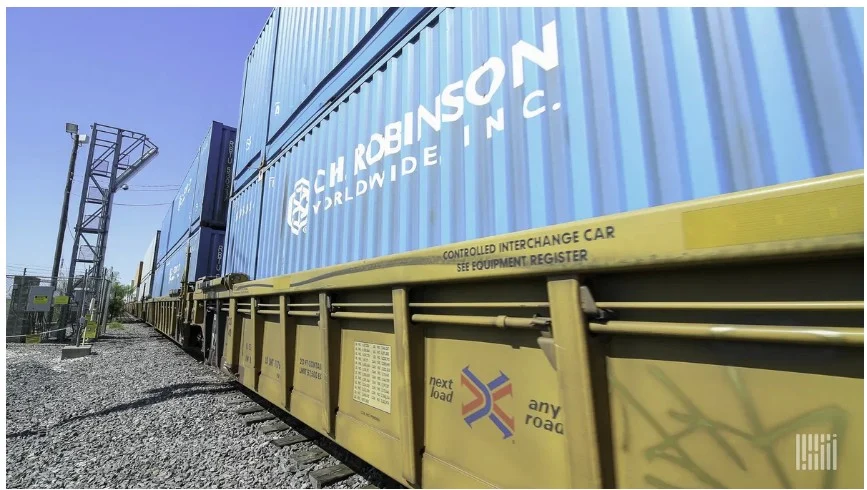
The logistics and transportation sector is reeling following a landmark legal decision in a Dallas County courtroom that has sent shockwaves through the freight brokerage industry. Investors, reacting with immediate apprehension, triggered a sharp selloff in third-party logistics (3PL) stocks on Friday after a jury handed down a staggering $604 million compensatory damages verdict against C.H. Robinson Worldwide.
The decision in Lipe vs. Lupus Superior represents a pivotal shift in the legal landscape for freight brokers. For years, the industry relied on the Federal Aviation Administration Authorization Act (F4A) as a shield against vicarious liability in accidents involving third-party carriers. However, following a unanimous Supreme Court ruling in May—Montgomery vs. Caribe Transport II—that defense has effectively evaporated. The verdict in Texas is widely viewed as the first major “domino to fall” in a post-Montgomery environment, signaling a new and precarious reality for companies that facilitate the movement of goods across the United States.
Market Reaction: A Sector-Wide Retreat
The financial markets responded with swift volatility as institutional investors moved to de-risk their positions in the 3PL sector. C.H. Robinson (NASDAQ: CHRW), the primary target of the verdict, saw its shares tumble $19, or 9.25%, to close at $186.50. This decline was particularly jarring, as the company had reached a 52-week high of $210.33 just two days prior to the announcement.
The contagion quickly spread to industry peers. RXO (NYSE: RXO) saw its shares drop 7.71%, or $2.14, to $25.63, having touched a 52-week high of $29.90 earlier in the week. Landstar System (NYSE: LSTR) also faced downward pressure, retreating 3.68% to $200.32. While the broader S&P 500 remained marginally positive on the day, the targeted selloff underscored the market’s recognition that the fundamental risk profile for freight intermediaries has undergone a structural change.
Chronology of a Legal Watershed
To understand the severity of this verdict, one must trace the timeline of both the underlying incident and the shifting legal framework that governed it.
The 2021 Tragedy
The case stems from a tragic 2021 traffic collision that resulted in the deaths of three individuals, as well as the employee driver of the carrier, Lupus Superior. C.H. Robinson had been contracted to manage the transportation of a beverage shipment for Arizona Beverages and had, in turn, hired Lupus Superior to perform the haul. In the subsequent lawsuit, plaintiffs argued that C.H. Robinson bore responsibility for the incident, a claim that would have previously been dismissed under the "safety exception" of the F4A.
The Montgomery Precedent
The turning point for the industry occurred in May, when the Supreme Court of the United States ruled in Montgomery vs. Caribe Transport II. C.H. Robinson had been a central defendant in that case, successfully utilizing the F4A to avoid litigation in lower courts. The Supreme Court’s decision to reject the broad interpretation of F4A protection stripped away the primary legal barrier that brokers used to insulate themselves from negligence claims involving the motor carriers they hire.
The Dallas Verdict
With the F4A shield gone, the Dallas jury moved forward with the Lipe vs. Lupus case. The jury’s decision to award $604 million in compensatory damages is, according to analysts, structured in a way that places the primary financial burden on C.H. Robinson. While the verdict has been delivered, it has not yet been certified by Judge Dianne Jones, marking only the beginning of what is expected to be a multi-year appellate process.
The Core Dilemma: What Defines a "Safe" Carrier?
One of the most concerning aspects of this verdict for the brokerage community is the jury’s disregard for federal safety metrics. Evidence presented during the trial confirmed that Lupus Superior possessed a "Satisfactory" safety rating from the Federal Motor Carrier Safety Administration (FMCSA)—a rating held both before and after the crash.
The Failure of Federal Benchmarks
Research analysts at TD Cowen highlighted the absurdity of the current environment, noting that if a carrier with an FMCSA-approved "Satisfactory" rating is insufficient to shield a broker from liability, the industry lacks a clear, objective standard for carrier selection. The question now haunting every brokerage executive is: If the federal government’s stamp of approval isn’t enough, what standard are we supposed to use?
The Industry’s Defense
In an amicus brief filed before the Supreme Court decision, attorney Marc Blubaugh of the law firm Benesch, representing the Transportation Intermediaries Association, warned of this exact outcome. He argued that there is no consistent way for a broker to evaluate safety records across thousands of independent carriers. Because local juries and judges often lack technical expertise in transportation safety, they are prone to reaching conflicting and punitive conclusions based on hindsight rather than established regulatory standards.
Implications: Financial Risks and Operational Realities
The potential impact on earnings and operations is significant. Wall Street analysts are currently modeling several scenarios, though most agree that the immediate financial hit to C.H. Robinson will be mitigated by the appellate process.
Earnings and Insurance Coverage
Analysts at Stephens, led by Bascome Majors, noted that while the company is unlikely to face an immediate charge against earnings, even a negotiated settlement in the range of $150 million to $350 million would represent a substantial blow. C.H. Robinson’s insurance "tower" consists of a $10 million deductible and a $135 million limit. If the appeals process does not yield a favorable outcome, the company could be forced to pay significant sums beyond its insurance coverage, directly impacting its bottom line.
The "Employer" Label
A particularly ominous finding from the jury was the determination that the driver for Lupus Superior was, for the purposes of the trial, effectively an employee of C.H. Robinson. Given that brokers do not technically hire or manage individual drivers, this classification sets a dangerous precedent. If brokers are to be held liable for the actions of a carrier’s employees as if they were their own, the fundamental business model of the 3PL industry is at risk of being dismantled.
Future Outlook: A New Reality for 3PLs
The consensus among market observers is that the era of "easy" litigation defense is over. As TD Cowen’s research report, The First Domino to Fall?, succinctly put it, pending court cases across the nation are now accelerating.
Increased Frequency of Nuclear Verdicts
"Verdicts are coming faster than most expected," the report stated. "Many pending court cases were waiting for the SCOTUS ruling for more clarity and are now moving forward in the courts." This suggests that the industry should prepare for a sustained period of litigation volatility. The "nuclear verdict"—an award exceeding $10 million—is becoming a common feature in transportation law, forcing companies to re-evaluate their carrier vetting processes, insurance premiums, and contractual language.
Long-Term Consequences
For the next several years, the industry will likely be defined by the outcome of these ongoing legal battles. Companies will need to invest heavily in legal defense and potentially move toward more stringent, proprietary safety monitoring systems that go far beyond the baseline requirements of the FMCSA. However, as noted by industry experts, no matter how robust a brokerage’s safety screening is, it may never be enough to satisfy a jury in the event of a catastrophic accident.
Ultimately, the Dallas decision is more than just a large jury award; it is a signal that the risks associated with interstate commerce have been reallocated. The freight brokerage industry, once shielded by federal law, must now navigate a landscape where every shipment carries the potential for a business-altering liability claim. Investors and operators alike are now faced with the sobering reality that the cost of doing business in logistics has just increased significantly, and the path to stability remains long and uncertain.