
ZURICH, Switzerland – The International Football Association Board (IFAB), the custodians of the Laws of the Game, has announced significant amendments to the Video Assistant Referee (VAR) protocol, poised to take effect this summer. These revisions primarily empower VAR to intervene in cases of player misidentification for yellow or red cards, aiming to enhance fairness and accuracy in critical on-field decisions. The updated guidelines also signal a renewed focus on tackling simulation, a persistent issue in modern football, and introduce specific refinements for corner kick reviews in UEFA competitions.
The impending changes represent a pivotal moment in the ongoing evolution of VAR, reflecting IFAB’s commitment to refining the technology’s application based on real-world experiences and feedback from stakeholders across the global football landscape. As the new season approaches, these adjustments are expected to bring greater clarity to controversial moments, reduce the incidence of mistaken identity, and potentially alter player behavior on the pitch.
The Core Mandate: Correcting Player Misidentification
The most impactful change allows VAR to recommend a review, and subsequently for the referee to alter, a yellow or red card if the match official has incorrectly identified the player from the offending team who committed a foul or offense. This specific empowerment addresses a long-standing frustration in the game where, in moments of chaos or multiple players involved, the wrong player might be carded, leading to unjust consequences for individuals and teams.
This summer’s implementation means that if a referee intends to issue a caution or send-off but directs it to the wrong player on the pitch, VAR can now step in to correct that specific error. This is distinct from disputes over whether an offense itself warrants a card; rather, it focuses solely on ensuring the intended disciplinary action is applied to the correct individual. This subtle yet crucial distinction underscores IFAB’s intent to uphold the integrity of individual player records and ensure appropriate justice is served.
Chronology: The Genesis of Change from World Cup Incidents
The impetus for these specific protocol changes can be traced back to practical challenges and controversial moments witnessed in recent high-profile tournaments, particularly the last FIFA World Cup. These incidents highlighted gaps in the previous VAR framework and demonstrated the need for greater flexibility in certain scenarios.
One notable instance occurred when a yellow card was initially issued to United States defender Tim Ream for a perceived foul. However, upon VAR review, it was determined that the offense was actually a simulation committed by Paraguay’s Miguel Almiron. The VAR correctly intervened, leading to the reversal of Ream’s card and the appropriate caution being issued to Almiron for diving. This case perfectly illustrated the potential for misidentification of the offense itself, even if not strictly misidentification of the player in the conventional sense.
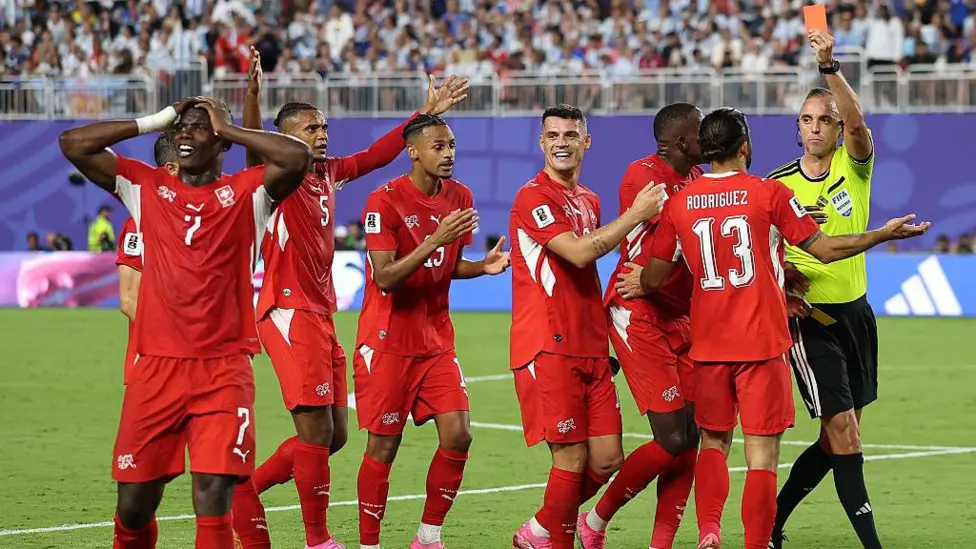
A more controversial and widely discussed case involved Switzerland striker Breel Embolo during a World Cup quarter-final match against Argentina. In the 72nd minute, Embolo was controversially shown a red card. The initial on-field decision saw Argentina’s Leandro Paredes booked with a yellow card for a reckless tackle. However, VAR review indicated that it was the Swiss striker, Embolo, who initiated the contact, and the subsequent interaction led to a different interpretation of the incident. Since Embolo had already received an earlier yellow card, the VAR review ultimately led to his second booking and subsequent dismissal. This incident, occurring just five minutes after Switzerland had equalized to make the score 1-1, proved highly contentious, with Argentina eventually winning 3-1 after extra time.
These specific instances, particularly the Embolo case where the nature of the offense and the primary instigator were re-evaluated, fueled public and expert debate on VAR’s scope. They underscored the complex interplay between foul play, simulation, and player identification, pushing IFAB to consider how VAR could more effectively address these nuances without overstepping its mandate. The public response to these VAR interventions, especially against Almiron and Embolo, was largely positive, with many supporters perceiving them as a welcome step towards eradicating simulation from the game. This public sentiment undoubtedly played a role in guiding IFAB’s refinements.
Supporting Data and Context: The Nuances of Officiating
The new protocol navigates a delicate balance between objective fact-checking and subjective interpretation, a perpetual challenge for VAR implementation.
The Nuance of Misidentification vs. Subjective Interpretation
IFAB’s refined definition of "misidentification" is crucial here. It primarily refers to instances where a referee clearly intends to sanction a player for an offense, but mistakenly applies the card to a different player from the same team, or even an opponent. For example, if Player A commits a foul, but the referee, in the heat of the moment, shows a card to Player B (who was also involved but not the primary offender), VAR can now correct this specific error.
However, as UEFA has clarified, the shift from discerning a "foul" to a "simulation" remains highly subjective. In cases like Almiron’s and Embolo’s, the referee was required to visit the pitch-side monitor to make the final judgment. This act of reviewing the footage and making a decision signifies a subjective assessment rather than a mere factual misidentification. Therefore, UEFA’s stance is that simulation itself, when a referee has reviewed it and made a call, is not considered a "misidentification" in the strictest sense of the new protocol. The referee’s final judgment, after viewing the replays, is still paramount in these nuanced situations. This distinction is vital to prevent VAR from becoming a tool for re-refereeing every subjective decision on the pitch.
Tackling Simulation: A New Frontier for VAR
Despite UEFA’s clarification regarding subjective calls, the new protocol indirectly strengthens VAR’s ability to address simulation. Since VAR can now intervene in cases of "inaccurate second yellow cards," it opens a pathway to penalize simulation more effectively. If a player simulates, and this simulation leads to an opponent receiving an incorrect second yellow card (and subsequent dismissal), VAR could now intervene to correct the carding of the opponent and, by extension, highlight the initial simulation that caused the chain of events.
Similarly, if simulation leads to a wrong direct red card or an erroneous penalty award, VAR would have the scope to correct these "clear and obvious errors." This broadened scope is expected to deter players from diving, as the risk of their actions being exposed and leading to a reversal of an opponent’s card, or even a direct sanction against themselves for unsporting behavior, increases significantly. The public’s desire to eliminate diving has been a consistent call, and these changes represent a tangible step towards achieving that goal, even if indirectly.
Corner Kick Protocol Refinements
UEFA has also announced specific refinements concerning corner kick reviews. Unlike some previous implementations, possibly seen in the World Cup, UEFA’s protocol will be more streamlined. VAR will now check for incorrect corners, but this will be limited solely to the "last touch" before the ball goes out of play. Crucially, it will not extend to reviewing potential offside positions during the build-up play that led to the corner.
This UEFA-specific amendment is designed to minimize disruptions and maintain the flow of the game. Reviewing offside in the build-up to every corner would significantly increase VAR stoppage time, potentially frustrating players and fans alike. By focusing only on the "last touch," UEFA aims to strike a balance between accuracy and efficiency, ensuring that obvious errors in corner awards are corrected without excessively prolonging match play.
The Role of the Referee
It is essential to reiterate that despite these expanded powers for VAR, the on-field referee remains the ultimate decision-maker. VAR’s role is to assist the referee in correcting "clear and obvious errors" or "serious missed incidents." For subjective calls, like the distinction between a foul and a simulation, the referee’s visit to the pitch-side monitor (Referee Review Area – RRA) remains a critical step. This ensures that the referee’s authority is maintained and that the human element of judgment, with the aid of technology, continues to be central to football officiating.
Official Responses and Stakeholder Perspectives
The new VAR protocol changes are not merely technical adjustments; they reflect a broader philosophy shared by football’s governing bodies to continually improve the game’s fairness and appeal.
IFAB’s Vision
IFAB, in its role as the guardian of the Laws of the Game, consistently seeks to refine the rules to adapt to the modern game while preserving its spirit. These latest amendments are part of an ongoing commitment to make VAR a more effective and less controversial tool. The objective is clear: to ensure that key match-altering decisions are correct, thereby upholding the integrity of competitions and enhancing trust in officiating. IFAB’s continuous review process involves extensive consultation with players, coaches, referees, and confederations to gather comprehensive feedback on VAR’s performance and areas for improvement.
UEFA’s Implementation Strategy
Recognizing the crucial role of consistent application, UEFA will convene a summit next week for referees from its 54 member countries. This summit will be a critical forum for discussing all aspects of VAR use under the new protocols. The agenda will likely include detailed explanations of the revised guidelines, practical training scenarios, and discussions on best practices for intervention and review.
"Ensuring uniformity in the application of these new protocols across all UEFA competitions is paramount," stated a UEFA spokesperson, emphasizing the importance of the upcoming summit. "Our referees are at the forefront of implementing these changes, and their understanding and consistent interpretation will be key to the success of this evolution. We are committed to providing them with all necessary training and support." The challenge for UEFA will be to ensure that the spirit of the law is applied consistently, from the Champions League final to domestic league matches across its diverse membership.
Coaches’ and Players’ Reactions
Initial reactions from coaches and players are anticipated to be mixed but generally positive towards the intent. Coaches will likely welcome any measure that reduces the impact of clear errors, particularly player misidentification, which can unfairly disrupt tactical plans and team momentum. Players, especially those who have been victims of mistaken identity or blatant simulation, will appreciate the increased accuracy. However, concerns about the speed of VAR decisions and the potential for new interpretations to create fresh controversies may also emerge. The hope is that greater clarity will lead to fewer prolonged stoppages and more decisive outcomes.
Fan Engagement and Public Opinion
The public, often critical of VAR’s perceived inconsistencies and delays, has shown strong support for interventions that address simulation. The popularity of the decisions against Almiron and Embolo indicated a widespread desire to see such unsporting conduct penalized. If the new protocols lead to a noticeable reduction in simulation and a fairer application of disciplinary actions, it could significantly improve public perception of VAR and rebuild trust in the system. However, fans will also demand efficiency; long delays for subjective reviews will continue to be a source of frustration.
Implications for the Game
The new VAR protocol changes carry wide-ranging implications that could subtly but significantly reshape various aspects of football.
Impact on Refereeing Decisions
The enhanced scope for VAR to correct player misidentification empowers both the VAR official and the on-field referee. VAR officials will have a clearer mandate to intervene in specific factual errors, while on-field referees can proceed with greater confidence, knowing that egregious errors in player identification can be rectified. This could lead to a slight shift in the mental approach of referees, potentially allowing them to focus more intensely on the primary offense rather than the precise identity of every player involved in a melee. Ultimately, the goal is fewer wrongful dismissals or bookings, leading to fairer outcomes for individual players and their teams.
Influence on Player Conduct
Perhaps one of the most significant long-term implications will be on player conduct. With VAR now capable of indirectly penalizing simulation if it leads to an incorrect second yellow, direct red, or penalty, players might become more hesitant to dive or exaggerate contact. The risk-reward calculation for simulation will change: a successful dive might still win a free-kick or penalty, but the chance of it being overturned, potentially leading to a card for unsporting behavior, or rectifying a wrong card given to an opponent, will increase. This could foster a more ethical approach to gameplay, promoting fair play and reducing the theatrical elements that often mar the beautiful game.
Consistency Across Leagues and Competitions
The challenge of achieving consistency in VAR application across different leagues and competitions remains formidable. While IFAB sets the global standard, and UEFA will implement its specific guidelines for its competitions, domestic leagues within UEFA’s 54 member countries will still need to adopt and interpret these changes. Variations in referee training, cultural attitudes towards simulation, and the technical infrastructure available can all contribute to slight differences in application. The upcoming UEFA summit is a crucial step in fostering this consistency, but ongoing dialogue and education will be essential to ensure a harmonized approach globally.
The Evolving Landscape of Football
VAR is not a static technology; it is a continuous work in progress. These latest protocol changes are a testament to football’s willingness to adapt and refine its rules in the face of technological advancement. The balance between preserving the flow and spontaneity of the game and achieving maximum accuracy in critical decisions will always be a subject of debate. As technology continues to evolve, further refinements or additional protocols for VAR are inevitable. Future discussions might revolve around semi-automated offside technology, further streamlining reviews, or even real-time data integration to aid officiating.
In conclusion, the new VAR protocol changes represent a considered and practical evolution in football officiating. By specifically addressing player misidentification and indirectly bolstering efforts against simulation, IFAB and UEFA aim to enhance fairness, reduce controversy, and uphold the integrity of the game. As these changes come into effect this summer, all eyes will be on their practical application and their ultimate impact on the beautiful game. The upcoming referee summit will be instrumental in laying the groundwork for a smoother transition into this new era of VAR.