
In the digital-first era of European banking, the promise was simple: Artificial Intelligence would usher in a golden age of instant, 24/7 customer service. By deploying sophisticated chatbots and AI-driven virtual assistants, challenger banks and payment providers aimed to slash operational overheads while offering "frictionless" resolutions to user queries. However, a stark reality is now emerging from the data: the automation revolution is hitting a wall, and consumers are increasingly vocal about their dissatisfaction.
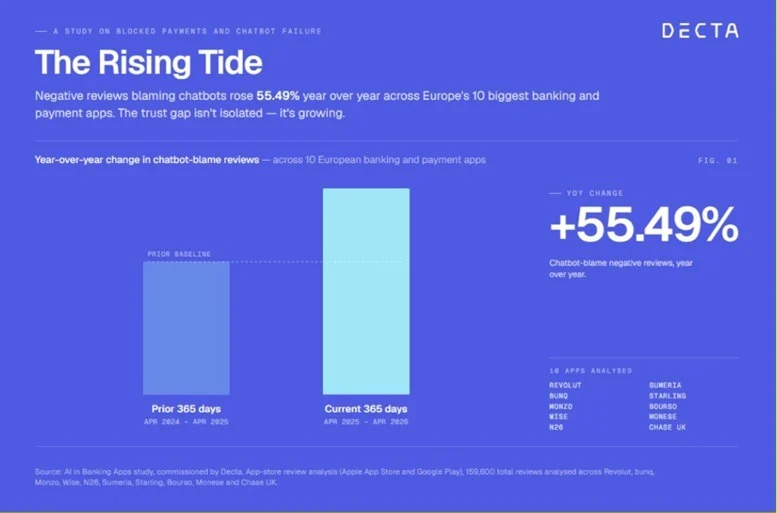
A comprehensive new study by payment infrastructure company DECTA reveals a troubling trend for the fintech sector. Negative app store reviews explicitly blaming AI chatbots for unresolved service issues have surged by 55.49% year-on-year across Europe’s ten most-used banking and payment applications. The analysis, which scrutinized 159,600 user reviews across major platforms including Revolut, N26, Wise, bunq, Monzo, Sumeria, Starling Bank, Bourso, Monese, and Chase UK, paints a picture of a sector struggling to balance fiscal efficiency with the fundamental human requirement of reliable support.
The Core Findings: A Crisis of Competence
The data is granular and damning. Of the 34,167 negative reviews analyzed by DECTA, a significant plurality cited a chatbot or AI assistant as the primary roadblock to resolving a critical banking issue. This is not merely a matter of "bad user experience"; it represents a systemic failure of AI deployment in the financial services sector.
The research identifies a widening gap between where AI customer service is deployed and what it is actually capable of resolving. While chatbots are adept at answering static, policy-based questions—such as "what is your IBAN?" or "how do I change my password?"—they are catastrophically failing when it comes to high-stakes, transactional, or emotional queries.
The Anatomy of AI Failure: A Chronology of Frustration
To understand the current climate, one must look at the progression of AI implementation in fintech over the last 36 months.
Phase 1: The Optimization Wave (2022–2023)
Fintechs, eager to prove their scalability and profitability to venture capitalists, began aggressive migrations toward AI-first support models. The narrative was one of "superior technology," where algorithms would outpace human agents in speed and consistency. During this period, chatbots were marketed as the frontline defense against rising support ticket volumes.

Phase 2: The Efficiency Pivot (2023–2024)
As economic headwinds grew stronger, the focus shifted from pure customer experience to cost-cutting. Companies like Klarna famously made headlines by announcing that their AI assistants were handling the workload of 700 full-time customer service agents. This was hailed as a milestone in the "AI-first" movement, but it ignored the qualitative trade-off.
Phase 3: The Consumer Reckoning (2025–Present)
The current period, highlighted by the DECTA study, marks the collapse of the "automation at all costs" strategy. Consumers, faced with frozen funds, unexplained transaction declines, and account lockouts, are finding that the "AI barrier" is not a concierge—it is a gatekeeper that refuses to grant entry to human help. The 55.49% surge in negative reviews is the direct output of this frustration.
The "Big Four" Failure Points
The DECTA study highlights four primary problem types that account for 57% of all chatbot-blame complaints. These categories are telling, as they represent the moments when a bank-customer relationship is most fragile:
- Unauthorized Transaction Disputes: When a user discovers a fraudulent charge, they are in a state of high anxiety. A chatbot’s inability to grasp the urgency or nuance of fraud often leads to the user feeling abandoned during a crisis.
- Unexpected Account Freezes: Automated AML (Anti-Money Laundering) triggers often lock accounts without notice. Chatbots, restricted by "canned" responses, cannot provide the context or the human empathy required to de-escalate a customer who has just lost access to their livelihood.
- Payment Declines in Real-Time: Whether at a point of sale or during a cross-border transfer, a declined payment requires real-time authorization logic that an AI often cannot override or explain.
- Verification and KYC Bottlenecks: When automated identity verification fails, users are trapped in a loop of "please upload your ID again," with no human oversight to manually review the documents.
These are not edge cases. These are the "moments of truth" in banking. When a customer is locked out of their account, they do not need a scripted apology or a link to a FAQ page. They need a human who possesses the agency to view the account history, override a decision, or provide a concrete timeline for resolution.
Industry Implications and the Regulatory Landscape
The findings of the DECTA report arrive at a critical juncture for the financial sector, as both regulators and executives begin to question the wisdom of unchecked AI reliance.
The European Union’s AI Act serves as a major regulatory signal. By classifying AI systems used in creditworthiness assessments and financial decisions as "high-risk," the EU is effectively forcing firms to move away from "black-box" automation. Banks are now required to document and justify how automated decisions are made—a move that fundamentally undermines the efficiency of chatbots that rely on opaque, self-learning scripts.

Furthermore, the "Klarna effect"—the realization that replacing human staff with AI can lead to measurable drops in customer satisfaction—has sent shockwaves through the industry. A Forrester analysis projects that one in four AI deployments in financial services will be scaled back or entirely re-engineered within the next two years. The cost savings achieved on the balance sheet are increasingly being offset by the "hidden costs" of customer churn, loss of brand equity, and the administrative burden of handling escalated complaints that could have been resolved in seconds by a human.
The Future of AI in Banking: Hybridization or Failure?
The lesson from the DECTA report is not that AI is useless, but that its current application is fundamentally misaligned with consumer needs. Banks have used AI as a "deflection" tool rather than an "empowerment" tool. By placing the AI layer between the customer and the resolution, they have turned an efficiency asset into a liability.
Moving forward, the successful fintechs will be those that adopt a "Human-in-the-Loop" architecture. This model uses AI to summarize data, categorize issues, and pull up relevant documentation for the agent, but leaves the final decision-making and empathetic engagement to the human.
The data suggests that the "AI reckoning" is far from over. As consumers become more sophisticated and regulatory scrutiny intensifies, the fintechs that refuse to integrate human oversight into their support structures will find their competitive advantage eroding. A 55.49% rise in negative sentiment is a warning shot. In the world of digital banking, where loyalty is tied to the reliability of the app, those who paper over gaps with scripts instead of fixing them with human intelligence will eventually be left behind by a consumer base that demands more than just an automated "Sorry, I don’t understand."
For financial institutions, the message is clear: automation can save you money today, but it may cost you your reputation tomorrow. The challenge for the next generation of banking is to determine not what AI can do, but what it should do, and when it is time to step aside and let a person handle the conversation.