In recent years, the landscape of the American workplace has undergone a seismic shift. The mundane interactions of daily life—ordering a coffee via a kiosk, observing autonomous floor-scrubbers in airport terminals, or troubleshooting a billing issue with an AI-driven chatbot—have become the new normal. While these conveniences were once viewed as novelties, the COVID-19 pandemic acted as a powerful catalyst, forcing businesses across every sector to accelerate their adoption of automation.
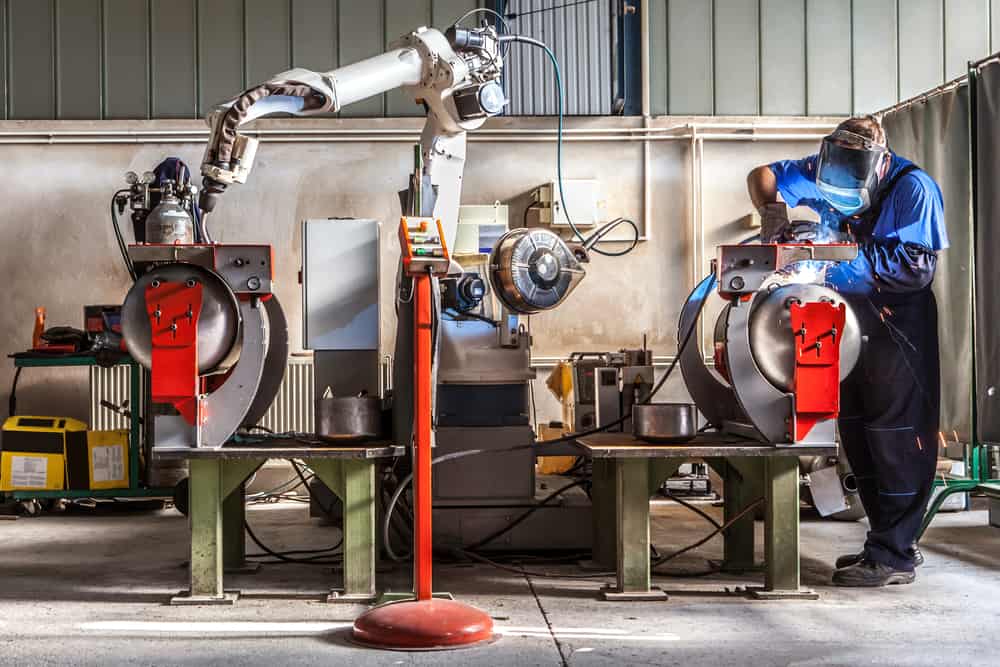
As companies sought to maintain operations while minimizing physical contact and overcoming labor shortages, the rationale for replacing human labor with machines became undeniable. Unlike their human counterparts, machines do not fall ill, do not require rest, and serve as an effective solution for maintaining social distancing protocols. However, this rapid technological transition has ignited a national debate regarding the long-term stability of the workforce. According to data synthesized from the Bureau of Labor Statistics and landmark research from the University of Oxford, approximately 42% of the U.S. labor force currently faces a high risk of being supplanted by automation.
The Anatomy of Vulnerability: Which Jobs Are at Risk?
Not all occupations are equally susceptible to the march of technology. The research suggests a clear dichotomy: roles that demand high-level creativity, complex emotional intelligence, and nuanced interpersonal skills remain largely resilient to automation. Conversely, roles defined by repetitive physical labor or routine information processing are increasingly on the chopping block.
A comprehensive study by the Brookings Institution highlights that sectors such as office administration, production, transportation, and food preparation represent the most significant frontiers for automation. These roles are inherently logical targets for algorithmic efficiency because they rely on predictable tasks—sorting data, moving goods, or following rigid preparation instructions.
Interestingly, there is a complex relationship between pay and automation risk. While many low-wage roles are highly susceptible to automation, some low-paying positions—such as personal care and domestic service work—remain at a lower risk. This is because these roles require a human touch, adaptability, and emotional labor that current artificial intelligence cannot replicate.

Supporting Data: The Wage-Automation Correlation
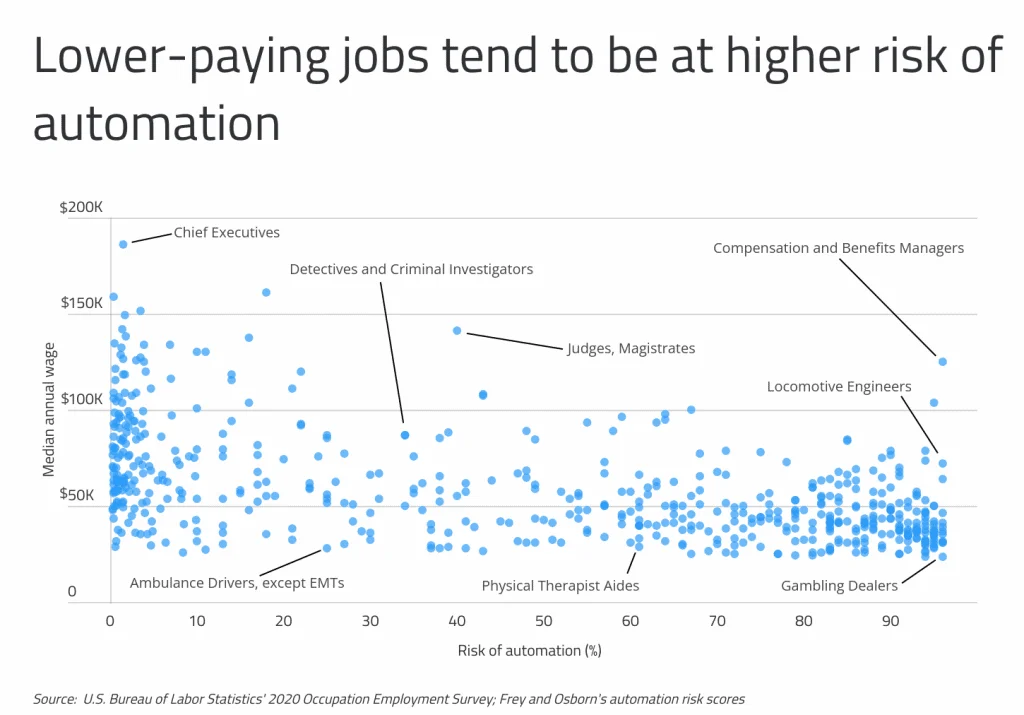
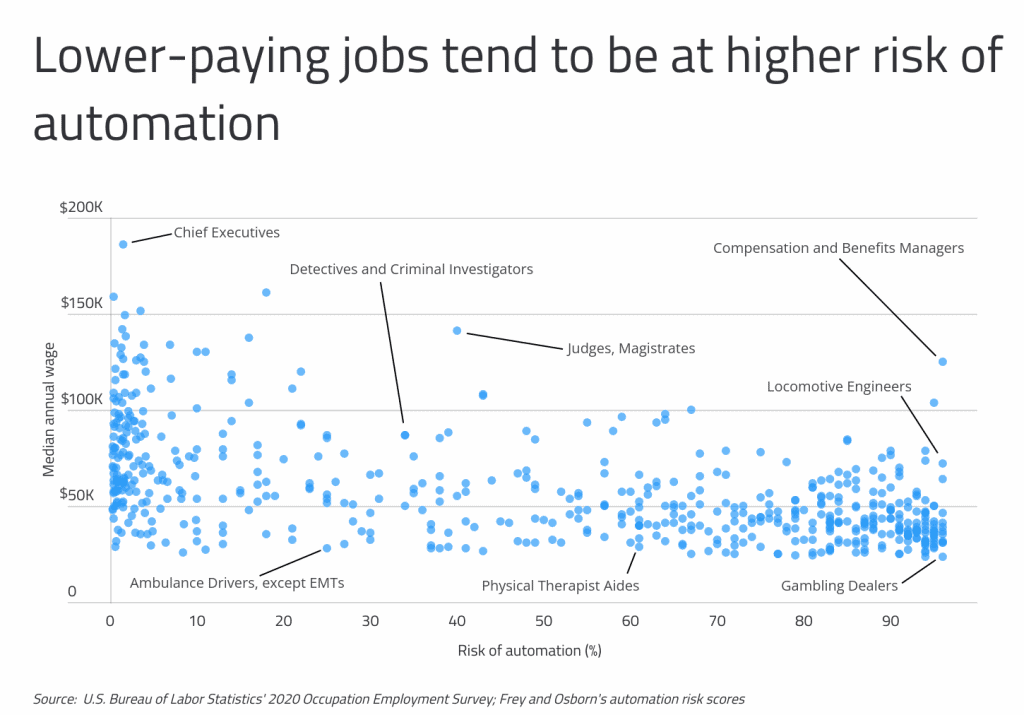
The correlation between a job’s automation risk and its compensation is striking. By cross-referencing Bureau of Labor Statistics wage data with the automation probability scores derived from the University of Oxford’s research, a clear trend emerges: the higher the automation risk, the lower the annual median wage.

For instance, the role of a Gambling Dealer is estimated to have a 96% probability of automation. Correspondingly, these professionals earn a median annual wage of less than $24,000. On the opposite end of the economic spectrum, Chief Executive Officers, who grapple with complex strategic decision-making and high-stakes interpersonal management, face only a 1.5% risk of automation, with median annual wages hovering around $186,000.

This data suggests that the "automation gap" threatens to exacerbate existing wealth inequalities. As routine tasks become digitized, the labor market may bifurcate further, favoring highly specialized roles while displacing those in the middle and lower tiers of the economic hierarchy.

A Geographical Divide: Where Automation Hits Hardest
The impact of automation will not be felt uniformly across the United States. Regional industry compositions and the specific skill sets of local workforces mean that some states and metropolitan areas are significantly more exposed than others.
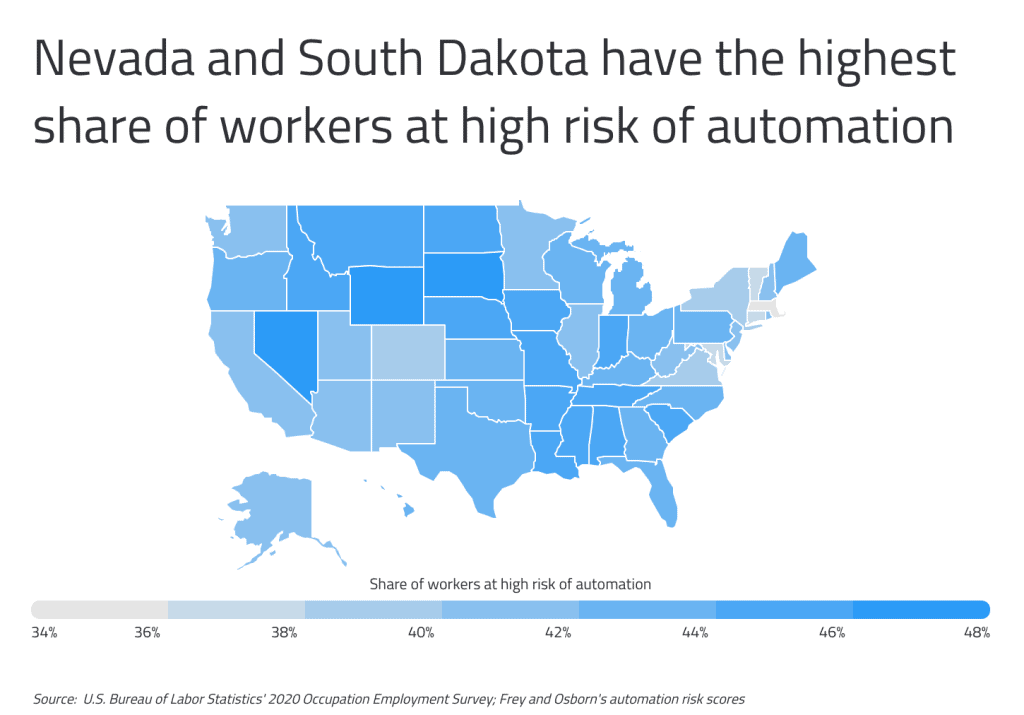
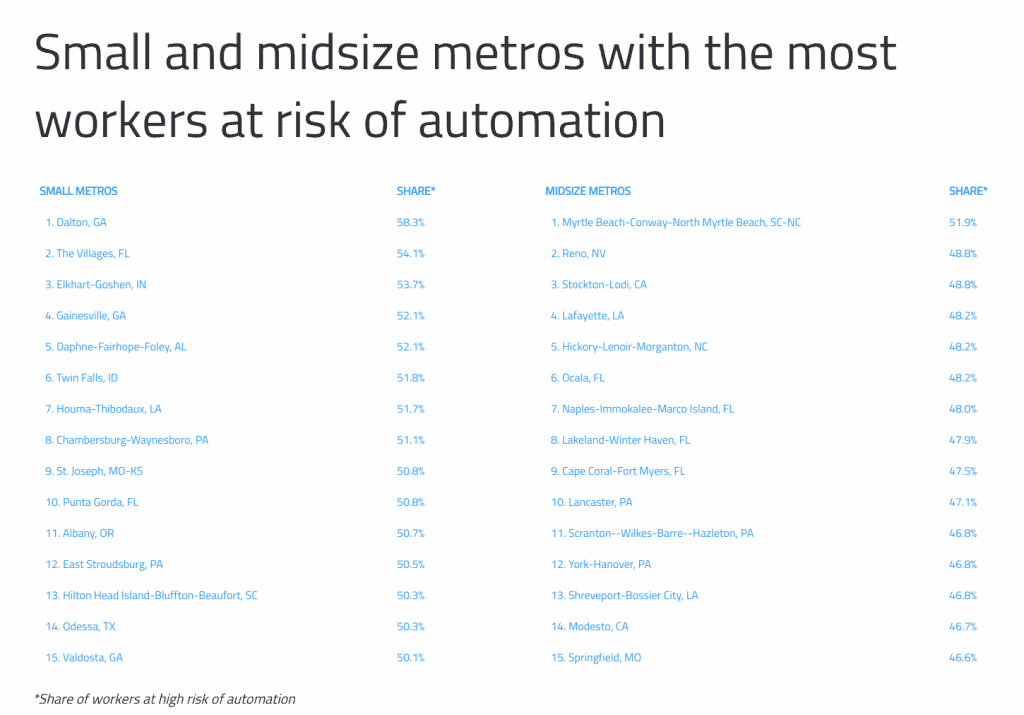
Rural communities, which often rely heavily on traditional manufacturing, agriculture, and routine logistics, are disproportionately vulnerable. At the state level, the disparity is stark. Nevada leads the nation with 48.4% of its workforce at high risk of automation, followed closely by South Dakota at 46.9%. In Nevada’s case, the heavy reliance on the service and gaming industry—where repetitive tasks like dealing cards are easily automated—creates a unique economic vulnerability.

The Top 15 Metros Facing the Automation Wave
Researchers at Commodity.com have identified the metropolitan areas where the concentration of "at-risk" jobs is highest. By analyzing the share of workers in high, medium, and low-risk occupations, the following regions have been highlighted as the most susceptible to the coming technological shift (for areas with populations exceeding 100,000):

- Las Vegas-Henderson-Paradise, NV: Dominated by the gaming and hospitality sectors, this region faces the highest risk due to the high probability of automating routine service tasks.
- Riverside-San Bernardino-Ontario, CA: A logistics and distribution hub where automation in warehousing and transportation poses a significant threat to the local workforce.
- Memphis, TN-MS-AR: As a major center for shipping and freight, the reliance on manual logistics labor makes this metro area a prime candidate for full-scale automation.
- Louisville/Jefferson County, KY-IN: Heavy manufacturing and logistics infrastructure place this region in a precarious position.
- Grand Rapids-Wyoming, MI: A hub for production and manufacturing, where the shift toward "Industry 4.0" is transforming traditional assembly roles.
- Indianapolis-Carmel-Anderson, IN: A broad industrial and logistics base that is increasingly integrating autonomous systems.
- New Orleans-Metairie, LA: Similar to Las Vegas, the reliance on tourism and hospitality services creates a vulnerability to AI-driven service platforms.
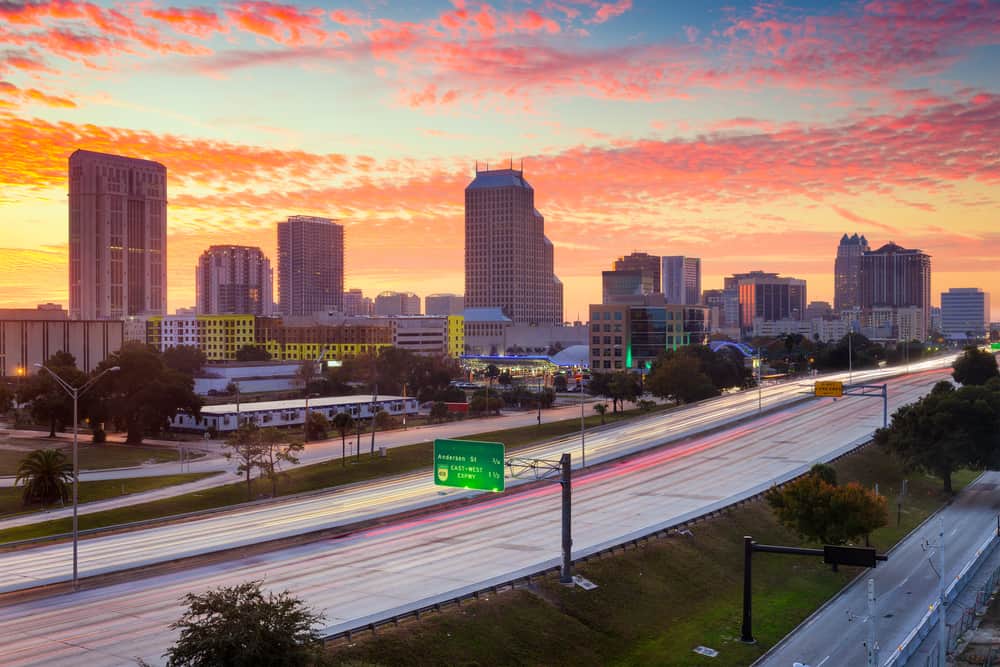
- Orlando-Kissimmee-Sanford, FL: The high concentration of service-oriented roles in the theme park and tourism sectors creates a high risk of replacement by kiosks and automated systems.
- Nashville-Davidson-Murfreesboro-Franklin, TN: Rapid growth in logistics and data processing has brought a high density of automatable tasks.
- Birmingham-Hoover, AL: A legacy of industrial production that is now facing the transition toward automated manufacturing.
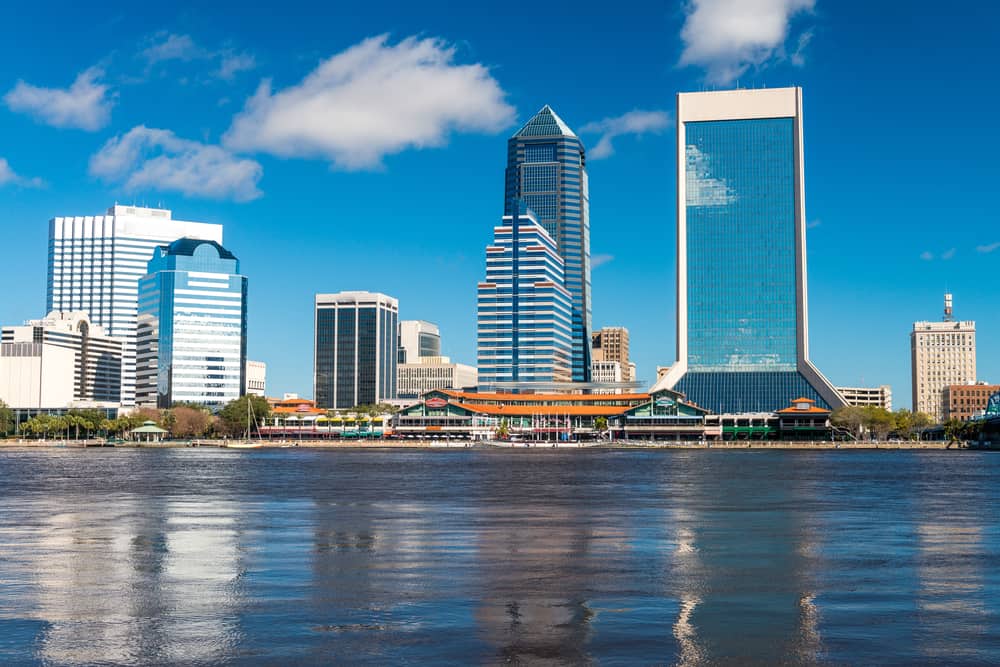
- Jacksonville, FL: Significant reliance on logistics and port-related activities makes this city highly susceptible to supply chain automation.
- St. Louis, MO-IL: A diverse economy that nonetheless retains a large share of production and administrative roles at high risk.
- Dallas-Fort Worth-Arlington, TX: Despite its economic diversity, the massive scale of its logistics and administrative workforce creates a high total volume of workers at risk.
- Miami-Fort Lauderdale-West Palm Beach, FL: A service-heavy economy that is vulnerable to the rapid deployment of customer-facing automation.
- Los Angeles-Long Beach-Anaheim, CA: The vast scale of manufacturing, retail, and administrative support in this region contributes to a high number of individuals facing potential displacement.
Implications for the Future of Work
The implications of these findings are profound. If nearly half of the American workforce is at risk of being replaced by machines, the societal response must go beyond mere adjustment; it requires a structural overhaul of education and labor policy.
The Need for Reskilling
The most immediate implication is the urgent need for a national focus on reskilling. As routine tasks vanish, the workforce must be retrained for roles that require human empathy, complex problem-solving, and machine management. Educational institutions, from trade schools to universities, must pivot toward curricula that emphasize "human-centric" skills that are shielded from algorithmic replacement.

Economic Policy and Social Safety Nets
As automation progresses, the traditional link between labor and income may weaken. Policy discussions around Universal Basic Income (UBI), negative income taxes, or robust vocational transition subsidies are no longer fringe ideas; they are becoming essential components of a stable economic transition. Governments must consider how to handle the tax base implications if a significant portion of the workforce is displaced, potentially shifting the tax burden toward the owners of the capital (the machines) rather than the labor.

The Psychological Impact
Beyond the economics, the psychological toll of widespread automation cannot be overlooked. For many, work provides not just a salary, but a sense of purpose and identity. As roles disappear, there is a risk of a "crisis of meaning" in communities that have historically defined themselves by their industries. Transitioning these populations will require more than just financial support—it will require a reimagining of community identity.

Conclusion
The march of automation is neither inherently "good" nor "bad"; it is a transformation of the tools we use to build our civilization. However, the data provided by the Bureau of Labor Statistics and the University of Oxford serves as a clear warning. Without proactive, region-specific strategies to address the vulnerabilities identified in cities like Las Vegas and Memphis, the economic divide will only widen.

The path forward lies in acknowledging the inevitability of this shift while investing heavily in the human capital that machines cannot replace. By focusing on education, labor mobility, and a modern social safety net, the United States can navigate this transition—ensuring that the rise of the machines does not come at the expense of the people they were meant to serve.