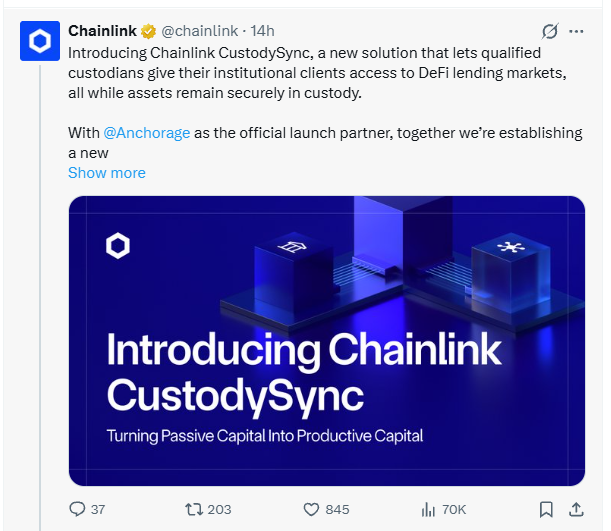
In a landmark development for the decentralized finance (DeFi) sector, Chainlink has officially unveiled CustodySync, a sophisticated institutional-grade solution designed to bridge the chasm between traditional financial custodians and the high-yield opportunities of DeFi lending markets. By enabling seamless interaction between secure, regulated custody environments and blockchain-based lending protocols, Chainlink is positioning itself as the critical infrastructure layer for the next wave of institutional capital adoption.
The announcement represents more than a mere product launch; it is a strategic maneuver aimed at unlocking billions of dollars in dormant digital assets. With Anchorage Digital named as the inaugural launch partner, the solution sets a new standard for how financial institutions interact with on-chain protocols without compromising the stringent security mandates required by regulators and risk management committees.
Main Facts: What is CustodySync?
CustodySync is an architectural framework engineered to synchronize custody systems with DeFi lending protocols throughout the entire lifecycle of a loan. Traditionally, institutional investors have been hesitant to engage with DeFi due to the "custody dilemma": the need to move assets from highly regulated, offline, or multi-signature custody wallets into the volatile, internet-facing environments required for smart contract interaction.
CustodySync effectively eliminates this friction. By allowing assets to remain within the safety of a qualified custodian—such as Anchorage—while simultaneously being utilized as collateral for lending platforms, the solution enables institutions to participate in the $80 billion DeFi lending ecosystem.
Core Benefits of the Solution:
- Operational Efficiency: Automates the synchronization of loan lifecycles, significantly reducing the manual overhead previously required to track on-chain positions from off-chain custody accounts.
- Enhanced Valuation Accuracy: Provides real-time data feeds that ensure collateral valuations are precise, preventing the mismatches that often plague cross-platform lending.
- Risk Mitigation: Dramatically reduces the risk of forced liquidations caused by technical delays or synchronization errors between systems.
- Regulatory Compliance: Maintains the highest level of institutional security, ensuring that assets are never "at risk" in the traditional sense, as they remain under the control of qualified custodians throughout the lending term.
Chronology: The Road to Institutional Integration
The evolution of Chainlink’s strategy has been a deliberate march toward institutional acceptance. Over the past several quarters, the team has focused on building the "Cross-Chain Interoperability Protocol" (CCIP) and expanding its Oracle network to support the complex data needs of traditional finance (TradFi).
- The Infrastructure Foundation: Over the last 18 months, Chainlink invested heavily in the Cross-Chain Interoperability Protocol, creating the secure messaging backbone required to link disparate banking ledgers with public and private blockchains.
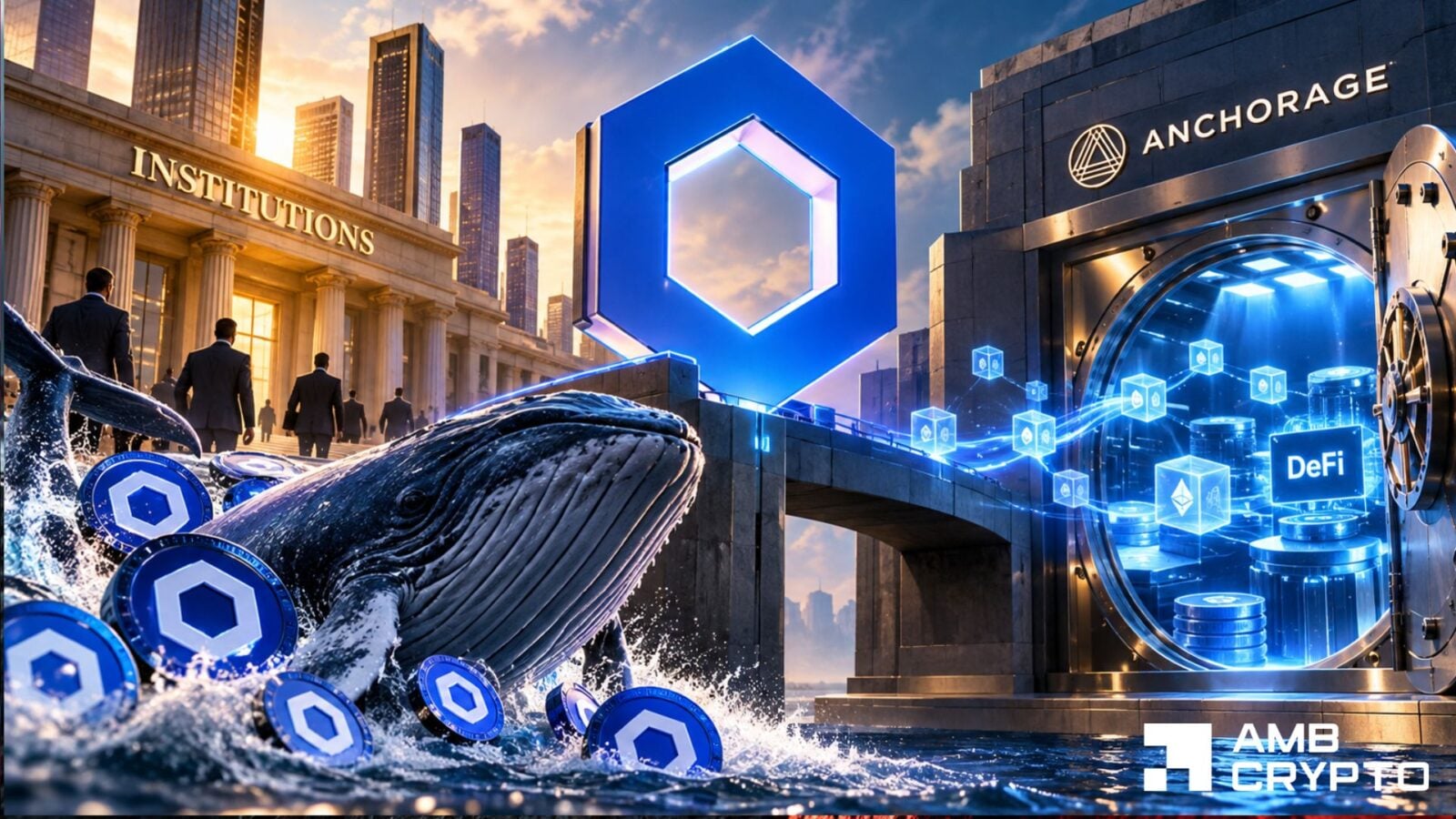
- The Anchorage Partnership: The selection of Anchorage Digital as the primary launch partner was not accidental. As one of the few federally chartered digital asset banks, Anchorage provides the regulatory legitimacy that global institutions require.
- The Announcement (October 2026): Chainlink formally introduced CustodySync to a global audience, highlighting its potential to unlock access to over $700 billion in currently custodied digital assets.
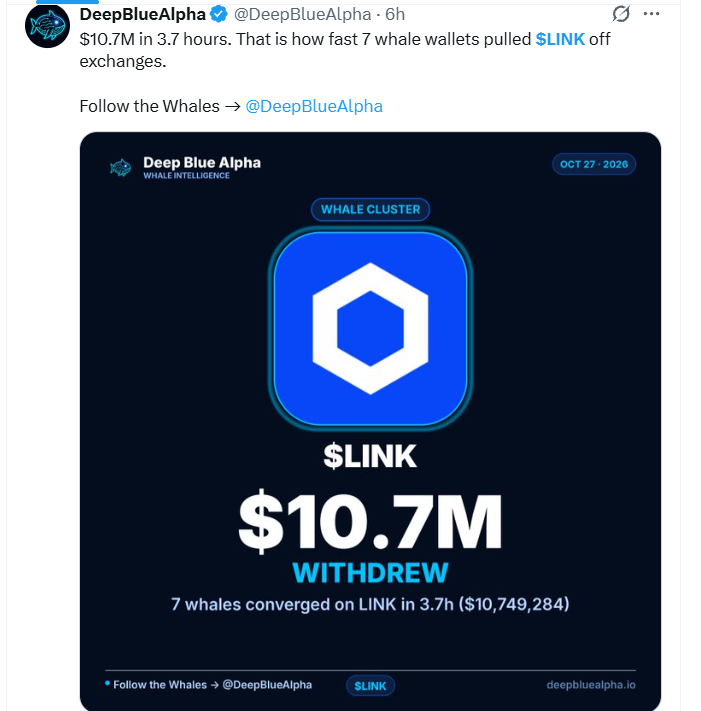
- Market Reaction: Within hours of the announcement, significant whale activity was observed on the blockchain, with over $10.7 million in LINK tokens moved off exchanges, signaling a potential shift in supply dynamics.
Supporting Data: Whales and Market Positioning
The introduction of CustodySync coincides with a period of intense accumulation by major holders, or "whales." Blockchain analytics indicate that seven distinct whale wallets moved approximately $10.7 million worth of LINK from centralized exchanges into private custody in a window of just 3.7 hours.
This movement is statistically significant. When large holders withdraw assets from exchanges, it generally implies a transition from a "trading" mindset to a "holding" or "staking" mindset. By reducing the immediate supply available on exchanges, these whales are effectively tightening the float, which may create a buffer against sudden market volatility.
However, analysts are cautious about interpreting this as a purely bullish signal. While these withdrawals suggest a long-term commitment to the Chainlink ecosystem—likely in anticipation of the institutional adoption cycle—the data does not explicitly state the investors’ end goal. Whether these assets are being moved to secure cold storage, or being prepared for participation in upcoming institutional lending protocols, remains a subject of intense speculation.
Official Responses and Strategic Implications
The industry response to CustodySync has been overwhelmingly positive, with many analysts noting that this is the missing piece of the puzzle for traditional hedge funds and asset managers.
The Institutional Perspective
Institutional investors have long complained about the "operational drag" of DeFi. Moving assets from a custodian to a smart contract involves multiple layers of approval, high latency, and significant security risks. By integrating directly with the custodian’s backend, Chainlink’s CustodySync effectively hides the complexity of blockchain interaction, allowing a fund manager to deploy capital into a lending market with the same ease as a traditional repo trade.
The DeFi Perspective
For the DeFi ecosystem, the influx of institutional liquidity is a "holy grail." The current $80 billion in lending assets is largely retail-driven or crypto-native. The integration of traditional custodians brings a level of "sticky" capital that is less prone to the boom-and-bust cycles characteristic of speculative retail markets. This stability could lead to lower borrowing costs and more sustainable interest rate environments.
Technical Analysis: LINK’s Market Performance
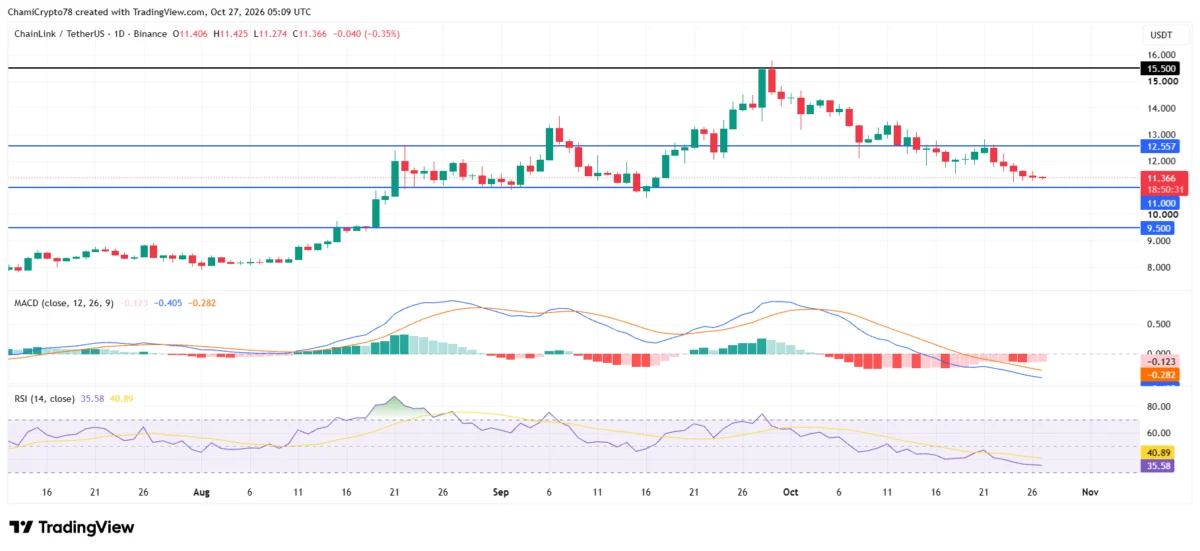
Despite the positive fundamental news surrounding CustodySync, the price of LINK has faced technical headwinds. As of late October 2026, the token is trading around $11.36, representing an extended pullback from its late-September high of $15.50.
The Bearish Landscape
- Downward Momentum: The daily chart reveals a consistent trend of lower highs and lower lows. Sellers currently maintain dominance, with the price testing a critical support level at $11.00.
- Indicator Divergence: The Relative Strength Index (RSI) sits at 35.58, indicating weak buying pressure. While not yet in the extreme "oversold" territory (typically below 30), it suggests that the market lacks the momentum to trigger a sharp reversal in the short term.
- MACD Signals: The Moving Average Convergence Divergence (MACD) line is currently at -0.405, well below the signal line at -0.282. This alignment is a classic indicator of bearish sentiment, confirming that the current downtrend has structural backing.
Future Outlook
While the short-term outlook remains cautious, the $11.00 level acts as a critical line in the sand. Should the market defend this support, it could set the stage for a recovery attempt toward the $12.55 resistance level. Conversely, a failure to hold this support could expose the token to a test of the $9.50 range.
The dichotomy between the fundamental news (institutional adoption) and the technical price action is a common phenomenon in the crypto space. Often, the market "prices in" the difficulty of the macro environment before responding to the long-term value provided by protocol upgrades.
Implications: A New Era for DeFi
The launch of CustodySync marks the maturation of Chainlink from a simple "oracle provider" to a comprehensive "institutional middleware" platform. By solving the custody-to-DeFi connectivity issue, Chainlink is effectively clearing the regulatory path for major banks to engage with decentralized protocols.
The implications are three-fold:
- Increased Market Efficiency: By synchronizing custody and lending, the industry can expect to see reduced spreads and more efficient capital allocation.
- Standardization: CustodySync provides a blueprint that other custodians will likely follow. If this model becomes the industry standard, we could see a rapid increase in the total value locked (TVL) across all DeFi lending platforms.
- Institutional Legitimacy: Perhaps most importantly, the involvement of qualified custodians like Anchorage acts as a "seal of approval." It signals to regulators that DeFi can be a safe, compliant, and transparent environment for institutional capital.
As the financial world moves toward a tokenized future, the infrastructure built today will dictate the winners of tomorrow. Chainlink, by focusing on the intersection of institutional security and decentralized innovation, has positioned itself as the backbone of the next generation of global finance. Whether the market price of LINK reflects this shift in the coming weeks remains to be seen, but the structural change to the financial landscape is already underway.