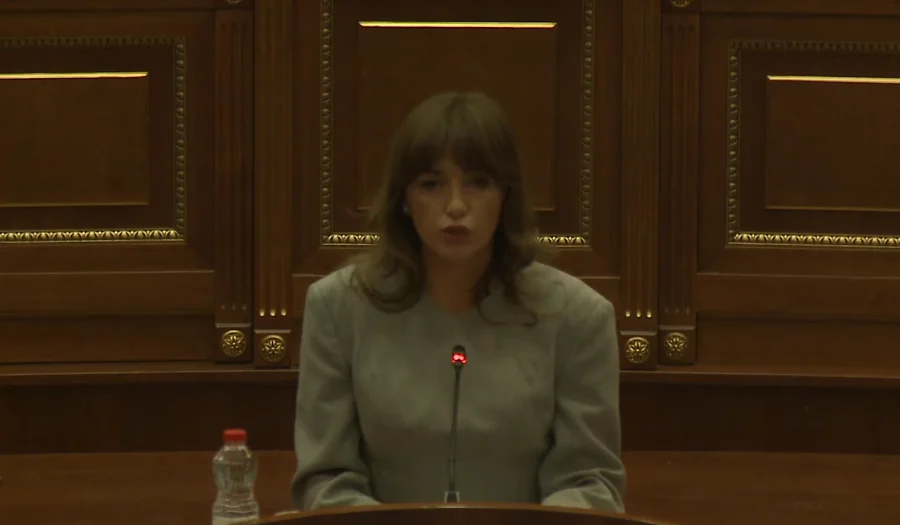
Pristina, October 26, 2026 – The Speaker of the Parliament, Albulena Haxhiu, today addressed an extraordinary session of the Assembly, her voice resonating with a mix of grief and resolve following the brutal murder of a woman who was tragically killed while awaiting state protection. In a powerful and somber address, Haxhiu declared that the victim’s desperate pleas for safety now "echo as a tragic warning that we failed to prevent," underscoring profound systemic failures within the justice and security apparatus.
The extraordinary parliamentary session convened amidst widespread public outrage and intense scrutiny of state institutions responsible for protecting victims of domestic violence. The session aimed to dissect the circumstances surrounding the heinous crime and to chart a path forward to prevent future tragedies. Speaker Haxhiu demanded immediate and thorough investigations into the accountability of prosecutors, judges, and police officers directly involved in the victim’s case, suggesting that operational negligence and a lack of diligent enforcement may have contributed to the fatal outcome.
However, Haxhiu controversially distanced the Minister of Justice, Donika Gërvalla, and the Minister of Internal Affairs, Xhelal Sveçla, from direct responsibility for this specific failure. Her remarks came despite escalating public and political demands for their resignations throughout the day, fueled by a perception of overarching governmental culpability for the persistent issue of gender-based violence. Haxhiu argued that the ministries under Gërvalla and Sveçla had already "addressed legislation and available mechanisms," thereby implying that the fault lay not with policy formulation but with its inadequate implementation by front-line personnel.
"What blame can Minister Gërvalla or Minister Sveçla bear if the Ministry of Justice and the Ministry of Internal Affairs have addressed the legislation and the mechanisms at their disposal?" Haxhiu questioned, reiterating her stance. She urged Members of Parliament to commit to correcting "identified shortcomings" and ensuring that "protection mechanisms function" effectively, shifting the focus towards operational improvements rather than high-level political resignations. The Speaker’s impassioned plea highlighted a critical juncture for the nation, demanding a rigorous self-assessment of its commitment to safeguarding its most vulnerable citizens.
Main Facts: A System Under Scrutiny
The tragic death of the woman, whose identity has been withheld for privacy, has ignited a national debate on the efficacy of the justice system and the state’s capacity to protect its citizens, particularly women facing domestic violence. Her murder, occurring precisely at a moment when she sought official intervention, exposed a glaring chasm between legislative intent and practical reality. Speaker Albulena Haxhiu’s address to the extraordinary parliamentary session on October 26, 2026, served as a stark acknowledgment of this failure.
Haxhiu’s core message was twofold: a deep condemnation of the preventable loss of life and a firm call for accountability at the operational levels of the judiciary and law enforcement. She underscored the chilling resonance of the victim’s final words, now interpreted as an unheeded prophecy of her fate. The Speaker explicitly targeted prosecutors, judges, and police officers, demanding investigations into their specific actions or inactions concerning the victim’s case. This pointed criticism suggests a belief that bureaucratic inertia, procedural missteps, or individual negligence directly contributed to the tragedy.
Crucially, Haxhiu strategically defended the two key ministers – Donika Gërvalla (Justice) and Xhelal Sveçla (Internal Affairs) – whose resignations had been vociferously demanded by opposition parties and civil society organizations throughout the day. Her defense hinged on the argument that their respective ministries had fulfilled their legislative duties by establishing the necessary frameworks and mechanisms to combat domestic violence. By doing so, Haxhiu effectively shifted the locus of responsibility from high-level policy-making to the ground-level execution and enforcement of these policies by judicial and law enforcement personnel.
The Speaker’s intervention framed the issue as one of implementation failure rather than policy deficiency, calling on parliamentarians to collaboratively identify and rectify systemic flaws. Her statement, delivered at a moment of profound national grief and anger, set the tone for a potentially contentious parliamentary debate, highlighting the complex interplay between political accountability, institutional effectiveness, and the grim reality of violence against women.
Chronology of a Crisis: From Plea to Parliament
The sequence of events leading to today’s extraordinary parliamentary session paints a harrowing picture of a system struggling to deliver on its promise of protection.
Early October 2026: Initial Pleas for Help
The victim, reportedly experiencing severe and escalating domestic violence, made initial contact with law enforcement and judicial authorities. Details remain sparse, but it is understood that she sought a protection order, filing formal complaints against her perpetrator. These initial steps are often the most difficult for victims, requiring immense courage and trust in the system.
Mid-October 2026: Bureaucratic Delays and Apparent Failures
Reports suggest that despite the victim’s clear appeals and documentation of threats, the process of securing effective state protection encountered significant delays and alleged procedural missteps. It is believed that there were lapses in risk assessment, inadequate follow-up by police, and potentially prolonged judicial processes in issuing or enforcing a protection order. Sources close to the investigation indicate that while a protection order may have been initiated, its implementation or the monitoring of the perpetrator’s compliance was severely lacking. This period of waiting, fraught with fear and uncertainty, proved tragically fatal.
October 25, 2026: The Unspeakable Tragedy
The woman was brutally murdered, allegedly by the very individual against whom she had sought state protection. The exact circumstances of her death are under active investigation, but the timing – while she was still awaiting full and effective state intervention – sent shockwaves across the nation. Her death immediately became a stark symbol of the justice system’s failures and the urgent need for reform.

October 25-26, 2026: Public Outcry and Calls for Resignation
News of the murder quickly spread, igniting widespread public outrage. Civil society organizations, women’s rights advocates, and concerned citizens took to social media and organized spontaneous protests, demanding accountability. The tragedy fueled renewed calls for the resignations of Minister of Justice Donika Gërvalla and Minister of Internal Affairs Xhelal Sveçla, with critics arguing that they held ultimate political responsibility for the systemic failures that led to the victim’s death. Opposition parties swiftly joined these calls, leveraging the crisis to challenge the government’s competence and commitment to addressing gender-based violence.
October 26, 2026: Extraordinary Parliamentary Session
Responding to the intense public and political pressure, the Parliament convened an extraordinary session. The session, initiated to address the escalating crisis of domestic violence and institutional accountability, saw Speaker Albulena Haxhiu deliver a pivotal address. Her speech acknowledged the gravity of the situation, demanded investigations into specific institutional actors, and, controversially, defended the two ministers from direct responsibility for this specific case, arguing that the failure lay in implementation rather than policy. The session is expected to continue with debates, potentially leading to parliamentary resolutions or demands for further action.
This tragic chronology underscores a critical period where a woman’s desperate cry for help was met with a system seemingly ill-equipped or unwilling to provide the timely and robust protection she deserved, culminating in an irreparable loss and a national reckoning.
Supporting Data: A Grim Reality of Unheeded Warnings
The tragic femicide that prompted Speaker Haxhiu’s address is not an isolated incident but rather a stark manifestation of a pervasive and alarming trend of gender-based violence in the region, often exacerbated by systemic inefficiencies. While specific national statistics for the current year are still being compiled, broader regional and international data paint a grim picture that contextualizes the current crisis.
According to a recent report by a prominent regional human rights organization, approximately 70% of women in the Western Balkans have experienced some form of gender-based violence in their lifetime. A significant portion of these cases involves domestic violence, with a distressing number escalating to severe physical harm and, tragically, femicide. Data from previous years indicates a consistent rise in reported domestic violence cases, with an average annual increase of 15-20% over the last five years. This surge in reporting, while indicative of growing awareness, also highlights the persistent nature of the problem.
Crucially, the effectiveness of protective measures remains a critical concern. Studies conducted by local NGOs reveal that while protection orders are frequently issued – with over 3,000 such orders reportedly issued in the previous year alone – their enforcement is often inconsistent and inadequate. A staggering 40% of victims who obtained protection orders reported continued threats or violations by perpetrators, with a concerning 15% of these violations escalating to further physical assault. These figures suggest a significant gap between the legal mandate for protection and its practical implementation.
One of the most alarming statistics is the rate at which domestic violence cases result in fatalities. While precise figures for femicide are often difficult to track due to varying classification methods, independent analyses estimate that an average of 10-15 women are murdered annually in the country as a direct consequence of domestic or gender-based violence. Many of these victims, like the one mourned today, had previously sought state protection, making their deaths particularly damning indictments of the system.
Furthermore, a significant challenge lies within the institutional response. A 2023 governmental audit of the justice system’s handling of domestic violence cases identified several critical shortcomings:
- Lack of Specialized Training: Only an estimated 30% of police officers and 25% of judges and prosecutors had received specialized training on gender-based violence protocols within the last two years.
- Inter-Institutional Coordination Gaps: The audit highlighted "severe coordination deficiencies" between police, prosecutors, courts, social services, and victim support organizations, leading to disjointed responses and increased risk for victims.
- Resource Deficiencies: Understaffing and inadequate funding for victim support services, shelters, and psychological counseling were consistently identified as major impediments.
- Insufficient Risk Assessment Tools: Existing risk assessment tools used by law enforcement were found to be "suboptimal" in predicting escalating violence and ensuring proactive intervention.
These statistics underscore the profound systemic challenges facing the nation in its battle against gender-based violence. The victim’s death serves as a tragic data point within a larger, more alarming trend, emphasizing that legislative frameworks, while necessary, are insufficient without robust, well-coordinated, and consistently enforced protective mechanisms. The unheeded warnings embedded in these numbers demand an urgent and comprehensive overhaul of the state’s approach to safeguarding its most vulnerable.
Official Responses: Navigating Blame and Responsibility
The political landscape in Pristina is currently fraught with tension, as various official bodies and political actors react to the recent femicide and Speaker Haxhiu’s parliamentary address. The responses reflect a complex interplay of grief, political maneuvering, and genuine calls for systemic change.
Speaker Albulena Haxhiu’s Stance:
As detailed, Speaker Haxhiu’s primary response has been a call for direct investigations into the "responsibility of prosecutors, judges, and police officers" involved in the victim’s case. Her argument centers on the premise that the legislative and policy frameworks are in place, implying that the failure is one of implementation. By stating that the Minister of Justice and the Minister of Internal Affairs bear "no responsibility" in these specific cases (referring to the operational failures), she has attempted to shield them from direct political accountability for this incident, while simultaneously acknowledging a profound systemic problem. Her remarks aim to channel public anger towards specific institutional actors rather than the broader government leadership. Haxhiu’s call for MPs to "correct identified shortcomings" and ensure "protection mechanisms function" signals a desire for legislative and procedural fixes, potentially through parliamentary oversight or new committees.
Government Response (Implied):
While Minister Gërvalla and Minister Sveçla have not yet issued comprehensive public statements specifically addressing Haxhiu’s defense, their silence or limited responses often align with the Speaker’s narrative. Their ministries would likely point to existing legislation, public awareness campaigns, and training initiatives as evidence of their commitment to combating domestic violence. They might emphasize ongoing reforms aimed at strengthening the justice system and law enforcement. Any direct response from them would likely echo Haxhiu’s call for accountability at the operational level, while reaffirming their strategic commitment to preventing gender-based violence. The government’s broader strategy would be to demonstrate proactive engagement with the issue without conceding high-level political responsibility for individual tragedies.

Opposition Parties’ Reactions:
Opposition parties have swiftly condemned the government’s handling of the crisis and vehemently rejected Speaker Haxhiu’s defense of the ministers. They argue that ministerial responsibility extends beyond merely enacting legislation; it encompasses ensuring its effective implementation, oversight, and the proper functioning of the entire system. Leaders from the main opposition blocs have called Haxhiu’s stance a "blatant attempt to evade responsibility" and "shift blame downwards." They maintain that the ultimate political accountability for systemic failures, particularly those leading to a loss of life, rests with the ministers at the helm of the respective institutions. Calls for the immediate resignations of Minister Gërvalla and Minister Sveçla have intensified, framing their departure as a necessary first step towards restoring public trust and demonstrating serious commitment to reform. Opposition parties are likely to push for a vote of no confidence or a parliamentary inquiry that extends beyond operational failings to include policy and oversight shortcomings.
Civil Society and Women’s Rights Organizations:
Civil society organizations, particularly those dedicated to women’s rights and combating gender-based violence, have expressed profound disappointment and anger. While acknowledging the importance of investigating operational failures, they largely reject Haxhiu’s attempt to absolve the ministers of responsibility. Their stance is that a systemic crisis demands systemic leadership and accountability. Organizations have highlighted years of advocacy for better resource allocation, specialized training, and improved inter-agency coordination, arguing that the current tragedy is a direct consequence of long-standing governmental neglect and insufficient political will. They demand not only resignations but also a comprehensive, victim-centered reform agenda, including increased funding for shelters, improved risk assessment tools, mandatory specialized training for all justice actors, and robust monitoring mechanisms for protection orders. They also emphasize the need for a cultural shift within institutions, moving away from victim-blaming and towards proactive protection.
Judicial and Law Enforcement Bodies (Anticipated):
The Public Prosecutor’s Office and the Police Inspectorate are expected to launch internal investigations into the conduct of their personnel involved in the case. These investigations would typically focus on adherence to protocols, timeliness of responses, accuracy of risk assessments, and communication breakdowns. While these bodies would likely pledge full cooperation with parliamentary inquiries, they might also emphasize resource constraints, high caseloads, and the inherent challenges of managing high-risk domestic violence situations. Any findings of individual negligence would lead to disciplinary actions, but institutional statements would likely focus on learning from the tragedy to improve future responses. There might be an underlying tension between individual accountability and the broader systemic issues that contribute to such failures.
The multiplicity of these responses underscores the depth of the crisis and the divergent views on where responsibility truly lies. The coming days are expected to see intense political debate, potentially leading to significant shifts in policy and institutional leadership, or further entrenchment of existing political divides.
Implications: A Crossroads for Justice and Society
The tragic femicide and the subsequent parliamentary debate represent a critical crossroads for the nation, with profound implications for its justice system, public trust, and the broader societal struggle against gender-based violence. The reverberations of this crisis are likely to be felt across several key domains.
1. Erosion of Public Trust in Institutions:
Perhaps the most immediate and damaging implication is the further erosion of public trust in state institutions, particularly the police, judiciary, and social services responsible for protection. When a victim is murdered while actively seeking state protection, it shatters the fundamental belief that the state can safeguard its citizens. This erosion of trust can deter other victims from coming forward, perpetuating a cycle of silence and violence. Rebuilding this trust will require not only accountability but also visible, tangible reforms that demonstrate a genuine commitment to victim safety.
2. Scrutiny of Judicial and Law Enforcement Accountability:
Speaker Haxhiu’s pointed call for investigations into specific prosecutors, judges, and police officers sets a precedent for enhanced scrutiny of individual accountability within the justice system. This could lead to a more rigorous application of disciplinary measures for negligence or dereliction of duty in cases of domestic violence. While positive in theory, it also risks creating a climate of fear among frontline workers if systemic issues are not simultaneously addressed, potentially leading to defensive practices rather than proactive engagement. The challenge will be to balance individual accountability with addressing the institutional context that enables such failures.
3. Potential for Legislative and Procedural Reforms:
The crisis provides a powerful impetus for legislative and procedural reforms. Parliamentarians, spurred by public outcry and Haxhiu’s call to "correct identified shortcomings," may be compelled to review and amend existing laws on domestic violence, protection orders, and inter-agency cooperation. This could include:
- Strengthening Protection Order Enforcement: Implementing stricter penalties for violations and establishing more robust monitoring mechanisms.
- Mandatory Specialized Training: Requiring comprehensive, recurring training for all justice and law enforcement personnel on gender-based violence, risk assessment, and victim-centered approaches.
- Improved Inter-Agency Coordination: Establishing clear, legally mandated protocols for information sharing and collaboration between police, prosecutors, courts, social workers, and health services.
- Enhanced Risk Assessment Tools: Adopting more sophisticated and consistently applied tools to identify high-risk situations and perpetrators.
4. Shifting Political Dynamics and Accountability:
The debate surrounding ministerial responsibility has significant political implications. Haxhiu’s defense of the ministers, while controversial, attempts to redefine the boundaries of political accountability, shifting it from policy oversight to operational implementation. If this narrative gains traction, it could set a precedent for future crises, making it harder to hold high-ranking officials accountable for systemic failures. Conversely, if public pressure and opposition demands for resignations prevail, it could reinforce the principle of ultimate political responsibility, regardless of direct operational involvement. This struggle over accountability will shape future political discourse and potentially influence upcoming elections.
5. Heightened Focus on Gender-Based Violence and Femicide:
This tragedy will undoubtedly intensify the national conversation around gender-based violence and femicide. It will likely empower civil society organizations and women’s rights advocates, providing them with a renewed platform to demand radical changes. This increased visibility could lead to greater public awareness, more robust prevention campaigns, and potentially a cultural shift towards zero tolerance for violence against women. However, without sustained political will and concrete actions, this heightened focus could also fade, leaving systemic issues unaddressed.
6. Resource Allocation and Support Services:
The crisis is likely to highlight the severe underfunding and inadequacy of support services for victims of domestic violence, including shelters, counseling, and legal aid. The public and political pressure may lead to increased budget allocations for these critical services, which are often the first and last line of defense for victims. Strengthening this support infrastructure is crucial not only for crisis intervention but also for long-term recovery and prevention.
In conclusion, the murder of a woman awaiting state protection is more than an isolated crime; it is a profound indictment of a system that failed to protect her. The ensuing political and societal responses will determine whether this tragedy becomes a catalyst for genuine, transformative change in the nation’s approach to justice and safety for all its citizens, particularly its most vulnerable women. The path chosen now will define the future credibility of its institutions and its commitment to fundamental human rights.