For decades, the corporate playbook for leadership continuity has remained largely unchanged: identify high-potential employees, enroll them in elite leadership development programs, and keep their names on a shortlist for when a vacancy arises. Yet, a pervasive, quiet crisis is unfolding within the C-suites and boardrooms of the world’s largest companies.
When a critical role opens, the conversation frequently shifts from the confident inquiry of “Who’s next?” to the anxious, frantic question, “Who is actually ready?”
As organizations navigate an era of unprecedented volatility, the gap between being a “high potential” individual and a “ready” leader has become a chasm. According to DDI’s Global Leadership Forecast 2025, a staggering 80 percent of organizations report a lack of confidence in their leadership pipelines. This data suggests that the problem is not a lack of raw talent, but a structural failure in how we cultivate it.
The Anatomy of the Readiness Gap
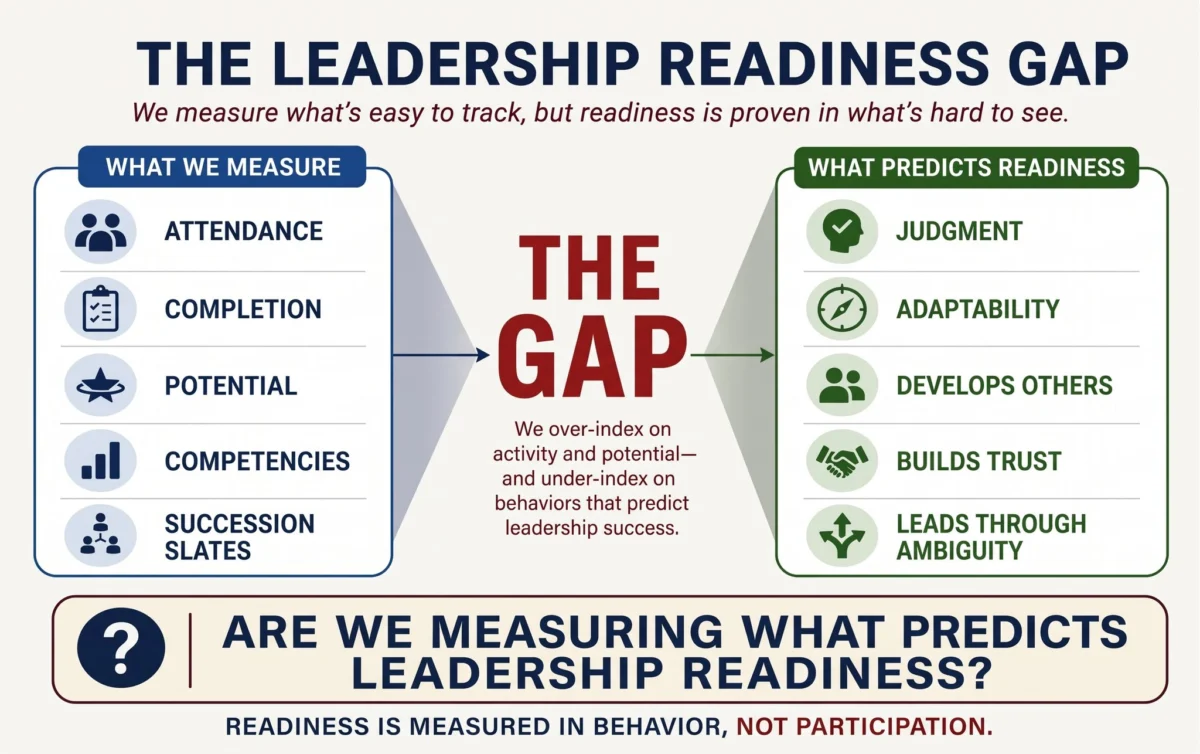
The fundamental flaw in modern succession planning is the conflation of potential with preparedness. Potential is a measure of what an individual might become given the right circumstances; readiness is a measure of what they can consistently demonstrate in the here and now.
Defining Contextual Readiness
Leadership readiness is not a static state of being; it is deeply contextual. A manager may possess the technical brilliance to lead an established, high-performing team, yet lack the specific judgment or experience required to steer an organization through a radical digital transformation or a hostile market turnaround.
Readiness requires more than just mastering the curriculum of a corporate training module. It demands the capability to navigate ambiguity, the emotional intelligence to manage stakeholder expectations, and the resilience to lead during periods of instability. When organizations treat readiness as a generic milestone rather than a specific, situational requirement, they inadvertently set their brightest stars up for failure.
Chronology of a Systemic Failure
To understand why this gap persists, one must look at the lifecycle of talent development within the typical enterprise.
- The Identification Phase: Organizations identify "HiPos" (High Potentials) based on current performance, ambition, and institutional credibility. These individuals are placed into a pipeline.
- The Programming Phase: The chosen talent is funneled into leadership development programs—workshops, seminars, and mentorship cohorts. These are often measured by attendance, completion rates, and satisfaction surveys.
- The Promotion Gap: When a vacancy emerges, the organization promotes a HiPo. The transition is often treated as a success because the "process" was followed.
- The Realization of Incompatibility: The new leader struggles, not because they lack skill, but because the new role requires a fundamental shift in behavior—such as shifting from individual contributor success to empowering others—that was never practiced or tested.
- The Attrition Cycle: The leader’s confidence wanes, team morale drops, and the organization is forced to restart the search, often questioning the leader’s capability rather than the systemic failure that promoted them prematurely.
Supporting Data and Research
The DDI report findings underscore a disconnect between investment and impact. While companies are spending more than ever on leadership training—often touted as a multi-billion-dollar industry—the confidence metrics in leadership quality remain at historic lows.
The data reveals that the most effective organizations are those that move away from "theoretical assessments" and toward "lived performance." These organizations do not just teach leadership; they create "stress tests." By assigning future leaders to cross-functional projects, crisis management committees, or international assignments, they gather data on how these individuals perform when the stakes are high. The organizations that report the highest levels of pipeline confidence are those that treat development as a daily, evidence-based system rather than a periodic event.
Shifting the Paradigm: Three Necessary Transformations
Closing the readiness gap requires a departure from traditional HR orthodoxies. Executives and L&D leaders must embrace three fundamental shifts.
1. From Potential to Demonstrable Readiness
Potential is a promise; readiness is a proven track record. Organizations must stop viewing promotion as a reward for past performance and start viewing it as a requirement for future capability. When a HiPo is identified, the dialogue should shift from "Are they ready for a title change?" to "What experiences, practice, and evidence do we need to collect before they are prepared for the specific challenges of the next role?"

2. From Isolated Programs to Integrated Systems
A training program is a tool, not a system. Readiness is built through a continuous loop: Succession decisions → Identification of readiness gaps → Targeted development experiences → Observation and feedback → Reassessment.
If a leader needs to develop "big-picture" strategic thinking, they should not attend a lecture on strategy. They should be tasked with a project that requires them to draft a long-term strategic plan under the mentorship of a C-suite executive, with their results monitored and critiqued. This turns development into a practical, repeatable, and scalable system.
3. From Measuring Activity to Measuring Impact
For too long, the success of talent development has been measured by participation: "How many hours of training were delivered?" or "How many leaders completed the curriculum?"
As Dr. Keith Keating, formerly of BDO Canada, famously challenged his teams: "What value are you adding?" This question should be the north star for leadership development. Measurement must transition through a four-stage progression:
- Activity: Did they show up?
- Capability: Do they know the skill?
- Behavior: Are they applying the skill on the job?
- Impact: Is the business seeing a measurable difference in team performance and organizational outcomes?
Implications for Future-Proofing Organizations
The implications of failing to close this gap are severe. Organizations that lack a ready bench of talent are inherently fragile. They are susceptible to executive burnout, the loss of institutional knowledge, and an inability to respond to market shifts.
Conversely, companies that master the art of building readiness create a competitive moat. When leaders are truly prepared for the challenges of their roles, the organization experiences greater agility, higher employee engagement, and more consistent strategic execution.
Furthermore, this shift creates a more humane and sustainable leadership culture. By avoiding the "sink or swim" mentality of premature promotions, organizations protect their best people from the psychological toll of failure. They provide a scaffold of support that allows leaders to grow into their roles, rather than being forced to learn through the trauma of public underperformance.
A Call to Action for Leadership
The challenge of leadership readiness is not merely an HR issue; it is a fundamental business imperative that sits squarely on the desks of the CEO and the Board.
The question is no longer "Who is next in line?" That is a legacy question suited for a more stable, predictable era. The question for the modern, volatile landscape is: "Are they ready for what comes next, and what evidence do we have to prove it?"
If organizations wish to survive the next decade, they must cease the pursuit of "high potential" as a badge of honor and begin the rigorous, daily pursuit of "readiness" as a business discipline. Readiness is not something you discover in a board meeting when a position opens; it is something you build, observe, and refine every single day. The organizations that succeed will be those that realize that the best way to prepare for the future is to ensure that the leaders of tomorrow are already practicing the skills they will need—today.