The venture capital landscape has undergone a radical transformation in 2026, shattering traditional timelines for corporate maturation. In an era defined by aggressive capital deployment and a desperate race for artificial intelligence dominance, the "unicorn"—a startup valued at $1 billion or more—is no longer a milestone achieved after years of grit and scale. It is now, in many cases, a launch-day event.
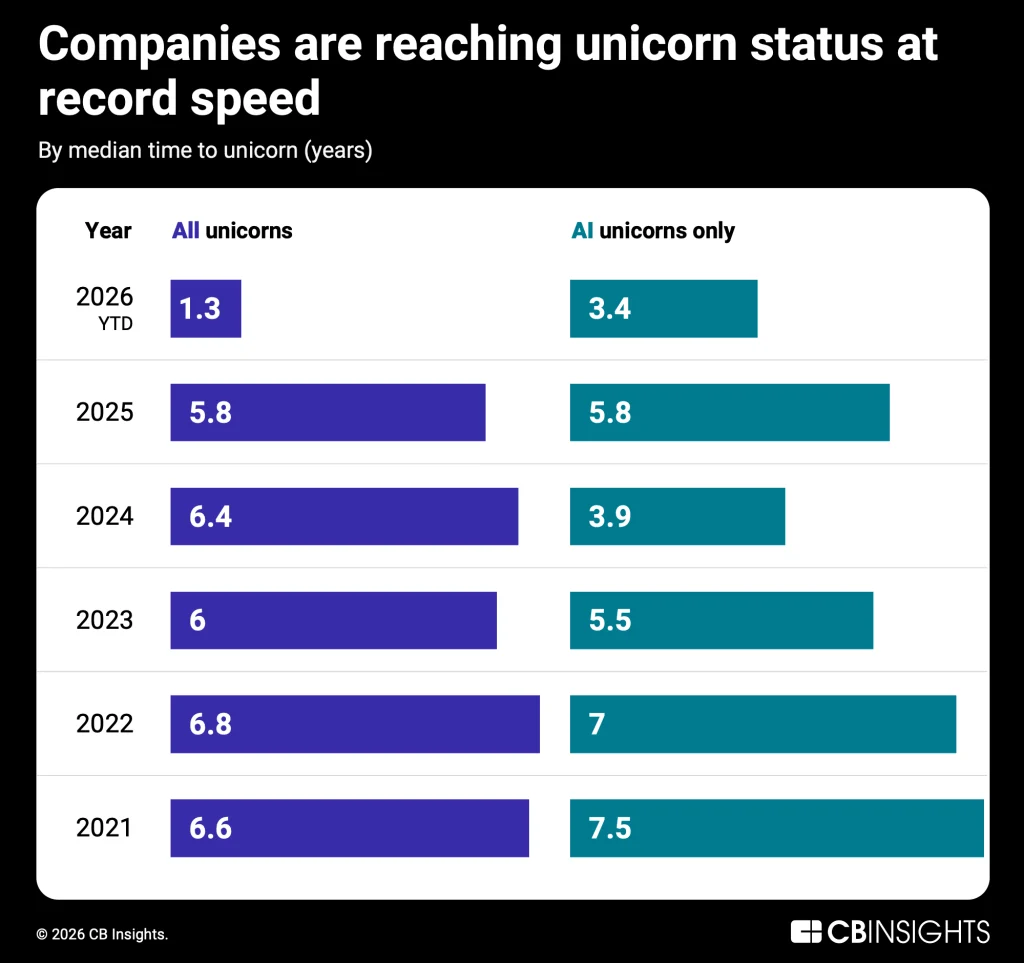
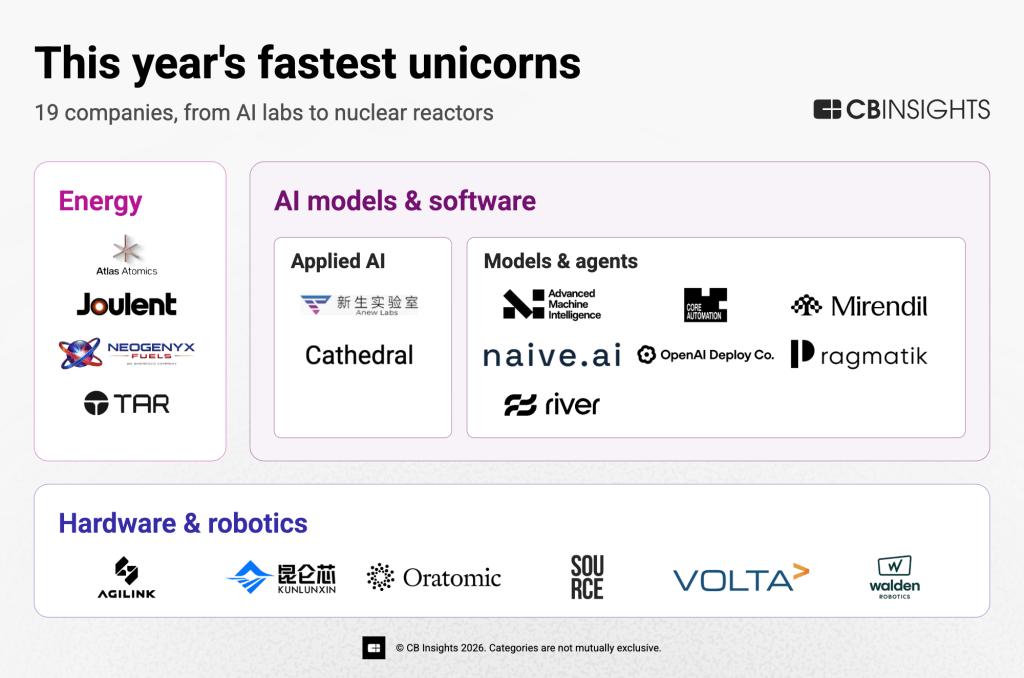
Recent data confirms that 19 companies founded in 2026 alone have already reached unicorn status, commanding a combined valuation of $60.5 billion. While the median time-to-unicorn for AI firms historically hovered around 3.4 years, this new class of startups is bypassing that growth curve entirely, hitting billion-dollar marks within months—or even weeks—of their public debut.
Main Facts: The "Town" Benchmark and the New Reality
The trend was highlighted most recently by the AI assistant startup Town, which secured a $108 million Series B funding round, pushing its valuation into the ten-figure bracket just four months after its inception. This isn’t an isolated anomaly; it is a symptom of a market where investors are increasingly betting on pedigree and potential rather than traditional metrics like revenue, product-market fit, or even a functional prototype.
Investors are currently funneling capital into three primary sectors: AI foundational research, energy infrastructure for data centers, and "physical AI" (robotics). In this environment, the absence of a product is no longer a deterrent—it is sometimes perceived as a clean slate, free from legacy technical debt.
Chronology: From Concept to Capitalization
To understand the acceleration of 2026, one must look at the compressed lifecycle of these firms:
- Q1 2026: A surge in departures from major AI labs (OpenAI, Anthropic, Meta, xAI) creates a talent vacuum. Investors begin earmarking billions for "founder-first" rounds.
- Q2 2026: The first wave of 2026-founded startups emerges. Companies like Core Automation and Mirendil are incorporated.
- Q3 2026: The "Power Crisis" takes center stage. AI companies realize that compute is useless without electricity. Infrastructure suppliers—some without a single operational power plant—begin hitting $1B+ valuations as they sign speculative long-term energy contracts.
- Q4 2026: Market maturity hits a fever pitch. We are currently seeing "valuation bloat," where firms like Core Automation jump from a $1B valuation to a $4B target within weeks, despite having neither revenue nor a commercialized product.
Supporting Data: The Talent Premium
The most striking trend in this year’s data is the "resume premium." Four of the most highly valued AI labs on our list are helmed by researchers who exited high-profile organizations.
Consider Core Automation and Mirendil. Both are building AI capable of conducting its own research—a recursive technological advancement that investors view as the "Holy Grail." Core Automation’s valuation leap to $4 billion without a product illustrates that investors are not paying for current performance; they are paying for the perceived inevitability of the team’s success. Similarly, Mirendil is reportedly in discussions for a $5 billion valuation, just three months after crossing the $1 billion threshold.

This "resume-based investing" signals a profound shift in risk assessment. When the cost of talent is the primary barrier to entry, the pedigree of the founding team becomes the most reliable proxy for future value.
The Infrastructure Pivot: Betting on Power
The bottleneck for AI is no longer just algorithms; it is raw, base-load power. Building a data center takes roughly 12 to 24 months, but securing grid connectivity can take three to seven years. Consequently, AI firms are effectively becoming energy developers.
Startups like Joulent are thriving in this climate. Unlike the speculative AI labs, Joulent occupies a more pragmatic niche: natural gas-powered energy infrastructure. Because they leverage proven technology—backed by industry veterans like Chevron—and possess multi-decade purchase agreements with locked-in buyers, they represent a more stable, albeit capital-intensive, form of unicorn. Investors are essentially betting on the "picks and shovels" of the AI revolution, recognizing that regardless of which AI model wins the race, they will all require the massive, reliable power supply that firms like Joulent are promising to build.
Robotics and the "China Factor"
The robotics landscape, or "embodied AI," presents a unique contrast between the East and the West. Of the five China-based unicorns identified, three are focused on robotics, all spun out of major domestic tech conglomerates. These companies benefit from a robust supply chain and a direct pipeline of engineering talent, allowing them to iterate hardware at a speed that has historically been impossible.
In the United States, the picture is more cautious. Walden Robotics stands as the sole US-based robotics unicorn on our list. While they have successfully deployed humanoids in Toyota manufacturing plants, their reliance on a single customer—Toyota itself—creates a vulnerability. Industry analysts are looking for proof of external market demand. A $1.1 billion valuation is easy to justify when the product works, but sustaining that growth requires diversifying beyond a single corporate parent.
Implications: The Risks of Accelerated Valuation
What does it mean when a company reaches unicorn status before it has even shipped its first version?
1. The Death of the "Slow Build"
The traditional path of bootstrapping, Series A, Series B, and iterative product refinement is being replaced by "blitz-capitalization." This forces companies to scale their operations, hiring, and infrastructure long before they have validated their business models.
2. High-Stakes Failure
The failure rate for these firms will likely be catastrophic. When a company is valued at $4 billion on the strength of a team’s reputation alone, the margin for error is non-existent. If the research does not yield a breakthrough within the next 18 months, there is no "pivot" possible—only a total collapse of value.
3. Market Distortion
By inflating valuations so early, these companies are making it impossible for smaller, more sustainable startups to compete for talent. Why would a world-class engineer work for a sustainable, revenue-generating startup when they can join a pre-product unicorn and receive millions in equity?
4. The Exit Strategy Dilemma
With companies reaching $1B+ valuations in months, the traditional exit strategies—IPO or acquisition—become complicated. Who acquires a $5 billion company that has no revenue? The pool of potential buyers is limited to a handful of "Big Tech" players, potentially leading to increased antitrust scrutiny and regulatory hurdles that could stall these companies in their tracks.
Conclusion: A New Era of Corporate Velocity
The 2026 unicorn explosion is a testament to the sheer scale of the AI-driven capital cycle. We are witnessing the decoupling of valuation from traditional performance metrics. Whether this represents a new, efficient way to finance the future or a speculative bubble that will define the next decade of market corrections remains to be seen.
One thing is certain: the rules of the game have changed. Investors are no longer waiting for companies to prove they can change the world; they are writing billion-dollar checks to ensure those companies are the ones who get to try. As the year draws to a close, the lesson for founders and investors alike is clear: in 2026, you don’t need a legacy to build a legend—you just need the right team, a massive amount of power, and a vision that is large enough to outrun the skepticism of the market.