For decades, the holy grail of corporate learning and development (L&D) has been a simple, yet elusive, objective: delivering the right learning to the right person at the right time. We have evolved from static catalogs to keyword-driven search, then to sophisticated recommendation engines, and finally to the era of adaptive learning. Artificial intelligence has undoubtedly accelerated this progression, streamlining content generation, tailoring assessments, and providing deep insights into learner behavior.
Yet, as L&D leaders navigate this new AI-augmented landscape, a nagging question persists: How do we know someone is actually ready to perform?
While AI excels at recommending what a learner should consume next, organizations are increasingly discovering that consumption is not synonymous with capability. As we stand at the precipice of a new era, it is time to shift our focus from personalizing the learning to personalizing the performance.
The Limitations of Content-Centric Personalization
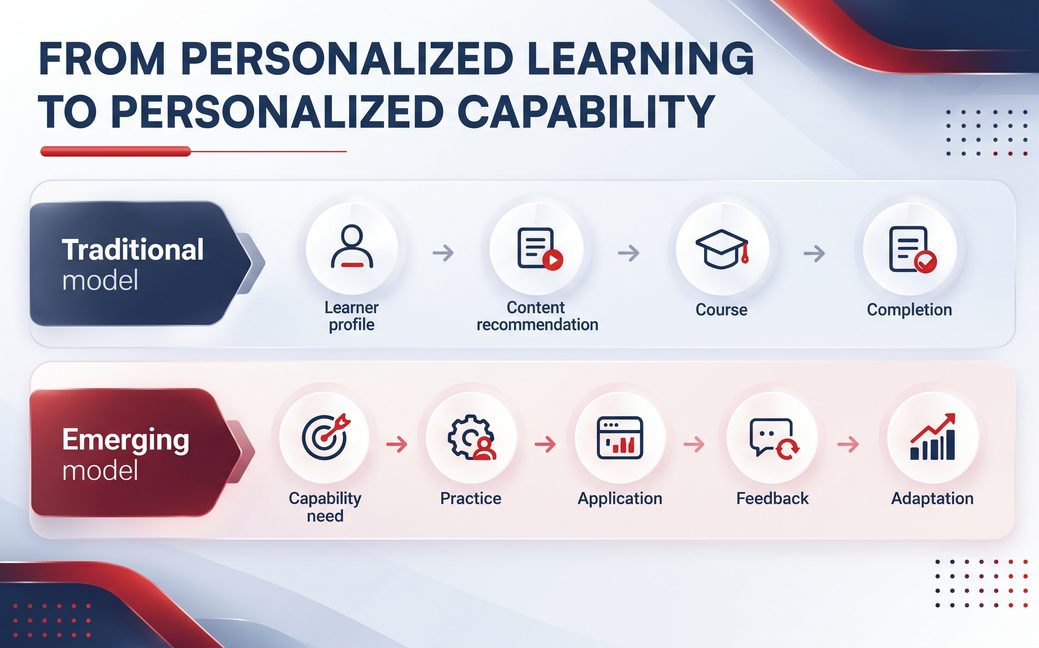
Traditional personalization has been largely binary: a system identifies a skill gap or an interest, then serves a relevant piece of content. This reduces the cognitive burden on the employee and ensures they aren’t wasting time on redundant training. However, relevance does not equal readiness.
Completing a digital course provides evidence of completion, but it offers almost no insight into whether the learner can successfully apply that skill under the pressure of real-world constraints. We have spent years optimizing for "learning consumption" while neglecting the "capability transition"—the bridge between knowing a concept and executing it.
The Three Pillars of Personalized Readiness
To move toward true performance-based development, we must distinguish between three layers of personalized learning:
- Consumption: What does this person need to read or watch? (The current status quo).
- Development: What does this person need to practice to build competence?
- Performance: What evidence do we have that this person can execute this skill in their specific role?
Most existing platforms operate exclusively in the first layer. The shift toward AI-enabled capability development requires us to look further upstream, moving from "What should this person learn?" to "What does this person need to perform better?"

Practice: The Next Frontier of Personalization
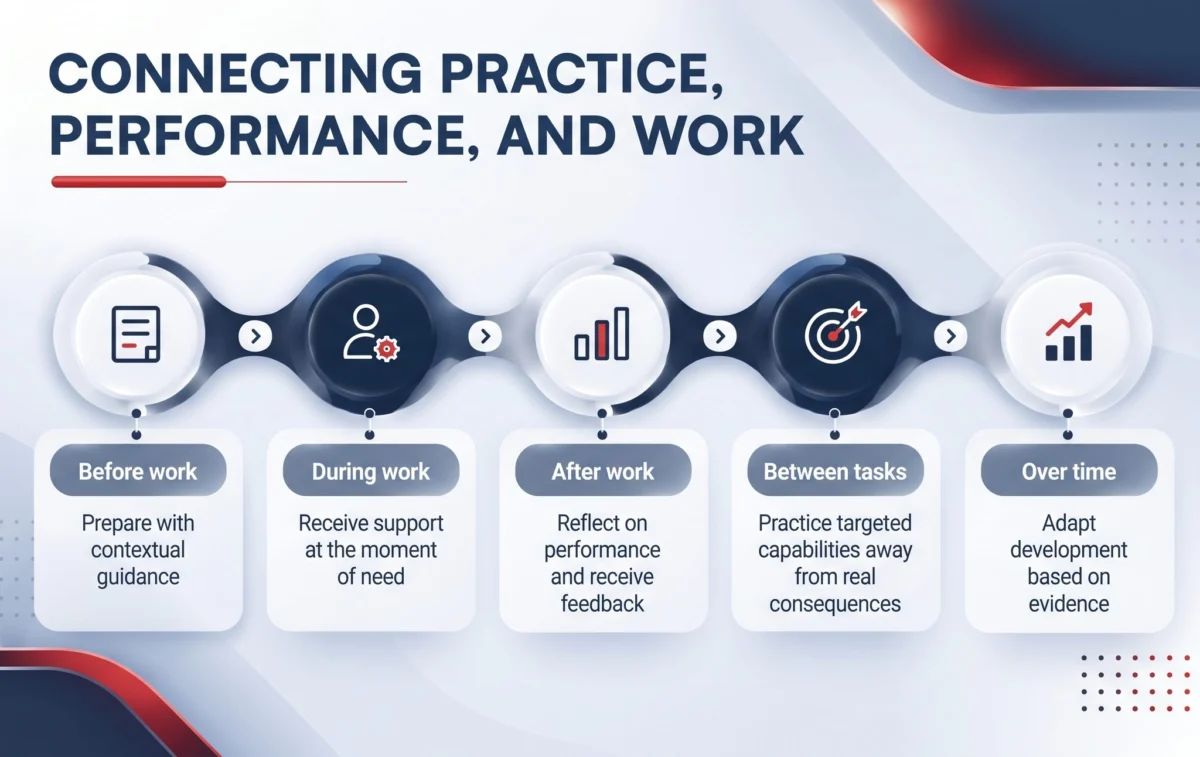
If the ultimate goal is organizational performance, the next logical evolution of L&D is the integration of "deliberate practice" into the workflow. Knowing the theoretical principles of a difficult client conversation is fundamentally different from navigating one.
The AI-Enabled Simulation Environment
AI is uniquely positioned to bridge this gap through high-fidelity, scalable practice environments. Instead of assigning a module on "Conflict Resolution," an organization can provide a manager with an AI-driven simulation where they must handle an unpredictable employee reaction. The AI provides real-time feedback, adjusts the complexity of the scenario based on the manager’s performance, and captures data on their decision-making process.
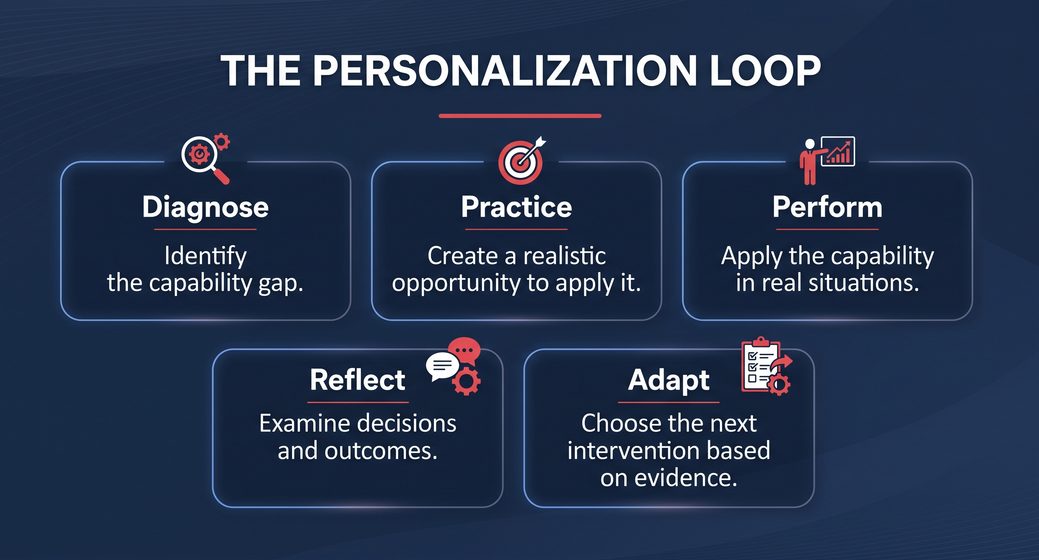
In this model, personalization means knowing what to practice next, rather than just being assigned the next course in a sequence. It treats development as a loop: practice, apply, receive feedback, improve, and repeat.
The "No-Intervention" Decision
Crucially, this new framework acknowledges that the best learning intervention is sometimes no intervention at all. If an employee can demonstrate high-level proficiency through their work and simulations, the system should recognize this "readiness" and step out of the way. Forcing a seasoned professional through a foundational course is not just a waste of time; it is a friction point that diminishes engagement.
Chronology of Technological Evolution in L&D
To understand where we are going, we must look at how the L&D landscape has shifted over the last twenty years:
- 2005–2010: The Catalog Era. Centralized Learning Management Systems (LMS) functioned as digital libraries. Success was measured by catalog size and access.
- 2010–2015: The Search/Curation Era. As content exploded, the focus shifted to finding the "right" asset. The rise of LXP (Learning Experience Platforms) prioritized searchability and content curation.
- 2015–2022: The Adaptive/Recommendation Era. Data-driven algorithms began predicting learner needs based on historical behavior, creating "Netflix-style" learning paths.
- 2023–Present: The Agentic/Capability Era. The current transition toward AI agents that focus on performance outcomes, diagnostic gap analysis, and real-time, context-aware practice.
Supporting Data and Market Trends
The movement toward agentic AI in the workplace is not just an L&D trend; it is an enterprise-wide shift. According to recent projections by Gartner, approximately 40 percent of enterprise applications will include task-specific AI agents by the end of 2026, a massive jump from less than 5 percent in 2025.
The most critical takeaway for leaders is the move toward domain-specific agents. General-purpose AI models are excellent for broad knowledge, but they lack the nuance required for high-stakes, role-specific performance. Organizations that attempt to layer generic AI over generic content will fail to address the specific judgment and decision-making requirements of specialized roles. Capability requires context, and context is found at the intersection of domain expertise and professional practice.
Implications: Making Readiness Measurable
The transition from "completion-based" to "evidence-based" development requires a fundamental change in how L&D teams report success to the C-suite.
Moving Beyond Completion Rates
For decades, L&D has relied on the "Three C’s": Completion, Consumption, and Confidence. While these metrics provide a pulse on engagement, they are merely indicators, not evidence.
- Confidence is a feeling, not a skill.
- Completion is an action, not a result.
A more robust "Readiness Score" should be synthesized from:
- Demonstrated Proficiency: Performance in AI-led simulations.
- Quality of Application: Observations from managers or peer reviews in the flow of work.
- Consistency: The ability to perform a task correctly over a period of time, not just during a one-off assessment.
This does not require the surveillance of every employee action. Rather, it requires the establishment of boundaries and the collection of meaningful, targeted evidence that informs development pathways.
Strategic Recommendations for CLOs
Chief Learning Officers are uniquely positioned to lead this transformation because they sit at the nexus of talent development and business strategy. To successfully pivot, CLOs should adopt a three-pronged strategic approach:
1. Define Observable Capabilities
Before implementing any AI, CLOs must partner with business leaders to define what "good" looks like in concrete terms. If the objective is "better negotiation," the organization must agree on the specific behaviors that constitute a successful negotiation. If the behavior cannot be observed, it cannot be measured or developed.
2. Determine the "Mode of Practice"
Not every skill requires a complex simulation. Some capabilities are best developed through mentorship, some through real-world "stretch" assignments, and others through digital coaching. The CLO must curate the right environment for the specific capability, moving away from a one-size-fits-all digital strategy.
3. Establish Trust in Evidence
L&D leaders must have the courage to tell the business what "counts" as evidence. If the business demands a focus on completion rates, the CLO must push back with data showing how practice and performance metrics correlate to business outcomes like sales growth, incident reduction, or increased operational efficiency.
Conclusion: The New Mandate
The era of passive learning is coming to a close. While personalized content remains a valuable tool for foundational knowledge, it is no longer the destination. In an increasingly automated world, human judgment, complex decision-making, and specialized skills are the primary competitive advantages for any organization.
AI can help us understand what an individual can already do, identify precisely where they need to grow, create a safe harbor for them to practice, and provide the evidence needed to confirm they are ready for the challenge.
For the modern CLO, the mandate is clear: Stop measuring what the learner does, and start measuring what the learner can achieve. The future of L&D is not about getting the right content to the right person—it is about helping the right person demonstrate the right capability at the right moment. The transition from "learning-centric" to "capability-centric" is the most significant opportunity for L&D to prove its worth as a strategic business partner in the AI-driven economy.