For years, the playbook for reducing cart abandonment has remained remarkably consistent: streamline the UI, minimize the number of clicks, ensure mobile responsiveness, and offer a basic selection of credit card options. While these user experience (UX) improvements are foundational, new research suggests they are only solving half the problem. As we move further into 2026, the real culprit behind lost sales isn’t just a clunky button—it’s the invisible infrastructure of global payments.
A comprehensive new study conducted by WooCommerce and Stripe, which surveyed over 1,400 shoppers across North America, Europe, and the Asia-Pacific region, reveals that the modern checkout experience is far more complex than previously assumed. The findings indicate that merchants are bleeding revenue not necessarily because shoppers don’t want the product, but because the payment backend is failing to bridge the gap between intent and completion.
The State of the Checkout: Main Facts
The data is sobering for e-commerce leaders: three out of four shoppers have abandoned a cart in the last year. Of those instances, a staggering 63% were attributed specifically to payment and checkout friction.
The primary driver of this abandonment is not what most merchants expect. While many assume that a "decline" means a customer lacks the funds or is committing fraud, the study finds that 28% of checkout-related abandonment is caused by "soft failures." These are not true declines; they are systemic errors, such as network timeouts, routing inefficiencies, and missed retries during the authorization process. Essentially, perfectly valid transactions are being discarded by outdated or rigid payment stacks.
Following these failures, the remaining abandonment is split between overly complex checkout flows (21%) and the absence of a shopper’s preferred payment method (21%).

The Chronology of a Failed Transaction
To understand the "invisible" losses, one must look at the lifecycle of a single digital transaction.
When a customer clicks "Place Order," the request travels through a series of intermediaries. In a traditional, unoptimized stack, the request follows a singular, static path to the issuing bank. If that specific path encounters a momentary server latency, a regional network hiccup, or a routing error, the transaction fails.
In the past, this was treated as a "hard" rejection. However, modern payment intelligence—as highlighted in the report—shows that these are "soft" failures. If the system is equipped with adaptive logic, it can automatically reroute the transaction through a more reliable path or trigger an intelligent retry. Without this capability, the merchant loses the sale the moment the first signal fails.
Furthermore, as consumer expectations evolve, the "chronology" of the checkout has shifted. Younger demographics, particularly those aged 18–29, are moving away from manual credit card entry entirely. They prioritize speed and security, often relying on digital wallets or one-click checkout solutions. If a merchant’s checkout does not support these preferences at the exact moment of decision, the transaction lifecycle is severed before it even begins.
Supporting Data: The Regional and Demographic Divide
The research emphasizes that a "one-size-fits-all" payment strategy is effectively a strategy for failure. The landscape is deeply contextual, varying by region, device, and product category.
Regional Nuances
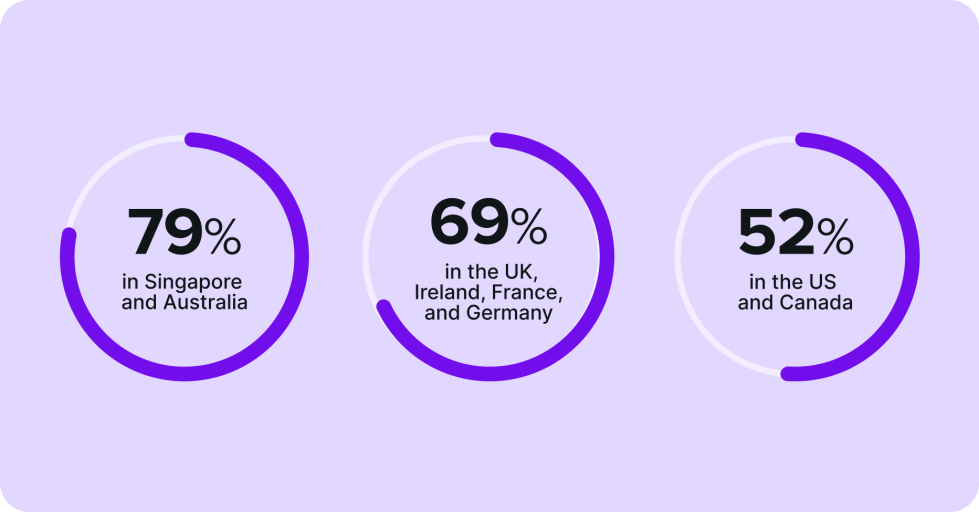
Cross-border commerce is no longer a luxury; it is a standard expectation. The survey found that 59% of shoppers made an international purchase in the past year. However, global conversion hinges on localization. For instance, in the Netherlands, the inclusion of the local payment method iDEAL can increase conversion rates by as much as 39%. Similarly, in China, offering Alipay is linked to a 91% increase in successful transactions.
The Rise of Alternative Payments
Alternative payment methods (APMs) are no longer "alternative"—they are essential.
- Digital Wallets: These are the most influential tools for cross-border success, accounting for 35% of purchase completions.
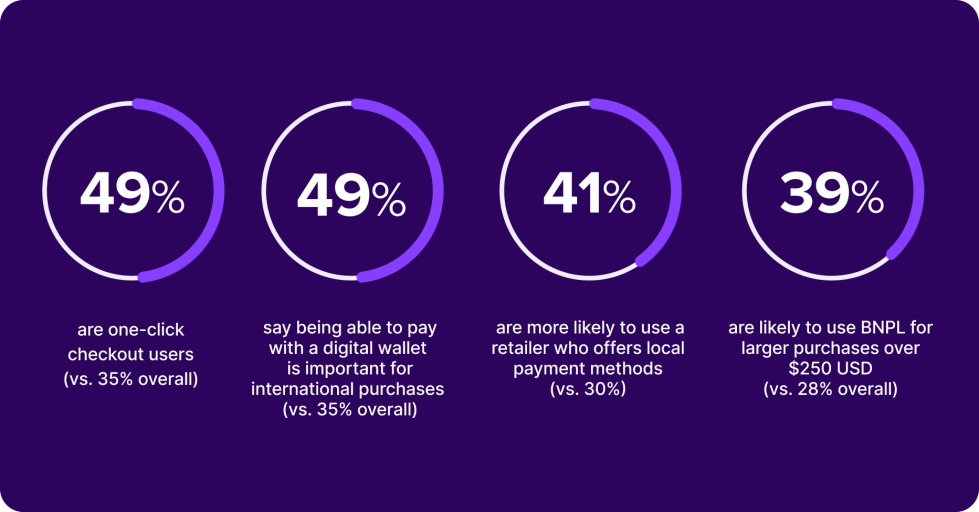
- Buy Now, Pay Later (BNPL): As cart sizes increase, so does the reliance on financing. 28% of shoppers are more likely to use BNPL for purchases over $250. Perhaps most tellingly, 18% of consumers state they would simply abandon a purchase of that size if BNPL were not available.
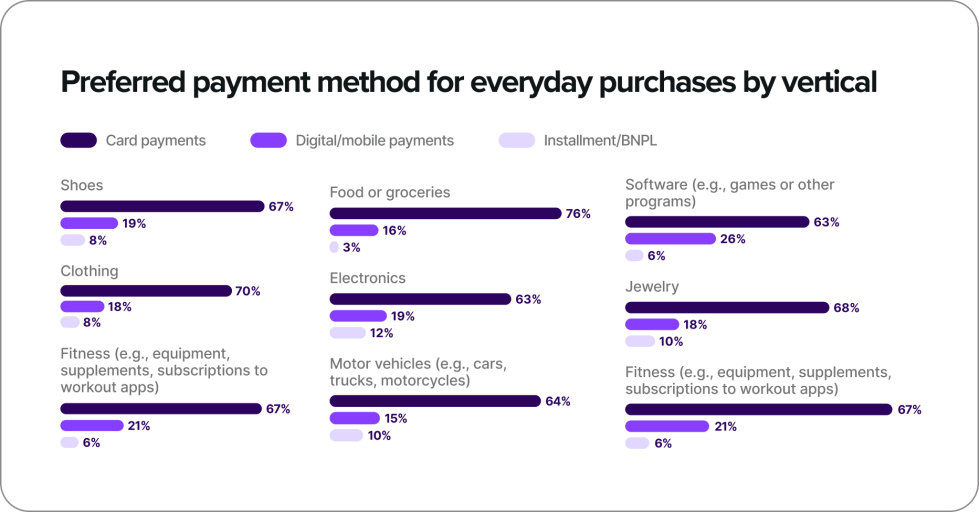
- Category-Specific Trends: The choice of payment is often dictated by the item being bought. Software and fitness purchases, which prioritize speed, see high usage of digital wallets (26% and 21% respectively). Conversely, big-ticket items like electronics and furniture rely heavily on BNPL, with 12% of shoppers specifically choosing retailers based on the availability of installment options.
The Generational Shift
Younger shoppers are the bellwether for the future of retail. Those aged 18–29 adopt new payment technologies at rates 40% higher than the general population. They are 49% more likely to use one-click checkout and are significantly more sensitive to the availability of local payment methods. The study suggests that the behaviors of this demographic are not outliers; they are precursors to the mainstream expectations of the entire consumer base for the next decade.
Official Perspectives: The Infrastructure Mandate
Industry experts and the authors of the study argue that merchants must shift their focus from surface-level UI to "payment intelligence."
"If your payment stack tries only one route or retries a failed attempt the same way, you leave approvable transactions on the table," the report notes. The implication is that merchants are often operating in the dark, unaware that their low authorization rates are a result of poor infrastructure rather than low product demand.
The experts suggest that retailers should begin auditing their checkout processes by asking three fundamental questions:
- What is the ratio of hard vs. soft declines? If a merchant cannot distinguish between a fraudulent attempt and a network timeout, they cannot optimize their revenue.
- Is the payment mix localized? If traffic data shows a spike in international visitors, but the payment stack only offers a standard domestic credit card gateway, the merchant is essentially turning away international revenue by default.
- Does the payment infrastructure support the Average Order Value (AOV)? For merchants selling high-ticket items, failing to integrate BNPL is an intentional abandonment of a significant segment of their customer base.
Implications: The Path Forward
The implications for the future of e-commerce are clear: the winners of the next five years will be those who treat payment architecture as a core pillar of their business strategy, rather than a background utility.
Building for Adaptability
Merchants must adopt a modular approach to their checkout. By utilizing flexible, open-source infrastructures like WooCommerce combined with advanced payment processors like Stripe, businesses can build a "living" checkout. This means the system automatically detects the user’s region, suggests the most relevant payment methods, and utilizes adaptive routing to ensure that soft failures are corrected before the customer even notices an issue.
The Strategic Shift
Moving forward, the goal for any merchant should be "payment transparency." This involves demanding better data from payment processors to understand exactly why a transaction failed. It involves treating payment localization as a launch requirement—no different than currency conversion or international shipping logistics.
As Christina Bevitori, a seasoned content strategist and contributor to the research, highlights, the goal is to create a seamless experience where the "how" of payment becomes invisible. When the infrastructure is robust enough to handle the technical complexities of routing, retries, and local preferences, the merchant can focus on what they do best: creating great products and building lasting customer relationships.
In conclusion, the era of "set it and forget it" payments is over. The data confirms that while the storefront is the face of the business, the checkout infrastructure is its heartbeat. By auditing current processes, embracing regional payment diversity, and investing in intelligent, adaptive systems, merchants can recover the billions of dollars currently lost to the "invisible" friction of the modern digital checkout.