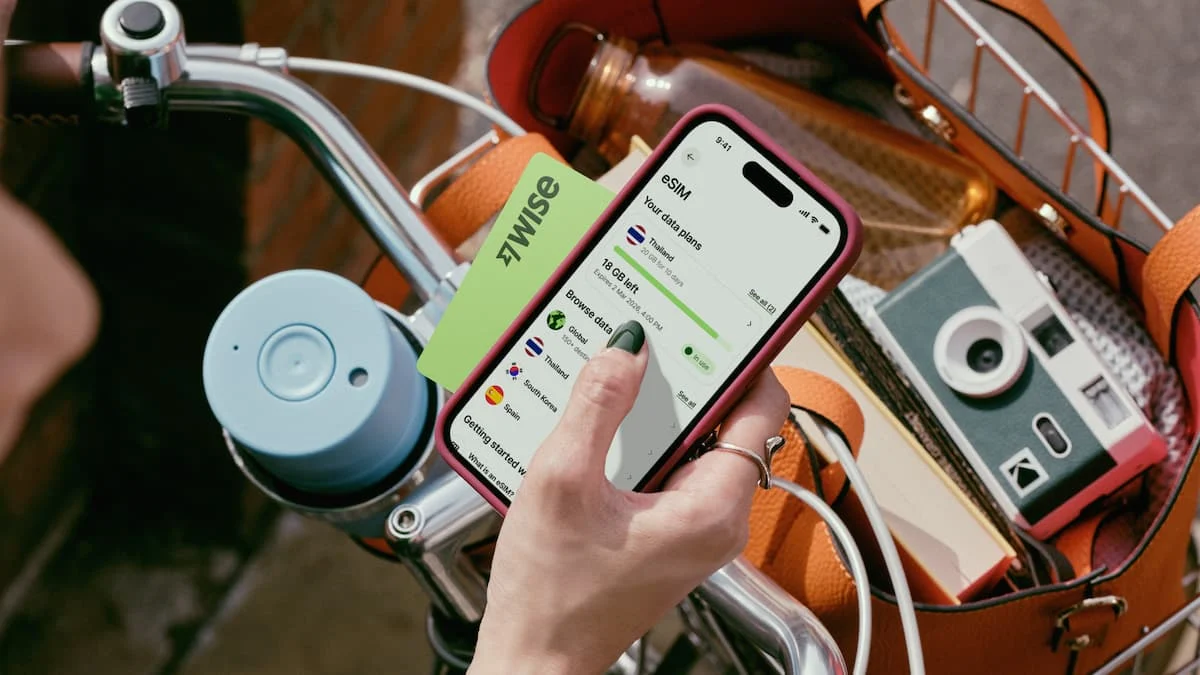
In a strategic pivot that signals the evolution of the “digital nomad” banking stack, Wise has significantly expanded its in-app Travel Hub. Effective October 6, 2026, the global fintech giant is rolling out two high-utility features designed to solve the two most persistent pain points of international travel: digital isolation and local payment exclusion. By integrating customisable eSIM data plans and direct access to domestic QR payment schemes across five continents, Wise is moving aggressively to transition from a foreign exchange provider to a comprehensive travel infrastructure partner.
The update is available to millions of Wise Account holders across the UK, the European Economic Area (EEA), the US, Canada, Brazil, Singapore, Malaysia, Australia, and New Zealand, marking a significant escalation in the battle for dominance in the global travel finance sector.
The Core Innovations: Connectivity and Commerce
1. The eSIM Revolution: Data on Your Own Terms
Collaborating with infrastructure provider Gigs U.K. Ltd, Wise has introduced an eSIM service that challenges the traditional telco model. Historically, international travellers have been forced to purchase rigid, pre-packaged roaming bundles, often resulting in significant financial waste when data goes unused or, conversely, steep overage charges when data runs dry.
Wise’s new offering allows users to define their specific data requirements and the duration of their coverage. Perhaps most notably, Wise has committed to refunding unused data—a radical transparency move that positions the company as a consumer-first disruptor in a sector traditionally characterized by “use-it-or-lose-it” policies. With standard regional plans spanning over 150 destinations, the model is built for longevity; a one-time installation ensures the eSIM remains on the device, eliminating the cumbersome process of re-downloading profiles for subsequent trips.
2. Bridging the Gap: The QR Payment Frontier
While eSIMs are a convenient addition, the most structurally significant development is the integration of a unified QR code payment scanner. For years, the rise of domestic real-time payment schemes—such as Pix in Brazil, PayNow in Singapore, and PromptPay in Thailand—has created a "two-tier" economy. While these systems are ubiquitous for locals, they have remained effectively gated to foreign visitors who lack local bank accounts.
Wise has successfully built direct connections to these rails, alongside DuitNow (Malaysia), QR Ph (Philippines), Swiss QR-bill, and Qvik (Hungary). By mapping its multi-currency account directly to these local protocols, Wise effectively allows its users to pay like locals. Furthermore, a high-profile partnership with Alipay+—the cross-border payment gateway owned by Ant International—extends this functionality to millions of merchants across mainland China, South Korea, Hong Kong, and Cambodia. This integration is a technical tour de force, bypassing the need for physical currency or foreign-card-unfriendly point-of-sale terminals.
Chronology of a Digital Transformation
The journey toward this expanded Travel Hub has been marked by a shift in Wise’s internal philosophy regarding what constitutes a “travel tool.”
- 2023–2024: Wise focuses on solidifying its core value proposition—low-cost, transparent FX—while incrementally adding features like airport lounge access and group bill-splitting.
- Early 2025: As competitors like Revolut gain traction with travel-related "add-ons," Wise identifies that the primary friction point for its users is no longer just the exchange rate, but the usability of their money once they land.
- Mid-2025: The company begins engineering the direct API connections required to interface with national payment schemes like Brazil’s Pix and Singapore’s PayNow.
- Late 2025: Partnership negotiations with Gigs U.K. Ltd and Ant International (Alipay+) are finalized to provide the backbone for mobile connectivity and Asian market access.
- October 6, 2026: The Travel Hub expansion officially goes live across nine global regions, signaling a new chapter in the company’s product roadmap.
Supporting Data: Why Connectivity and Cash Still Matter
The motivation behind these features is grounded in hard data. A comprehensive survey commissioned by Wise and conducted by YouGov—covering over 14,000 travellers across eleven nations—underscores the depth of the “travel friction” problem.
- The Wi-Fi Trap: 62% of international travellers remain tethered to hotel or public Wi-Fi to maintain connectivity. This reliance creates a vulnerability loop: without reliable mobile data, travellers cannot access map services, translation tools, or—critically—payment apps that require authentication.
- The Payment Gap: 43% of respondents identified cash management as their single biggest frustration abroad. Despite the global push toward a cashless society, many regions remain dominated by QR-based local rails that reject traditional Visa/Mastercard networks.
- Lost Experiences: Nearly 40% of survey participants admitted that connectivity limitations—ranging from an inability to navigate to a lack of compatible payment methods—forced them to skip local experiences like street food markets or small-scale artisan shops.
These statistics confirm that for the modern traveller, a "travel wallet" is useless if it cannot function in a real-world, localized environment.

Official Responses and Strategic Rationale
A spokesperson for Wise articulated the psychological and economic impact of the status quo:
"Your phone has no signal, you can’t look up directions, and you realize the local taxi or coffee shop doesn’t accept your card. It instantly makes you feel isolated and locked out of the local economy."
The company’s intent is clear: to eliminate the "stranger" status that travellers feel when moving between jurisdictions. By providing the tools to navigate (eSIM) and the tools to transact (QR payments), Wise is attempting to normalize international movement in the same way that a domestic resident interacts with their home city.
Implications: The Battle for the Travel Wallet
Competitive Read-Across
The fintech landscape is increasingly crowded. Revolut has already established a footprint in the eSIM space, making it the primary point of comparison for Wise. However, the depth of Wise’s QR integration sets a new industry benchmark. While other neobanks have experimented with travel perks, none have achieved this level of geographic integration with domestic payment rails.
Infrastructure as a Competitive Necessity
From a payments perspective, the shift toward QR-based domestic instant payment schemes is irreversible. These systems—Pix, PayNow, PromptPay—are no longer supplementary; they are the primary infrastructure of their respective economies. For Western fintechs, gaining access to these rails is shifting from a “value-add” to a “competitive necessity.”
Wise’s partnership with Alipay+ is particularly noteworthy. China has long been a difficult market for Western financial institutions to penetrate due to complex regulatory requirements and a domestic ecosystem that is largely closed to foreign cards. By leveraging Alipay+ as a gateway, Wise provides its users with a seamless, compliant way to transact in the world’s second-largest economy without needing a Chinese bank account.
The "Super-App" Question
Wise reported processing over $240 billion in cross-border transactions during the 2026 financial year, supported by a user base of roughly 19 million. The expansion of the Travel Hub—which now includes pay-as-you-go lounge access, multi-currency bill splitting, and in-app guides—is a deliberate effort to bundle services and increase the "stickiness" of the Wise account.
The central commercial question remains: will these features successfully drive account activation among non-users, or will they simply deepen engagement among existing ones? While Wise has yet to disclose specific engagement metrics for the new hub, the strategic direction is clear. By embedding itself into the logistical and financial fabric of travel, Wise is positioning its account as an essential travel companion, rather than a mere utility for currency conversion.
As the lines between telecommunications, banking, and travel services continue to blur, Wise’s latest move suggests that the future of fintech lies not in the speed of the transfer, but in the seamlessness of the experience. The company is no longer just moving money; it is enabling movement itself.